
REAL PATIENT STORY • THYROID CANCER • BHARATANATYAM DANCER • BANGALORE
35. A Dancer. A Mother. A Cancer Survivor.
Surgery Monday. Home Thursday. On Stage by September.
Aparna’s real story — how a husband’s insistence, a routine USG, and Dr. Sandeep Nayak’s scarless RABIT surgery turned the most frightening word she’d ever heard into a story she now shares to give others hope
Dr. Sandeep Nayak • MACS Clinic, Bangalore • RABIT Robotic Thyroidectomy • 20 June 2022
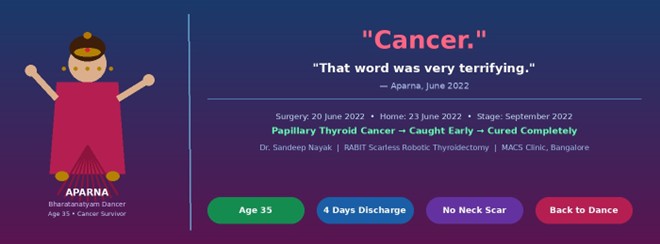
| 35 yrs
Aparna’s Age at Surgery |
4 Days
Hospital to Home |
3 Months
Back on Stage |
ZERO
Neck Scar Left Behind |
The Checkup She Didn't Want to Go For
Aparna did not go looking for cancer. She was going for a routine scan — the kind you postpone twice and finally keep the appointment for because your husband won’t stop asking.
That is not an embellishment. That is, in her own words, exactly what happened.
It was 2022. Aparna was 35 years old. A full-time homemaker in Bangalore, a mother to a 12-year-old daughter named Anamika, and — most importantly to understanding what came next — a woman who had recently rediscovered a passion she had carried her entire life. She had just begun learning Bharatanatyam, the classical Indian dance she had dreamed of studying since childhood but never found the time for. She was finally, at 35, doing it. Her daughter had started the classes first. Watching Anamika perform had reignited something in Aparna. She joined the classes herself. She was happy.
Then June came.
Her thyroid USG reports had been completely normal until that point. Every scan, every report — all clear. Her husband, methodical and persistent about health checkups in a way Aparna was not, insisted she go again. She was not ready to go. She told him so. He kept asking. She eventually agreed, mostly, she admits, to stop the conversation.
“My husband insisted me to go for the regular check-up again. First, I was not ready to do that. But again, he compelled me — ‘You have to go for it.'”
— Aparna, on the checkup that changed everything
That conversation — the small domestic negotiation that happens in thousands of households every week, the quiet nagging that most people eventually relent to — is the reason Aparna is alive and dancing today. Her husband’s insistence was not dramatic. It was not based on any symptom or fear. It was just the ordinary love of a spouse who knew: better to check.
"The Tumor Is Not Looking Fine."
The sonographer’s words during the scan were measured, clinical. But they landed with weight.
The nature of the tumor was changing. It was not looking fine. Aparna needed to see her endocrinologist immediately.
She had walked into that scan room half-distracted, going through the motions of a checkup she had not wanted to attend. She walked out with the specific, cold understanding that something was wrong.
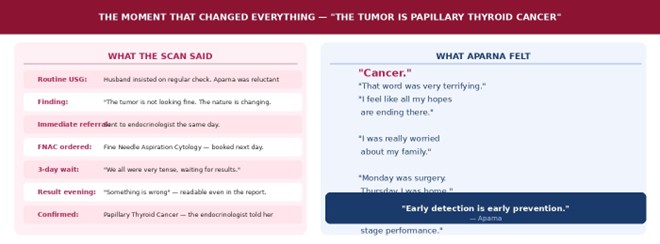
The endocrinologist reviewed the scan results and ordered an FNAC — a Fine Needle Aspiration Cytology biopsy — the same day. It was booked for the next morning.
“We all were very tense and waiting for the results. I think within three days, that evening, we got the result. And the result itself, we can read that something is wrong.”
— Aparna, on the three-day wait for her FNAC result
She went back to her endocrinologist. He read the report. He looked up at her. And he said the word.
“The tumor is now the papillary thyroid cancer.”
Papillary thyroid carcinoma. The most common form of thyroid cancer. Highly treatable when caught early. But Aparna did not hear any of that first. She heard one word.
“That word cancer, which he told to my face — that cancer word was very terrifying. I feel like all my hopes are ending there. After hearing that particular word.”
— Aparna
That feeling — the sudden collapsing of every assumption about the future — is something most cancer patients describe in very similar terms. It is not rational. The prognosis for Stage I papillary thyroid cancer is excellent. The treatment is established and effective. But none of that reaches you in the first moments after you hear the word. What reaches you is fear.
Aparna sat with that fear. Then she asked what came next.
The Referral That Mattered — Meeting Dr. Sandeep Nayak
Her endocrinologist referred her to oncology. He did not send her to a general department. He gave her a specific name.
Dr. Sandeep Nayak.
Aparna had never heard of him before that day. She had no frame of reference for what RABIT meant, or what a surgical oncologist specialising in robotic thyroid surgery did differently from anyone else. She arrived at the consultation with a cancer diagnosis, a frightened husband, and a single question: what happens now?
| Patient | Aparna — 35 years old, Bangalore |
| Occupation | Full-time homemaker + Bharatanatyam classical dancer |
| Daughter | Anamika, 12 years old |
| Husband’s role | Insisted on the routine checkup — the decision that made everything possible |
| Prior USG | All reports normal until June 2022 |
| Scan finding | Tumor nature changing — immediate specialist referral ordered |
| FNAC result | Papillary Thyroid Carcinoma — confirmed within 3 days |
| Referred to | Dr. Sandeep Nayak — by endocrinologist, specifically |
| Surgery | RABIT — Robotic Scarless Thyroidectomy |
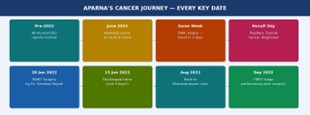
| Surgery date | Monday, 20 June 2022 |
| Discharge | Thursday, 23 June 2022 — just 4 days after surgery |
| Back to dance | August 2022 — Bharatanatyam class resumed |
| Stage performance | September 2022 — first public performance after surgery |
| Today | Cancer-free. Active homemaker. Continuing classical dance. |
Dr. Nayak reviewed her reports. He explained the diagnosis, the stage, the options. And then he explained something that Aparna was not expecting to hear.
She did not have to have a scar on her neck.
He had developed a procedure — RABIT — that allowed him to remove the thyroid completely through a small incision hidden in the armpit, using the da Vinci robotic surgical system. No cut on the neck. No visible mark. The same cancer clearance, through an approach the body could be discreet about forever.
Aparna was a dancer. The way her body looked — the line of her neck, her shoulders, her presence in front of an audience — mattered to her professionally and personally. She had not said this out loud. She probably did not need to.
“With a very tense mind, I went to the operation theater. I was really worried. I was really worried about my family, actually, from the day I heard that I’m not well.”
— Aparna, on the morning of surgery
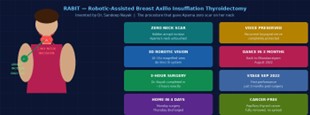

RABIT — The Operation That Left No Scar on Aparna's Neck
Most people who hear ‘thyroid surgery’ picture the same thing: a horizontal line across the lower neck. About four to six centimetres long. Permanent. Present in every photograph, every mirror, every moment someone’s eyes drift to your throat. For millions of thyroid surgery patients, that scar is simply part of the aftermath — the price of removing the cancer.
RABIT is the answer to a question most thyroid surgeons never asked: does it have to be?
Dr. Sandeep Nayak developed RABIT — Robotic-Assisted Breast Axillo Insufflation Thyroidectomy — over years of research and practice. The concept: access the thyroid not from the front, but from below. A small incision is made in the armpit — hidden in the natural skin fold, completely invisible at rest. The da Vinci Xi robotic system guides miniature instruments through a carefully created tunnel beneath the skin of the chest wall, reaching the thyroid from below. The neck surface is never opened. Never touched.
What the Surgery Involved — What Aparna Went Through
Priya had completed her chemo-radiotherapy six weeks before surgery — the standard and correct approach. But radiation does something to tissue that every pelvic surgeon dreads: it triggers fibrosis. The normal tissue planes that guide a surgeon — the natural spaces between organs that should peel apart with minimal force — get filled with dense, sticky scar tissue. Structures that should be easy to separate become glued together.
In Priya’s case, the adhesions between the rectum and the vaginal wall were particularly severe. That area became one of the most painstaking parts of the entire operation.
The Incision — Hidden in the Armpit
One small cut. In the fold of the armpit where the arm meets the chest. That was the only opening made anywhere on Aparna’s body. Everything else happened beneath the skin.
The Robotic System — What Dr. Nayak Used to See Inside
The Nerves — Why Voice Preservation Was Critical
Three Hours. Then It Was Over.
“I think it took almost three hours for my surgery, and immediately within half an hour, they allowed my father and my husband to come and visit me. That same afternoon, I got shifted to my room.”
— Aparna, on the hours after surgery
Monday Surgery. Thursday Home. The Recovery Nobody Expected.
Aparna woke up in the recovery room and did what every patient does immediately after thyroid surgery: she checked her voice. It worked. She checked her throat. Nothing — no wound, no dressing, no tenderness at the front of her neck. Just her own undisturbed skin.
The next day, the bandages were removed. Within four days of the surgery, she was discharged.
“The very next day, they removed all the bandages from my body. And within four days, I got discharged from the hospital. So Monday was my surgery. That same Thursday, I got discharged and reached my home.”
— Aparna
Four days. Surgery on a Monday, home on Thursday. That is not a long hospital admission. That is a long weekend.
This is one of the genuine advantages of robotic minimally invasive surgery over open surgery — not just the absence of a neck scar, but the speed at which the body recovers when it has not been opened through a large incision. Aparna’s neck had not been touched. There was nothing to heal there. The only recovery site was the small armpit wound, which needed routine care and healed quickly.
📌 Key fact: Papillary thyroid carcinoma detected at Stage I has a 5-year survival rate exceeding 99%. The earlier the detection, the more straightforward the treatment and the faster the recovery.
Post-Operative Care — What Aparna Manages Now
Removing the thyroid means the body can no longer produce the hormones it once made there. Aparna now takes levothyroxine — a synthetic thyroid hormone — once a day, every morning before food. It replaces the function of the missing gland completely.
- Daily levothyroxine tablet — taken once every morning, dose calibrated specifically for her
- TSH blood test every 6 to 12 months — to confirm the hormone dose remains optimal
- Periodic neck ultrasound — to monitor for any local recurrence at the surgical site
- Annual oncology follow-up — to confirm her cancer-free status continues
These are not burdens. They are habits — like any morning routine. Aparna has incorporated them entirely. The tablet is taken. The appointment is kept. The ultrasound is done. And every time, the result is the same: she is well.

June Was Surgery. September Was the Stage.
She had wanted to learn Bharatanatyam since childhood. Not casually — with urgency. But life had always intervened. When her daughter Anamika was born, Aparna made a quiet decision: she could not have the childhood she had wanted, but Anamika could. She enrolled Anamika in Bharatanatyam classes the moment she turned three.
“From my childhood days itself, I have a strong urge — I learned classical dances, but unfortunately, I was not able to do that. But it was there in my mind, somehow I have to get trained in classical dance, especially in Bharatanatyam.”
— Aparna
Aparna began accompanying her daughter to every class, every performance. Watching Anamika dance reignited what childhood had put there and adult life had deferred. Eventually, she joined the classes herself. She was not a beginner trying something new. She was a person finally arriving somewhere she had always been heading.
And then the cancer diagnosis arrived, and she was terrified of losing it.
“After the disease, and I can tell after the surgery, I got worried that again I’ll lose the chance for pursuing my passion. I thought I won’t be able to dance anymore because of this health condition.”
— Aparna, on the fear that came after her diagnosis
She did not lose it.
August 2022 — just two months after her surgery — Aparna was back in class. Her body, which had recovered faster than she had allowed herself to hope, was back in motion. The movements that require core strength, precise footwork, fluid upper body control — Bharatanatyam asks everything of the body. And her body answered.
September 2022. Three months after the surgery that had frightened her more than anything else in her adult life. Aparna stood on a stage and performed.
“That September itself, I did my first stage performance after the surgery. Luckily, after that surgery, again, I got all my hopes back. And now, with God’s grace, I continue to be cancer-free.”
— Aparna
The neck that Dr. Nayak had left completely unmarked. The voice that his precision in the operating theatre had protected. The energy of a woman who had been told she had cancer in June and was performing classical dance in September. All of it, together, on stage.
And standing in the audience, watching — Anamika. The twelve-year-old who had started the Bharatanatyam classes that had brought her mother back to the thing she loved. The daughter who had, without knowing it, been part of the chain of events that led her mother to this stage.
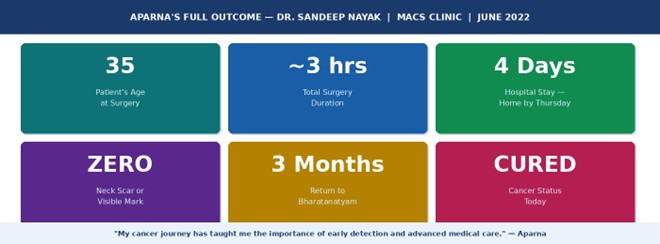
What the Surgery Achieved — Aparna's Full Outcome
Clinical Results
Papillary thyroid carcinoma — Stage I, confined entirely within the gland
Clear surgical margins — no cancer cells at the edge of the specimen
Aparna's Recovery Milestones
| Surgery Day | Monday, 20 June 2022 — ~3 hours, no complications |
| Next Morning | Bandages removed. Neck completely clean. Voice normal. |
| Day 4 — Thursday | Discharged home. 23 June 2022. |
| August 2022 | Back to Bharatanatyam class — 8 weeks post-surgery |
| September 2022 | First public stage performance — 3 months post-surgery |
| Ongoing | Daily levothyroxine tablet + regular blood tests + follow-up |
| Today | Cancer-free. Continues classical dance. Full family life. |
The Surgeon Who Made This Possible — Dr. Sandeep Nayak
Prof. Dr. Sandeep Nayak
Inventor of RABIT • Founder & Chief, MACS Clinic • Executive Director Surgical Oncology & Robotic Surgery, KIMS Hospital, Bangalore
Aparna’s endocrinologist knew who to send her to. That specificity matters. RABIT is not a technique every thyroid surgeon offers — it requires years of dedicated training and practice with the da Vinci robotic system. Dr. Nayak did not adopt RABIT from someone else. He invented it.
He has now performed the procedure more than 500 times. He has also invented RIA-MIND — a scarless robotic neck dissection for oral cancers — and developed robotic ISR for rectal cancer. In each case, the driving question is the same: how do we take the cancer with the smallest possible cost to the patient’s life?
| Full name | Prof. Dr. Sandeep P. Nayak |
| Qualifications | MBBS | DNB General Surgery | DNB Surgical Oncology (CNCI Kolkata) | MRCS Edinburgh, UK | Fellowship Laparoscopic & Robotic Oncosurgery |
| Positions | Founder & Chief — MACS Clinic | Executive Director — Surgical Oncology & Robotic Surgery, KIMS Hospital, Bangalore | Chairman — Oncology Services, Karnataka |
| RABIT | Invented the RABIT technique | 500+ scarless thyroid surgeries performed |
| Also invented | RIA-MIND (robotic neck dissection — no neck scar) | Robotic ISR (no-stoma rectal cancer surgery) |
| Awards | Times Health Excellence Award 2018, Times of India | KS International Innovation Award | Pampanagowda Video Award |
| Memberships | Royal College of Surgeons Edinburgh, UK | ASCO | IASO | ASI | AMASI |
| Clinic address | MACS Clinic, No. 96/A/9/1, 42nd Cross, 3rd Main, 8th Block, Jayanagar, Bengaluru — 560 070 |
| Book appointment | www.drsandeepnayak.com | macsforcancer.com |
What Aparna Wants Every Patient to Know
At the end of her story, Aparna is direct. She is not speaking as a medical authority. She is speaking as a 35-year-old woman who heard the word cancer and came out the other side dancing.
“My cancer journey has taught me the importance of early detection and advanced medical care. I hope my story will inspire other patients who’s going through a tough phase in their life. Early detection is early prevention.”
— Aparna, Thyroid Cancer Survivor, Bangalore
Five Things Her Story Makes Undeniable
- A husband’s insistence saved a life. When someone who loves you keeps asking you to get checked — get checked. Aparna’s husband had no medical reason to push for that scan. He pushed anyway. That is why she is here.
- Normal reports are not a reason to stop monitoring. Aparna’s thyroid USG had been clear for years. Then it wasn’t. The cancer did not announce its arrival. It changed quietly, and it was only caught because she kept going for scans. Routine monitoring is not paranoia. It is how this story went the way it did.
- Stage I thyroid cancer is one of the most treatable diagnoses in oncology. The survival rate exceeds 99% at Stage I. But that number only applies if it is caught at Stage I. Aparna’s scan caught it there. That timing is everything.
- The fear after diagnosis is real — and survivable. Aparna felt that her hopes were ending when she heard the word cancer. Three months later she was performing on stage. Fear is not a prediction. It is a response. And it passes.
- You do not have to accept a scar if your surgeon has another option. Aparna is a dancer. Her body is her instrument. The RABIT procedure preserved that instrument. If you are facing thyroid surgery, ask specifically about scarless or minimally invasive approaches before consenting to a traditional open procedure. Not every patient is suitable — but many are, and many never know to ask.