
CLINICAL CASE STUDY • STAGE IV BREAST CANCER • SURGICAL ONCOLOGY
Stage IV Breast Cancer: When Surgery Still Makes Sense
Dr. Sandeep Nayak • MACS Clinic, Bangalore • Laparoscopic Oophorectomy • Exceptional Response to Systemic Therapy
PATIENT DETAILS
Age: 52 Gender: Female
Medical History: Diagnosed with Stage IV invas

carcinoma of the left breast, oestrogen-receptor positive (ER+), HER2-negative, with limited bone metastasis and no visceral organ involvement.
CASE PRESENTATION
A 52-year-old female was referred to MACS Clinic in Bangalore with newly diagnosed Stage IV breast cancer. Initial evaluation, clinical examination, mammography, core biopsy, PET-CT, and a bone scan confirmed invasive ductal carcinoma of the left breast with limited skeletal metastasis involving two vertebral lesions and one pelvic lesion. There was no liver, lung, or brain involvement. Receptor profiling returned strongly ER-positive, progesterone-receptor positive, and HER2-negative.
Under the care of Dr. Sandeep Nayak, a senior surgical oncologist in Bangalore, a multidisciplinary team evaluated the case and formulated a systemic-therapy-first plan with a reassessment for surgical benefit after measurable response. The patient and family were counselled that, in Stage IV breast cancer, surgery is offered only when it is expected to be clinically beneficial a principle Dr. Nayak regards as central to metastatic cancer management.
“Whenever a patient comes to us for any disease, the important aspect is to remember — what we do, is it going to be beneficial for the patient or not. Because if it is not beneficial, the procedure or the treatment is only going to be detrimental.”
— Dr. Sandeep Nayak, Surgical Oncologist, MACS Clinic
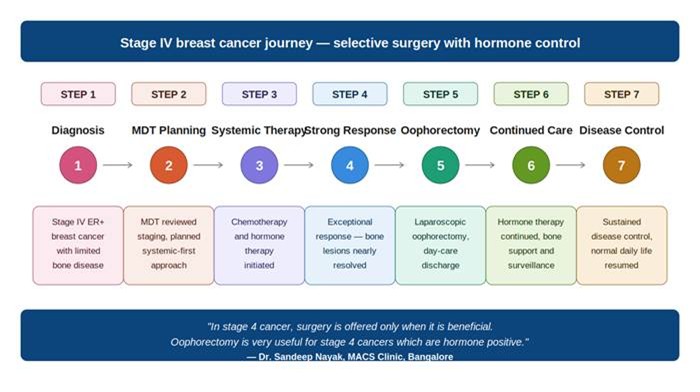
The Stage IV patient journey — systemic therapy first, selective surgery when it adds clinical benefit
DIAGNOSIS
Stage IV (metastatic) invasive ductal carcinoma of the left breast (cT3N2M1), oestrogen-receptor positive, progesterone-receptor positive, HER2-negative, with limited skeletal metastasis.
Stage IV breast cancer indicates that cancer cells have spread from the breast to distant sites. In this case, metastasis was confined to the skeleton, without involvement of vital organs — a more favourable metastatic presentation than visceral spread. Strong hormone-receptor positivity made the disease highly responsive to oestrogen-blocking therapy, which formed the cornerstone of treatment planning. The therapeutic goal was disease control rather than immediate cure with the option of selective surgery reserved for cases demonstrating exceptional response to systemic therapy.
TREATMENT
- First-line Systemic Therapy — Chemotherapy followed by endocrine therapy (aromatase inhibitor)
- Response Reassessment — PET-CT and bone imaging after 6 months
- Laparoscopic Bilateral Oophorectomy — day-care procedure for ovarian hormone suppression
- Continued Hormone Therapy and Bone-Modifying Agents
- Long-term Surveillance
DETAILED DESCRIPTION OF TREATMENT
Given the Stage IV presentation with limited skeletal metastasis, the medical team at MACS Clinic opted for a systemic-therapy-first approach rather than immediate surgical intervention. Chemotherapy was initiated to reduce overall disease burden, followed by endocrine therapy tailored to the patient’s hormone-receptor profile. Bone-modifying agents were added to reduce skeletal complications and support bone density during treatment.
After six months of systemic therapy, follow-up imaging showed an exceptional response the primary breast tumour had shrunk significantly and the skeletal lesions showed near-complete resolution with sclerotic healing. In this category of exceptional responders, Dr. Sandeep Nayak’s approach is to consider curative-intent interventions that would otherwise not be offered at Stage IV, provided the clinical benefit is clearly established.
|
“Every once in a while we have the fortune of treating a patient who responds very, very well to the treatment even though it is stage four. In those patients, we think them to be very good responders to treatment — and we go ahead and perform a curative surgery.” — Dr. Sandeep Nayak |
A laparoscopic bilateral oophorectomy was performed as an ancillary procedure to enhance hormonal control of the disease. Since ovarian oestrogen production can fuel breast cancer aggressiveness, removing the ovaries was a direct strategy to deepen hormone suppression beyond what medication alone could achieve. The laparoscopic approach allowed the procedure to be completed as a day-care surgery, with the patient discharged the very next morning and minimal recovery disruption.
Post-oophorectomy, the patient continued on hormone therapy with deeper oestrogen suppression now achievable. Regular imaging surveillance and bone health monitoring were scheduled at three-monthly intervals to track ongoing disease control. The combined strategy systemic therapy, surgical hormone suppression, and bone-supportive care delivered sustained disease stability well beyond what first-line chemotherapy alone would typically achieve.
POST-OPERATIVE ASSESSMENT
The patient recovered from the laparoscopic oophorectomy within 24 hours, with discharge on post-operative day one and a return to full normal activity within a week. There were no surgical complications, and the addition of surgical ovarian suppression produced a measurable deepening of hormone blockade on follow-up biomarker testing. Follow-up imaging at three, six, and twelve months confirmed sustained disease control, with continued sclerotic healing of the bone lesions and no new metastatic sites. The patient reported a return to pre-diagnosis functional status working, travelling, and caring for her family with only mild hormone-therapy side effects managed through routine supportive measures.
This case illustrates an important principle in Stage IV breast cancer care: surgery is not off the table simply because the cancer is metastatic. In carefully selected patients particularly those who respond exceptionally well to systemic therapy or who have hormone-positive disease that benefits from oophorectomy well-chosen surgical interventions can meaningfully improve disease control and quality of life. The decision, as Dr. Sandeep Nayak consistently emphasises, is always guided by one principle: whether the intervention is genuinely beneficial for that specific patient.
CONTACT — MACS CLINIC, BANGALORE
Surgeon: Dr. Sandeep Nayak, Surgical Oncologist
Clinic: No. 96/A/9/1, 42nd Cross, 3rd Main, 8th Block, Jayanagar, Bengaluru – 560 070
Email: support@macsclinic.com
Phone: +91 9482202240 | +91 80357 40000
Website: drsandeepnayak.com | macsforcancer.com