

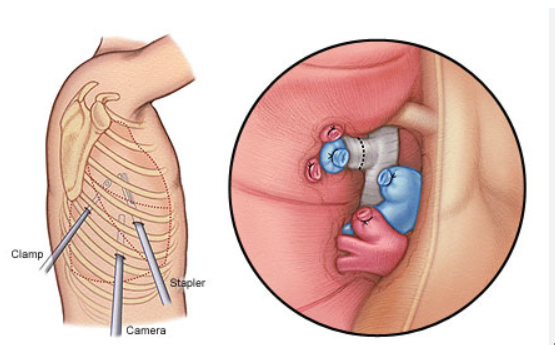
VATS surgery for lung cancer is video-assisted thoracoscopic surgery and if you’ve ever wondered why some lung cancer patients are walking around looking relatively fine a week after their operation while others are still in hospital recovering from a chest that got cracked open, this is usually the answer, because VATS uses a camera and thin instruments through a few small cuts between the ribs instead of splitting the sternum or spreading the ribs apart and that difference in what the body goes through is the entire reason recovery looks so different on the other side.
According to Prof. Dr. Sandeep Nayak, Surgical Oncologist in India, “VATS gives lung cancer patients a way through surgery that doesn’t leave them spending months recovering from a chest that was split open to get there.”
How Does VATS Surgery Actually Work for Lung Cancer?
These are the key things that happen during VATS lung cancer surgery:
- Ribs stay where they are: Two to four small cuts between the ribs is all it takes and the chest wall doesn’t get opened, which is the part of open thoracotomy that causes the kind of pain that takes months to properly go away.
- A camera does the seeing so the surgeon doesn’t have to peer into an open chest: Tiny HD camera through one incision, full magnified view of the tumour on a monitor, the surgeon is working with better visibility in some ways than open surgery actually allows.
- Long instruments do everything the hands used to do inside: Specialised instruments through the other incisions cut, staple and remove whatever part of the lung needs to come out without anyone’s hands going into the chest cavity at all.
- What comes out fits through the port with a bag: The removed tissue gets extracted through one incision site, contained to prevent any spread, and the small openings close without leaving the kind of wound that open thoracotomy patients spend weeks managing.
VATS covers lobectomy, segmentectomy and wedge resection depending on tumour location and how much lung needs to come out, and at a specialist centre it’s now the first conversation not the last resort. Lung cancer treatment at a surgical oncology centre that does VATS regularly is a genuinely different experience from what thoracotomy patients go through.
Who Is VATS Surgery Suitable for and Who Isn't?
These are the factors that determine whether VATS works for your specific lung cancer:
- Early stage is where VATS is at its best: Stage one and two non-small cell lung cancer is the territory where VATS consistently delivers and where any surgeon who knows what they’re doing would look at it before open thoracotomy enters the conversation.
- Where the tumour sits changes everything: Reachable, clearly defined, not grown into surrounding structures, that’s a VATS candidate, a tumour that’s spread locally or positioned somewhere the instruments can’t get a clean angle on is a different situation entirely.
- Your remaining lung has to be able to do the work: If smoking history or other conditions have already knocked your lung function down significantly then losing part of the lung to surgery puts real demands on what’s left and that assessment has to happen before anyone books an operating room.
- Previous chest surgery is a genuine complication: Scar tissue from prior procedures can make the camera view poor and the instruments hard to move cleanly, sometimes mid-procedure you convert to open and there’s no way around that reality going in.
Whether VATS fits your case is a question only staging scans and a surgeon who’s done enough of them to know the limits of the technique can honestly answer. This is worth reading to understand what minimally invasive surgery actually changed for patients going through lung cancer treatment.
Why Choose Dr. Sandeep Nayak for Cancer Treatment?
Dr. Sandeep Nayak has been doing minimally invasive cancer surgery for over 15 years and built RABIT, MIND and RIA-MIND at a point when most Indian oncology centres hadn’t committed to going that direction. Lung cancer surgery at the level VATS demands needs a surgeon who knows when it works, knows when to change course and doesn’t hesitate when the situation in theatre calls for it. Dr. Nayak chairs Oncology Services across Karnataka and sees patients at MACS Clinic in Bangalore where your lung cancer gets looked at properly rather than fitted into whatever plan worked for the last patient who came through.
Frequently Asked Questions
What is VATS surgery for lung cancer?
VATS is video-assisted thoracoscopic surgery where a camera and instruments through small cuts between the ribs replace the open chest incision of traditional lung surgery.
Is VATS better than open surgery for lung cancer?
For eligible patients yes, less pain, home in days not weeks and cancer control that holds up against open thoracotomy for early stage disease.
How long does recovery take after VATS lung surgery?
Home in three to five days for most patients, back to normal activity in four to six weeks, nowhere near the months open chest surgery takes.
Who is not suitable for VATS lung cancer surgery?
Advanced local disease, significantly compromised lung function or heavy scarring from prior chest surgery can all rule VATS out in favour of open thoracotomy.
Reference links:
- National Cancer Institute. Lung Cancer Treatment. https://www.cancer.gov/types/lung/patient/non-small-cell-lung-treatment-pdq
- American Cancer Society. Surgery for Non-Small Cell Lung Cancer. https://www.cancer.org/cancer/types/lung-cancer/treating-non-small-cell/surgery.html
- Disclaimer: The information shared in this content is for educational purposes and not for promotional use.

