
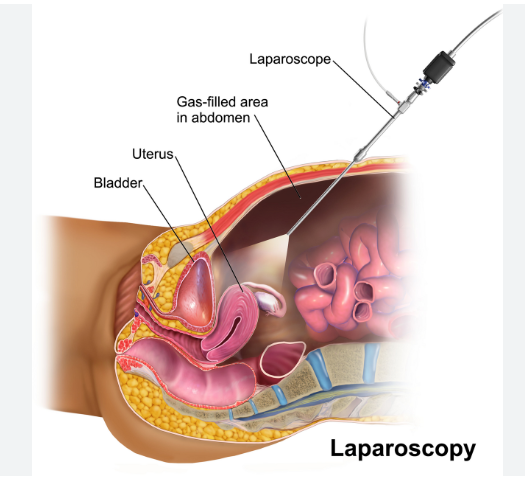
Laparoscopic surgery is keyhole surgery and the name tells you most of what you need to know because instead of cutting a large opening to get inside your body the surgeon makes a few cuts roughly the size of a fingernail, feeds a tiny camera through one of them so the inside of your body shows up on a screen in front of them, works through the other cuts with thin long instruments and the whole thing gets done without your body ever being properly opened which is why people who have it done are home in days, not weeks, and back to their actual lives long before anyone who had the same operation the open way would be anywhere close.
According to Prof. Dr. Sandeep Nayak, Surgical Oncologist in India, “Laparoscopic surgery changed what recovery looks like for cancer patients because the body is dealing with tiny holes rather than a wound that takes months to close properly.”
How Does Laparoscopic Surgery Actually Work?
These are the key steps that happen during a laparoscopic procedure:
- Carbon dioxide goes in before anything else: The abdomen gets inflated with gas first because without that space there’s no room for the camera or instruments to move, the organs are just sitting pressed up against each other and operating blind in there isn’t something anyone wants.
- A camera the width of a pen goes in through the first cut: It’s called a laparoscope and it sends a live magnified picture to the monitor in front of the surgeon, honestly in some ways the view is better than what you’d get peering into an open cavity.
- The actual work happens through the other cuts: Two or three more small incisions take the working instruments, the ones that cut, staple, remove, cauterise, everything the surgeon needs to do gets done through those ports while they watch the screen.
- What gets removed comes out through one of the ports: It goes into a small sealed bag to make sure nothing spreads, gets pulled out through one of the incision sites and then the cuts get closed and what you’re left with is genuinely not much for the body to deal with.
The reason laparoscopic surgery changed cancer treatment isn’t complicated, smaller wounds mean faster recovery and for someone already going through a cancer diagnosis that difference is not small. Laparoscopic cancer surgery at a specialist oncology centre now covers colorectal, gastric, kidney, liver and other cancers with outcomes that match open surgery.
What Makes Laparoscopic Surgery Different From Open Surgery?
These are the differences that actually matter when you’re the one going through cancer treatment:
- The wound is basically the whole story: Open surgery leaves a long incision the body spends weeks healing, laparoscopic surgery leaves cuts most patients look at afterward and genuinely cannot believe are all that’s there.
- You hurt less and that’s not an exaggeration: Less tissue pulled apart means a quieter pain response, fewer medications to manage it and getting up and moving again earlier which is actually what drives everything else in recovery forward.
- Two to four days in hospital instead of a week or more: There’s no large wound requiring hospital-level monitoring, no clinical reason to keep someone lying in a bed once they’re stable and most laparoscopic patients are surprised by how quickly the discharge conversation happens.
- Weeks back to normal instead of months: Work, food, exercise, just moving around your own house without it being an event, laparoscopic patients get there weeks before open surgery patients are even told to think about it.
Open surgery is still right for certain tumours in certain locations and any surgeon worth trusting will tell you that straight rather than pushing minimally invasive because it sounds better. This is worth reading if you want to understand what minimally invasive surgery actually changed for cancer patients in India.
Why Choose Dr. Sandeep Nayak for Cancer Treatment?
Dr. Sandeep Nayak got into laparoscopic and robotic cancer surgery over 15 years ago when most oncology centres in India hadn’t made up their minds about it yet and what came out of that is RABIT, MIND and RIA-MIND, techniques he built himself from what that experience actually taught him. He chairs Oncology Services across Karnataka and sees patients at MACS Clinic in Bangalore. Dr. Nayak will tell you honestly whether laparoscopic surgery suits your case or whether something else fits better and that’s the kind of conversation patients at a serious surgical oncology centre deserve to have.
Frequently Asked Questions
What is laparoscopic surgery explained simply?
Tiny cuts, a camera showing everything on a screen, thin instruments doing the work and no large open wound to recover from afterward.
Is laparoscopic surgery safe for cancer treatment?
Yes, for the right cancers and stages it delivers cancer control equivalent to open surgery with a recovery that’s genuinely in a different category.
How long does recovery take after laparoscopic surgery?
Home in two to four days for most patients, back to normal within two to four weeks, nowhere near what open surgery asks of you.
What cancers can be treated with laparoscopic surgery?
Colorectal, gastric, kidney, liver and several other cancers are routinely done laparoscopically at specialist oncology centres across India.
Reference links:
- National Cancer Institute. Surgery to Treat Cancer. https://www.cancer.gov/about-cancer/treatment/types/surgery
- American Cancer Society. Surgery for Cancer. https://www.cancer.org/cancer/managing-cancer/treatment-types/surgery.html
- Disclaimer: The information shared in this content is for educational purposes and not for promotional use.
