
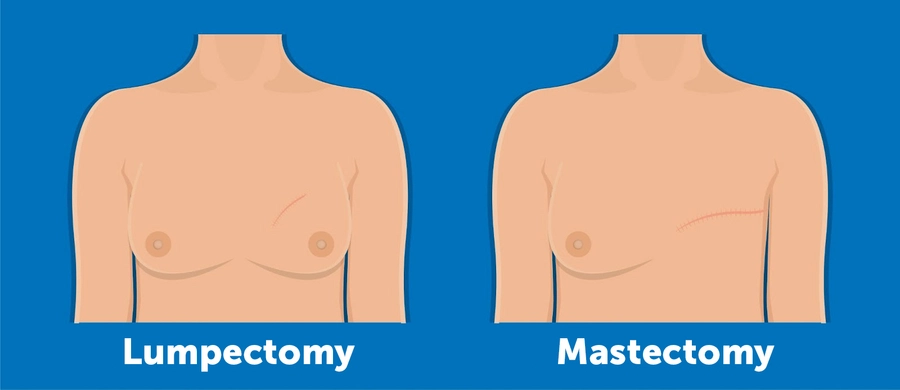
Lumpectomy takes out the tumour and a margin of surrounding tissue, leaving the rest of the breast in place. Mastectomy removes the whole breast. Survival outcomes for early-stage breast cancer are equivalent between the two when the patient is chosen correctly for each approach the difference isn’t about which is more aggressive, it’s about what works for that specific tumour in that specific breast.
According to Prof. Dr. Sandeep Nayak, Surgical Oncologist in India,
“Lumpectomy and mastectomy produce equivalent survival outcomes in the right patients the choice is never about being conservative or aggressive, it’s about what’s oncologically correct for that case.”
Unsure which surgical option is right for your diagnosis?
What Is Lumpectomy and Who Does It Work For?
Breast-conserving surgery works well for many patients but the clinical picture needs to support it before the team commits to it.
- What’s Removed: The tumour plus a clear rim of healthy tissue around it that rim gets sent to pathology immediately after surgery and if cancer cells sit at the edge, going back in to take more tissue is what happens next.
- Right Candidate: Small tumour relative to breast size, single lesion, no BRCA mutation driving ongoing risk in the remaining tissue, and located far enough from the nipple that clear margins are achievable without compromising the cosmetic result.
- Radiation After: Standard practice after lumpectomy includes breast cancer treatment with radiation to the remaining breast, which brings local recurrence rates down to a level comparable with mastectomy in appropriately selected patients.
- Recovery: Most patients go home the same day or within 24 hours and are back to normal activity in two to three weeks, considerably faster than what mastectomy recovery involves across the board.
When the selection criteria are met, lumpectomy with radiation is as oncologically sound as mastectomy and that’s not a compromise it’s the evidence.
How Is Mastectomy Different and When Does It Become Necessary?
Mastectomy steps in when lumpectomy genuinely can’t achieve what the surgery needs to deliver for that patient.
- Tumour Takes Up Too Much: When there isn’t enough healthy breast tissue left after removing the tumour to produce a functional or acceptable result, mastectomy stops being the aggressive choice and starts being the practical one.
- Multiple Lesions: Separate tumours sitting in different quadrants of the same breast can’t be addressed cleanly through breast conservation and mastectomy gives the patient a complete result rather than a series of partial ones.
- High Genetic Risk: A confirmed BRCA mutation means the remaining breast tissue after lumpectomy still carries real ongoing risk, making prophylactic mastectomy sometimes on both sides a well-supported option rather than an extreme one.
- Recurrence After Prior Treatment: When cancer returns in a breast that’s already had radiation, re-irradiation isn’t safe and robotic cancer surgery or conventional mastectomy becomes the only viable surgical path left for that patient.
Mastectomy often starts a longer process rather than ending one, and for more on what reconstruction involves afterward, our blog on breast reconstruction covers the options in detail.
Why Choose Dr. Sandeep Nayak for Breast Cancer Treatment ?
Dr. Sandeep Nayak brings 24 years of surgical oncology experience, DNB qualifications in Surgical Oncology and General Surgery and a fellowship in Laparoscopic and Robotic Onco-Surgery to every breast cancer surgical decision. He heads Oncology Services across Karnataka and leads breast cancer surgery at KIMS Hospital, Bangalore, with originator credits for RABIT and over 25 published clinical studies. Patients wanting a clear answer on whether lumpectomy or mastectomy is the right call for their specific case are seen here with every decision going through tumour board consensus. Call +91 8104310753 to book your consultation.
Frequently Asked Questions
Does lumpectomy give the same survival rate as mastectomy?
For appropriately selected early-stage patients survival outcomes are equivalent when radiation follows lumpectomy.
Is radiation always needed after lumpectomy?
In most cases yes, radiation to the remaining breast tissue is standard practice after lumpectomy.
Can a patient choose mastectomy even if lumpectomy is possible?
Yes, informed patient preference is a legitimate factor in the surgical decision and is fully supported.
How long does recovery take after lumpectomy versus mastectomy?
Lumpectomy recovery takes two to three weeks while mastectomy typically needs four to six weeks.
-
References
- National Cancer Institute — Breast Cancer Surgery Options
- World Health Organization — Breast Cancer Treatment
- Disclaimer: The information shared in this content is for educational purposes and not for promotional use.
