
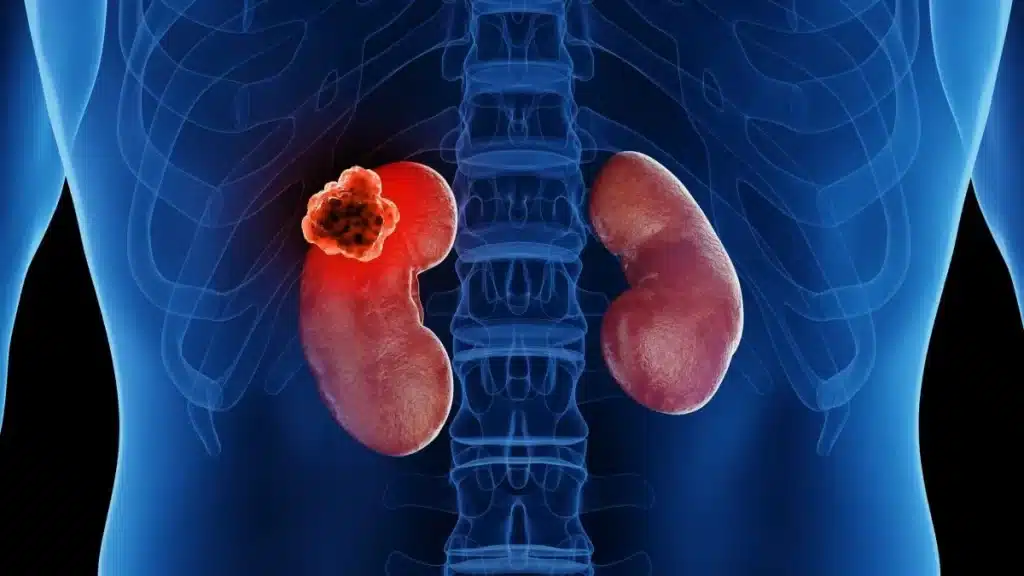
Kidney cancer under 4cm and selected tumours up to 7cm can be treated with partial nephrectomy, removing only the tumour and a clear margin of surrounding tissue while preserving the remaining functional kidney. Oncological outcomes for partial nephrectomy in T1 tumours are equivalent to radical nephrectomy removing the entire kidney. Full removal is indicated when the tumour is large, centrally located, involves the renal hilum or when partial resection cannot achieve clear margins safely. The decision is made at tumour board based on tumour size, location, the patient’s baseline kidney function and whether a minimally invasive approach is technically feasible.
According to Prof. Dr. Sandeep Nayak, Surgical Oncologist in India,
“Preserving the kidney matters beyond just the surgery. Patients with one functioning kidney face higher long-term cardiovascular and renal risk. Where partial nephrectomy is oncologically equivalent, it is the better operation.”
Have a kidney tumour and want to know whether full removal is actually necessary?
When Can Kidney Cancer Be Treated Without Full Removal?
Partial nephrectomy is now the standard of care for eligible kidney tumours and is offered at high-volume oncology centres using laparoscopic or robotic-assisted techniques.
- Tumours Under 4cm: T1a tumours under 4cm are the strongest candidates for partial nephrectomy with oncological outcomes identical to radical nephrectomy and kidney cancer treatment at KIMS Hospital, Bangalore offers robotic-assisted partial nephrectomy for eligible patients as the preferred approach over open surgery.
- Tumours 4 to 7cm: Selected T1b tumours between 4 and 7cm are suitable for partial nephrectomy when the tumour is exophytic, peripherally located and not involving the collecting system, with oncological equivalence to radical nephrectomy confirmed in current evidence.
- Single Kidney Patients: Patients with a solitary kidney, bilateral kidney tumours or compromised contralateral kidney function require partial nephrectomy regardless of tumour size because radical nephrectomy in this group would leave the patient dialysis-dependent.
- Active Surveillance Option: Very small incidentally detected tumours under 2cm in elderly patients or those with significant comorbidities are managed with active surveillance including regular imaging every three to six months rather than immediate surgery.
Where partial nephrectomy is technically achievable with clear margins, it is always preferable to radical nephrectomy from a long-term kidney function and cardiovascular risk standpoint.
When Is Full Kidney Removal Actually Necessary?
Radical nephrectomy remains the appropriate operation for specific tumour characteristics where partial resection cannot safely achieve the oncological goals of the operation.
- Large or Central Tumours: Tumours over 7cm or those involving the renal hilum, collecting system or renal vein make partial nephrectomy technically unreliable for achieving clear margins and robotic cancer surgery or conventional radical nephrectomy is planned when the tumour anatomy makes kidney preservation oncologically unsafe.
- Multiple Tumours: Multiple tumours distributed across the kidney make partial nephrectomy technically complex and in cases where tumour load prevents adequate remnant kidney preservation, radical nephrectomy is the safer oncological choice.
- Locally Advanced Disease: Tumours with direct invasion into adjacent structures, perinephric fat involvement confirmed on imaging or renal vein thrombus require radical nephrectomy with extended resection rather than any kidney-preserving approach.
- Poor Functional Remnant: When preoperative imaging and functional assessment show that the remnant kidney after partial nephrectomy would provide insufficient filtration based on the patient’s baseline function, radical nephrectomy with appropriate long-term renal management planning becomes the clinically safer option.
Tumour board review determines whether partial or radical nephrectomy is appropriate for each individual case and for more on specialist robotic kidney surgery, our blog on robotic surgery covers this in detail.
Why Choose Dr. Sandeep Nayak for Kidney Cancer Surgery ?
Dr. Sandeep Nayak brings 24 years of surgical oncology experience, DNB qualifications in Surgical Oncology and General Surgery and a fellowship in Laparoscopic and Robotic Onco-Surgery to kidney cancer surgery including robotic-assisted partial and radical nephrectomy at KIMS Hospital, Bangalore. He heads Oncology Services across Karnataka with originator credits for RABIT, MIND and L-VEIL techniques and over 25 published clinical studies. Patients with kidney tumours wanting clarity on whether full removal is necessary are seen here with every decision through tumour board review. Call +91 8104310753 to book your consultation.
Frequently Asked Questions
Can kidney cancer be cured without removing the whole kidney?
Kidney cancer under 7cm in eligible locations is treated with partial nephrectomy producing equivalent oncological outcomes to full kidney removal while preserving kidney function.
What size kidney tumour requires full removal?
Tumours over 7cm, centrally located tumours involving the renal hilum and locally advanced tumours with adjacent structure invasion typically require radical nephrectomy rather than partial resection.
Is robotic surgery available for partial nephrectomy in Bangalore?
Robotic-assisted partial nephrectomy is available at KIMS Hospital, Bangalore and is the preferred approach for eligible kidney tumours over open or conventional laparoscopic surgery.
What happens to kidney function after partial nephrectomy?
Partial nephrectomy preserves the functional remnant kidney, maintaining better long-term renal function and reducing cardiovascular risk compared to radical nephrectomy removing the entire kidney.
Reference Links-
- National Cancer Institute — Kidney Cancer Treatment
- World Health Organization — Renal Cell Carcinoma
- Disclaimer: The information shared in this content is for educational purposes and not for promotional use.
