
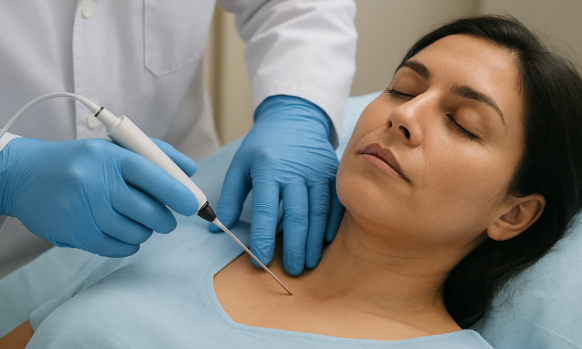
A biopsy is a medical procedure that removes a small sample of tissue, cells, or fluid from the body to be examined under a microscope by a pathologist. It is the most definitive way to diagnose cancer, determine its type, and plan treatment, often performed using needle aspiration, surgical excision, or endoscopic techniques guided by imaging.
According to Prof. Dr. Sandeep Nayak, Surgical Oncologist in India, “we cannot build a proper treatment plan from imaging alone the biopsy is what tells us the cancer type, the grade and the receptor profile, and every clinical decision after that depends on getting those details right.”
Have questions about what a biopsy result means for your treatment?
What Types of Biopsy Are Used in Cancer?
The technique chosen depends on where the tissue is and how much of it is needed to get a reliable answer from the laboratory.
- Fine Needle Aspiration: A thin needle draws cells from the target site without any incision, suitable when the lesion sits close enough to the surface and a preliminary cell assessment is all that’s needed to move the workup forward.
- Core Needle Biopsy: A thicker needle removes a small column of tissue rather than loose cells, which gives pathologists far more material to work with and produces a considerably more accurate reading of tumour grade and receptor characteristics.
- Excisional Biopsy: The whole lump gets surgically removed and sent for analysis, used when it’s small enough to take out entirely or when needle samples have repeatedly failed to give a clear enough answer to act on.
- Endoscopic Biopsy: A flexible scope passes through a natural body opening to reach and sample tissue in the oesophagus, stomach or bowel, and where deeper abdominal access is needed, laparoscopic cancer surgery techniques make it possible to reach the site with minimal disruption to surrounding structures.
The biopsy method isn’t chosen arbitrarily; it comes down to what the clinical team needs from the sample and which technique can actually deliver that from the location in question.
What Happens After the Tissue Is Collected?
Getting the sample is only the first part. What happens in the laboratory afterward is where the clinically actionable information actually comes from.
- Histopathology: The tissue is processed, stained and examined by a pathologist who determines whether cancer cells are present, identifies the tumour type and assesses how abnormal the cells look relative to healthy tissue in the same area.
- Receptor and Gene Testing: Breast, lung and several other cancer types get tested for hormone receptors, HER2 status and specific mutations because those results are what determine whether robotic cancer surgery alone is sufficient or whether targeted therapy needs to run alongside or before it.
- Staging Correlation: The pathology report doesn’t get read in isolation it’s placed alongside scan findings and clinical examination to confirm how far the cancer has spread, which is what determines whether surgery or systemic treatment should come first.
- Tumour Board Review: Before any plan reaches the patient, the full biopsy report goes in front of a multidisciplinary team where surgeons, oncologists and radiologists interpret everything together, because individual results don’t drive decisions the full picture does.
Turnaround time varies from a few days for standard histopathology to a couple of weeks when molecular testing is included, and for a clearer sense of how biopsy findings connect to surgical decisions, cancer surgery is covered separately.
Why Choose Dr. Sandeep Nayak for Cancer Diagnosis and Surgery?
Dr. Sandeep Nayak holds DNB qualifications in Surgical Oncology and General Surgery with a fellowship in Laparoscopic and Robotic Onco-Surgery and 24 years of experience in cases where accurate early diagnosis shaped what remained possible for the patient surgically and systemically. He leads cancer surgery and Robotic Surgery at KIMS Hospital, Bangalore and heads Oncology Services across Karnataka, with originator credits for RABIT, MIND and L-VEIL techniques and over 25 published clinical studies. Patients who need a second opinion on a biopsy result, clarification on a diagnosis or a full surgical assessment are seen here with every decision reviewed through tumour board consensus before it reaches them. Call +91 8104310753 to book your consultation.
Frequently Asked Questions
Does every cancer case require a biopsy before treatment?
In almost every case yes, because imaging cannot confirm cancer type, grade or molecular profile with the accuracy that treatment decisions actually need.
How long before biopsy results come back?
Standard histopathology usually returns within five to seven days, though molecular and genetic panels can extend that to two weeks or more.
Is the biopsy procedure painful?
Needle biopsies use local anaesthesia so the procedure itself is tolerable, though some soreness at the collection site for a day or two afterward is normal.
Can a biopsy make cancer spread to other areas?
No credible clinical evidence supports the idea that a properly performed biopsy causes cancer to spread elsewhere in the body.
Reference links:
- National Cancer Institute — Biopsy for Cancer Diagnosis
- National Institutes of Health — Pathological Diagnosis in Oncology
- Disclaimer: The information shared in this content is for educational purposes and not for promotional use.
