
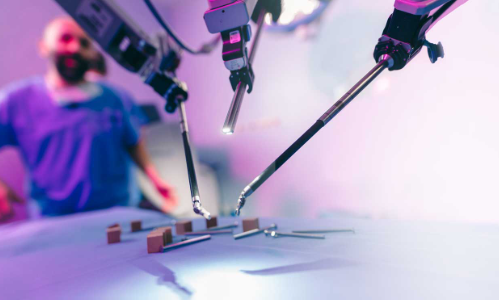
Robotic surgery is a minimally invasive technique where surgeons use computer-controlled robotic arms to perform precise operations through small incisions. In cancer treatment, it enhances dexterity and provides 3D, high-definition visualization for better tumor removal, resulting in less pain, reduced blood loss, and faster recovery compared to traditional open surgery.
According to Prof. Dr. Sandeep Nayak, Surgical Oncologist in India, “robotic surgery changes what is technically achievable in certain anatomical locations particularly the pelvis, chest and around the base of the skull where standard instruments have real limitations.”
Want to know if robotic surgery is the right option for your case?
How Does Robotic Cancer Surgery Work?
The system has three main components and each one plays a specific role in how the procedure is performed.
- Surgeon Console: The operating surgeon controls robotic arms from here using hand and foot movements, viewing a three-dimensional magnified image of the operative field while every instrument motion gets translated with far greater precision than manual laparoscopy allows.
- Patient Cart: This robotic unit sits beside the table holding three or four arms that pass instruments and a camera through small incisions, with a range of movement at the instrument tip that exceeds what a human wrist can physically achieve inside a confined surgical space.
- Tremor Filtration: The system filters natural hand tremor and scales movements so a larger motion at the console becomes a smaller more precise action inside the patient, which is particularly valuable when dissecting close to robotic cancer surgery sites involving major vessels or delicate nerves.
- Oncological Standards: Margins still need to be clear, lymph nodes still get assessed and the procedure is held to exactly the same oncological standards as open or laparoscopic surgery because the platform extends what the surgeon can do, not what the surgery needs to achieve.
The robotic system assists the surgeon clinical judgment behind every decision still belongs entirely to the person at the console.
Which Cancers Is Robotic Surgery Most Used For?
Certain anatomical sites benefit from robotic assistance more than others and those are where the technology has become most established in cancer care.
- Prostate Cancer: Robotic radical prostatectomy is one of the most performed robotic cancer operations globally, with the three-dimensional view allowing surgeons to work close to neurovascular bundles controlling continence and sexual function with considerably less risk of damaging them.
- Rectal Cancer: Deep pelvic dissection for rectal cancer is where robotic surgery arguably makes its biggest difference, allowing total mesorectal excision in a narrow pelvis where laparoscopic cancer surgery can be technically difficult to complete to the required oncological standard.
- Gynaecological Cancers: Robotic radical hysterectomy and lymph node dissection for cervical and uterine cancers are now standard at high-volume centres, with robotic dexterity well suited to pelvic anatomy where precision directly affects post-operative function.
- Head, Neck and Thyroid: Transoral robotic surgery reaches the base of tongue and oropharyngeal tumours without any external incision, and robotic thyroidectomy through the axilla leaves no visible scar on the neck at all outcomes open surgery simply cannot offer for these specific sites.
Patient selection and surgeon experience determine whether robotic surgery is appropriate for any given case, and for broader context on how surgical approaches are selected, cancer surgery is covered separately.
Why Choose Dr. Sandeep Nayak for Robotic Cancer Surgery?
Dr. Sandeep Nayak holds DNB qualifications in Surgical Oncology and General Surgery with a fellowship in Laparoscopic and Robotic Onco-Surgery and 24 years of experience performing robotic cancer operations across prostate, colorectal, gynaecological, head and neck and thyroid cancers. He leads Surgical Oncology and Robotic Surgery at KIMS Hospital, Bangalore and heads Oncology Services across Karnataka, with originator credits for RABIT, MIND and L-VEIL techniques and over 25 published clinical studies. Patients who want an honest assessment of whether robotic surgery is genuinely appropriate for their case are seen here with every decision going through tumour board review first. Call +91 8104310753 to book your consultation.
Frequently Asked Questions
Is robotic cancer surgery safer than open surgery?
Safety profiles are comparable robotic surgery reduces blood loss and recovery time in certain procedures but carries the same oncological standards as open surgery.
Is robotic surgery available for all cancer types in India?
It is established for prostate, colorectal, gynaecological, head and neck and thyroid cancers at high-volume centres with experienced robotic surgical oncologists.
How long does recovery take after robotic cancer surgery?
Most patients are discharged within two to four days, with return to normal activity typically faster than after equivalent open procedures.
Does robotic surgery cost more than laparoscopic surgery?
Yes, the technology involved carries a higher cost, though the clinical benefit in appropriate cases often justifies the difference for the patient.
Reference links:
- National Cancer Institute — Surgery to Treat Cancer
- National Institutes of Health — Robotic Surgery in Oncology
- Disclaimer: The information shared in this content is for educational purposes and not for promotional use.
