
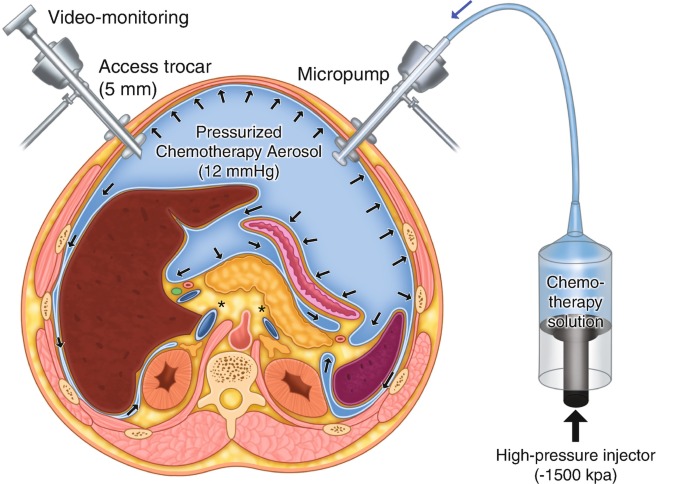
PIPAC stands for Pressurised Intraperitoneal Aerosol Chemotherapy, a newer minimally invasive procedure that delivers chemotherapy as a pressurised mist directly into the abdominal cavity through small laparoscopic ports, repeated every six weeks alongside systemic chemo. HIPEC delivers heated liquid chemotherapy in a single major procedure after cytoreductive surgery. PIPAC is mainly used when full surgical removal isn’t possible, HIPEC when it is. Both target peritoneal cancer spread but in fundamentally different ways.
According to Prof. Dr. Sandeep Nayak, Surgical Oncologist in India, “PIPAC has changed what we can offer patients with peritoneal cancer spread that isn’t fully resectable. It’s not a replacement for HIPEC, it’s a different tool for a different group of patients, and the choice depends entirely on how extensive the spread is and what’s surgically achievable.”
That choice between PIPAC and HIPEC deserves a clear explanation, not just medical jargon.
What Is PIPAC and How Does It Work?
PIPAC is a precise, minimally invasive chemotherapy delivery system. Here’s the breakdown.
- Aerosol delivery: Chemotherapy drugs are sprayed as a fine pressurised mist directly into the abdomen, reaching cancer cells across the peritoneal surface evenly.
- Pressure boost: The pressurised gas environment pushes the drug deeper into tumour tissue than liquid chemo achieves, improving local absorption significantly.
- Small incisions: Done laparoscopically through tiny ports, with no large cut, no organ removal, and patients usually discharged within one to two days.
- Repeated cycles: Given every six weeks alongside ongoing systemic chemotherapy, with three or more sessions typical depending on response.
So PIPAC is short, repeatable and minimally invasive. To understand the full peritoneal cancer treatment toolkit, the HIPEC treatment in Bangalore service page covers both PIPAC and HIPEC offered at MACS Clinic.
PIPAC vs HIPEC: A Side by Side Comparison?
The two are often confused but work in fundamentally different ways. Here’s how they actually compare.
|
Feature |
HIPEC |
PIPAC |
|
Mechanism |
Heated liquid chemo bath |
Pressurised aerosol mist |
|
Procedure type |
Major surgery with cytoreduction |
Minimally invasive laparoscopy |
|
Recovery time |
Around 3 months full recovery |
Discharge in 1 to 2 days |
|
Repeated |
Usually one time only |
Every 6 weeks, repeated cycles |
|
Used when |
Cancer can be fully removed |
Cancer is too extensive to remove |
- Surgery scale: HIPEC needs full cytoreductive surgery first to remove visible tumour. PIPAC doesn’t, it’s chemotherapy delivery alone.
- Patient eligibility: HIPEC suits patients fit for major surgery with limited spread. PIPAC suits those whose disease is too spread for full surgery or who can’t tolerate major surgery.
- Intent of treatment: HIPEC aims to cure carefully selected patients. PIPAC is usually palliative or used to shrink disease enough for future surgery.
- Combined often: Some patients receive PIPAC first to reduce disease, then become candidates for HIPEC later, with the two working together rather than competing.
So the choice depends on the disease burden and surgical fitness, not patient preference. To understand outcomes after the more established HIPEC procedure, our blog on life expectancy after HIPEC surgery walks through what survival actually depends on for individual patients.
Why Choose Dr. Sandeep Nayak for Your Breast Cancer Care?
Dr. Sandeep Nayak brings 24 years of surgical oncology experience, DNB qualifications in Surgical Oncology and General Surgery and a fellowship in Laparoscopic and Robotic Onco Surgery to the care of patients with peritoneal cancer spread. He performs both HIPEC and PIPAC at MACS Clinic and KIMS Hospital Bangalore, choosing between them based on each patient’s disease burden and surgical fitness, not on what’s most commonly offered elsewhere.
That tailored selection between PIPAC, HIPEC or both is what gives peritoneal cancer patients the right tool for their specific situation. Every case at MACS Clinic goes through a full tumour board, where the treatment plan is set together. Call +91 8104310753 to book your consultation.
Frequently Asked Questions
What is PIPAC?
Pressurised intraperitoneal aerosol chemo delivered through small laparoscopic ports.
How is PIPAC different from HIPEC?
PIPAC uses pressurised mist, HIPEC uses heated liquid. PIPAC is repeated, HIPEC is one time.
Who needs PIPAC?
Patients whose peritoneal cancer is unresectable for full surgery.
How often is PIPAC done?
Usually every six weeks alongside systemic chemotherapy.
References:
- National Cancer Institute, Peritoneal Cancer Treatment. https://www.cancer.gov/
- World Health Organisation, Cancer. https://www.who.int/news-room/fact-sheets/detail/cancer
