

A colon cancer diagnosis raises many questions, and one of the first is often about the stage. The stage describes how far the cancer has grown and whether it has spread, shaping nearly every treatment decision that follows. Understanding what each stage means, from the earliest Stage 0 to the advanced Stage 4, helps patients make sense of the road ahead. The encouraging news is that colon cancer is highly treatable, especially when caught early.
Dr. Sandeep Nayak explains, “The stage tells us how far the cancer has spread, but it does not define hope. Even advanced colon cancer can be treated effectively, and early stages are very often curable with the right treatment approach.”
Dr. Sandeep Nayak, a respected surgical oncologist in India with over 24 years of experience, is renowned for his expertise in D3 resection and minimally invasive colon cancer surgery. His research on diet and colorectal cancer has earned global recognition, and his approach reflects a commitment to the most effective, least invasive colon cancer treatment in Bangalore.
So what exactly does it mean when a doctor talks about the “stage” of your cancer? Let’s explore.
What Does Colon Cancer Staging Mean?
Staging is the system doctors use to describe the size of a colon cancer and how far it has spread. It is the foundation of every treatment plan. Key points to understand:
- A common language. Staging gives doctors a clear, standard way to describe the extent of the cancer.
- The TNM system. Most staging uses Tumor size, Node involvement, and Metastasis (spread) to classify cancer.
- Guides treatment. The stage determines whether surgery alone, chemotherapy, or a combination is needed.
- Predicts outlook. Earlier stages generally carry a better prognosis than later ones.
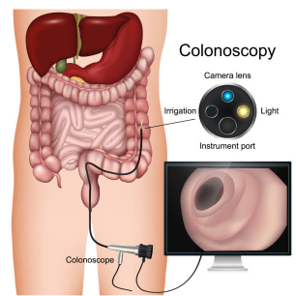
Understanding your stage is the first step toward understanding your treatment.
Concerned about a colon cancer diagnosis? Get an accurate assessment and clear plan from a specialist today.
Let’s start at the very beginning of the staging scale, where cancer is caught at its earliest point.
Stage 0 Colon Cancer: Very Early Cancer
Stage 0 is the earliest form of colon cancer, also called carcinoma in situ. At this point, abnormal cells are found only in the innermost lining of the colon and have not grown deeper.
- Where it is. Cancer cells stay in the inner lining and have not invaded deeper layers.
- Treatment. Often removed entirely during a colonoscopy (polypectomy) or with minor surgery.
- Outlook. The prognosis is excellent, with very high cure rates.
- Follow-up. Regular colonoscopies help catch any new growths early.
At this stage, treatment is simplest, and the outcome is nearly always a cure.
So what changes once the cancer starts growing into the colon wall itself? Let’s find out.
Stage 1 Colon Cancer: Growth Into the Colon Wall
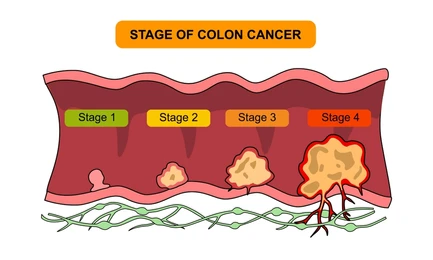
Stage 1 colon cancer has grown beyond the inner lining into the deeper layers of the colon wall, but has not reached the lymph nodes or spread further.
- Where it is. The tumor has invaded the muscle layers of the colon wall.
- Treatment. Surgery to remove the affected section of the colon (colectomy) is usually all that is needed.
- Chemotherapy. Rarely required at this stage.
- Outlook. Cure rates remain very high with proper surgery.
Surgery alone is typically curative at this stage.
What happens when the tumor pushes deeper, through the wall of the colon? Let’s explore Stage 2.
Stage 2 Colon Cancer: Deeper Growth Without Lymph Node Spread
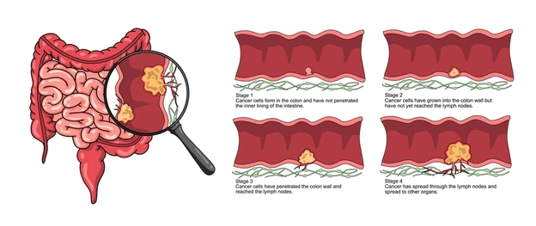
Stage 2 colon cancer has grown through the wall of the colon and may reach nearby tissue, but has not spread to the lymph nodes.
- Where it is. The tumor extends through the colon wall, sometimes into nearby structures.
- Treatment. Surgery to remove the affected section is the main treatment.
- Chemotherapy. May be recommended in higher-risk cases to reduce recurrence.
- Outlook. Still very favorable, especially with complete surgical removal.
A thorough surgery, such as D3 resection, is key to the best outcome at this stage.
But what does it mean when the cancer reaches the lymph nodes? Let’s discover why this stage is a turning point.
Stage 3 Colon Cancer: Lymph Node Involvement
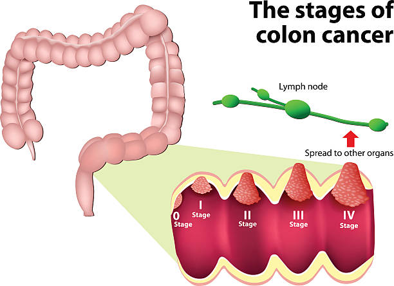
Stage 3 colon cancer has spread to nearby lymph nodes but not to distant organs. This is a crucial stage where combination treatment becomes important.
- Where it is. Cancer has reached one or more nearby lymph nodes.
- Treatment. Surgery to remove the tumor and affected lymph nodes, followed by chemotherapy.
- Why chemo matters. It targets any cancer cells that may have spread beyond what surgery removes.
- Outlook. Still very treatable, with good outcomes when managed by an expert team.
The quality of lymph node removal during surgery strongly influences results at this stage.
What about the most advanced stage, when cancer has traveled beyond the colon? Let’s discuss Stage 4.
Stage 4 Colon Cancer: Cancer Spread to Distant Organs
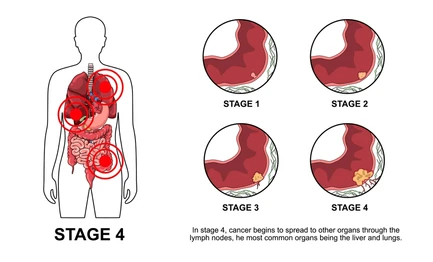
Stage 4 is advanced colon cancer that has spread to distant organs such as the liver, lungs, or the lining of the abdomen. It is more complex but still treatable.
- Where is it? Cancer has spread beyond the colon to distant sites like the liver or lungs.
- A combination of chemotherapy, targeted therapy, and surgery, when possible.
- Advanced options. Techniques like HIPEC can treat cancer that has spread within the abdomen.
- Varies by case, but modern treatments can significantly extend life and improve its quality.
Even at this stage, an experienced team can offer meaningful, effective treatment options. Advanced approaches like HIPEC are available for select cases.
Once treatment is over, many patients worry about one big question. Let’s address it head-on.
Can Colon Cancer Come Back After Treatment?
Recurrence is a common concern, and understanding it helps patients stay proactive. Colon cancer can return, but careful follow-up catches problems early.
- Recurrence risk. It depends on the original stage, with higher stages carrying more risk.
- Where it returns. Cancer may come back locally or in distant organs, such as the liver.
- Monitoring. Regular scans, colonoscopies, and blood tests help detect recurrence early.
- Treatment. Recurrent cancer can often still be treated, sometimes with surgery again.
Consistent follow-up care is the best defense against recurrence going unnoticed.
Conclusion
Understanding colon cancer stage by stage, from Stage 0 to Stage 4, takes some of the fear out of a diagnosis and helps patients face treatment with clarity. Each stage has its own approach, from simple removal in the earliest cases to combined surgery, chemotherapy, and advanced therapies in later ones. The reassuring truth is that colon cancer is highly treatable, and outcomes are best when a seasoned team guides care.
Dr. Sandeep Nayak, an acclaimed oncologist in India, with his global expertise in D3 resection and minimally invasive colon surgery, offers patients the most advanced and effective care at every stage. An early consultation can make all the difference.
Frequently Asked Questions
1. What are the early symptoms of colon cancer?
Changes in bowel habits, blood in stool, abdominal discomfort, and unexplained weight loss are common early signs.
2. Is Stage 0 colon cancer curable?
Yes. Stage 0 is highly curable, often treated by removing the cancer during a colonoscopy or with minor surgery.
3. What is the main treatment for early-stage colon cancer?
Surgery to remove the affected part of the colon is the main treatment for early stages, sometimes without chemotherapy.
4. What is D3 resection in colon cancer surgery?
D3 resection is a thorough surgical technique that removes the tumor along with a wide area of lymph nodes for better outcomes.
5. Can Stage 4 colon cancer be treated?
Yes. While advanced, Stage 4 can be managed with chemotherapy, targeted therapy, surgery, and advanced options like HIPEC.
6. What is the survival rate for colon cancer?
Survival is very high for early stages and lower for advanced ones, but modern treatment continues to improve outcomes at every stage.
7. How can I lower my risk of colon cancer recurrence?
Regular follow-up, a healthy diet, exercise, and avoiding smoking and excess alcohol all help lower recurrence risk.
Reference Links:
Disclaimer: The information shared in this content is for educational purposes and not for promotional use.
