

No, not all thyroid nodules need a biopsy or surgery. Most turn out to be harmless, and many never need more than a repeat ultrasound. A thyroid biopsy comes into the picture when the scan looks worrying or the nodule is on the larger side. Surgery is a smaller group still: cancer, results that stay unclear, a lump pressing on the windpipe, or a nodule making too much hormone.
According to Prof. Dr. Sandeep Nayak, Surgical Oncologist in Bengaluru at MACS Clinic, “Almost everyone who walks in with a thyroid nodule is afraid it’s cancer. Mostly it isn’t. In the first visit I try to separate the few that need action from the many we can safely keep an eye on,” he says.
Worried about a lump in your neck? Visit our clinic or send an enquiry, and we’ll go through your reports with you.
Which Thyroid Nodules Need a Biopsy?
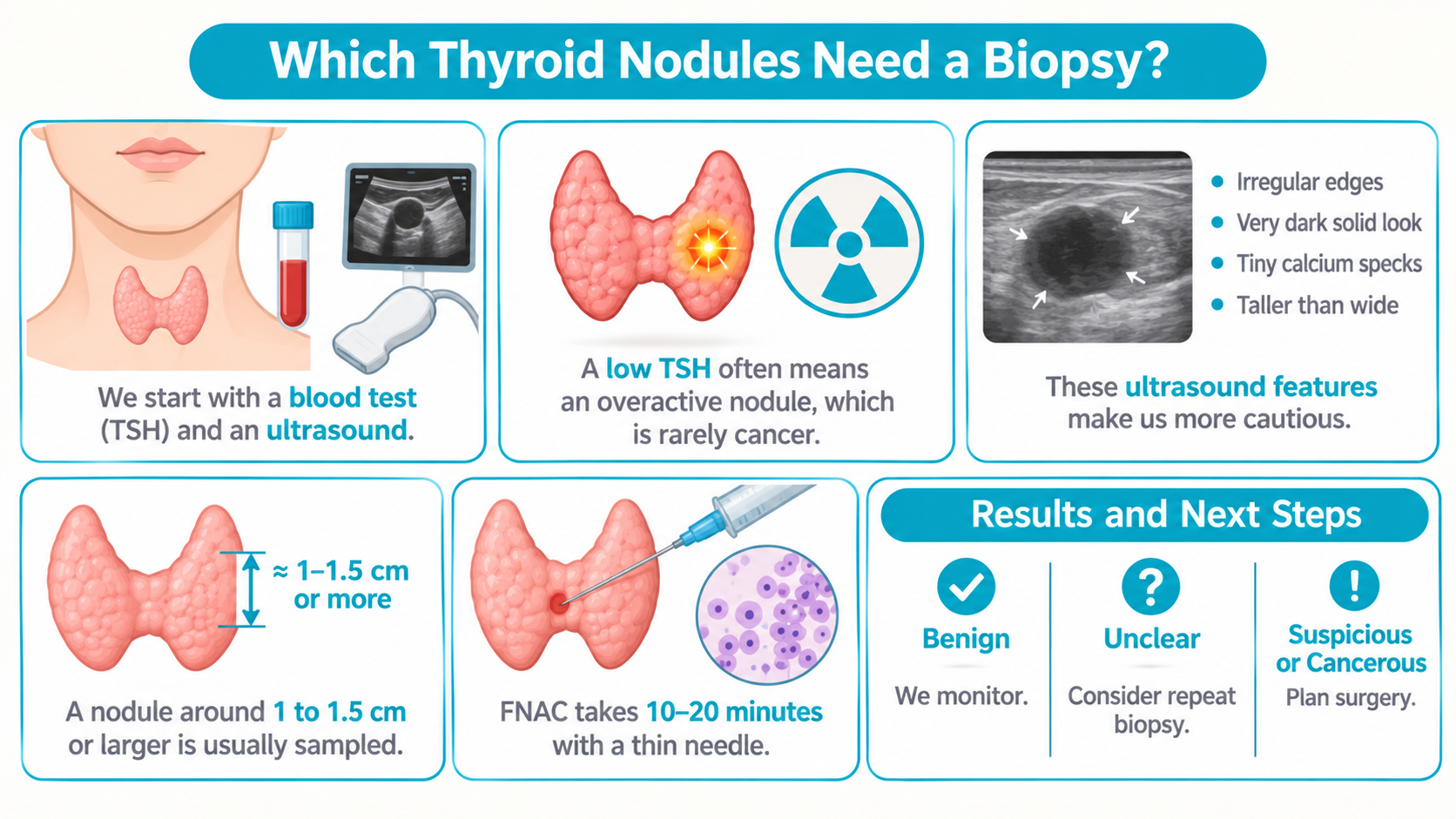
About 5 to 10 out of every 100 nodules turn out to be cancer, so we don’t biopsy every lump. We start with a blood test for TSH and an ultrasound of the neck, and go from there.
A low TSH usually points to an overactive nodule. These “hot” ones are rarely cancer, so a thyroid scan tends to come next, not a needle.
The ultrasound tells us more. Irregular edges, a very dark solid look, tiny calcium specks, or a nodule that is taller than it is wide all make us cautious. A cyst full of fluid usually doesn’t.
Size matters as well. Roughly speaking, a suspicious-looking nodule of around 1 to 1.5 cm or more gets sampled. A smaller one can still be sampled if it looks bad enough.
The test is called fine needle aspiration cytology, or FNAC. It takes 10 to 20 minutes. With ultrasound guiding a thin needle, the doctor draws out a few cells, and you go home the same day. The lab then reports the result on the Bethesda scale. A benign result means we watch. An unclear one may mean a repeat biopsy or molecular testing. A suspicious or cancerous result means we start planning surgery.
When Is Surgery Advised?
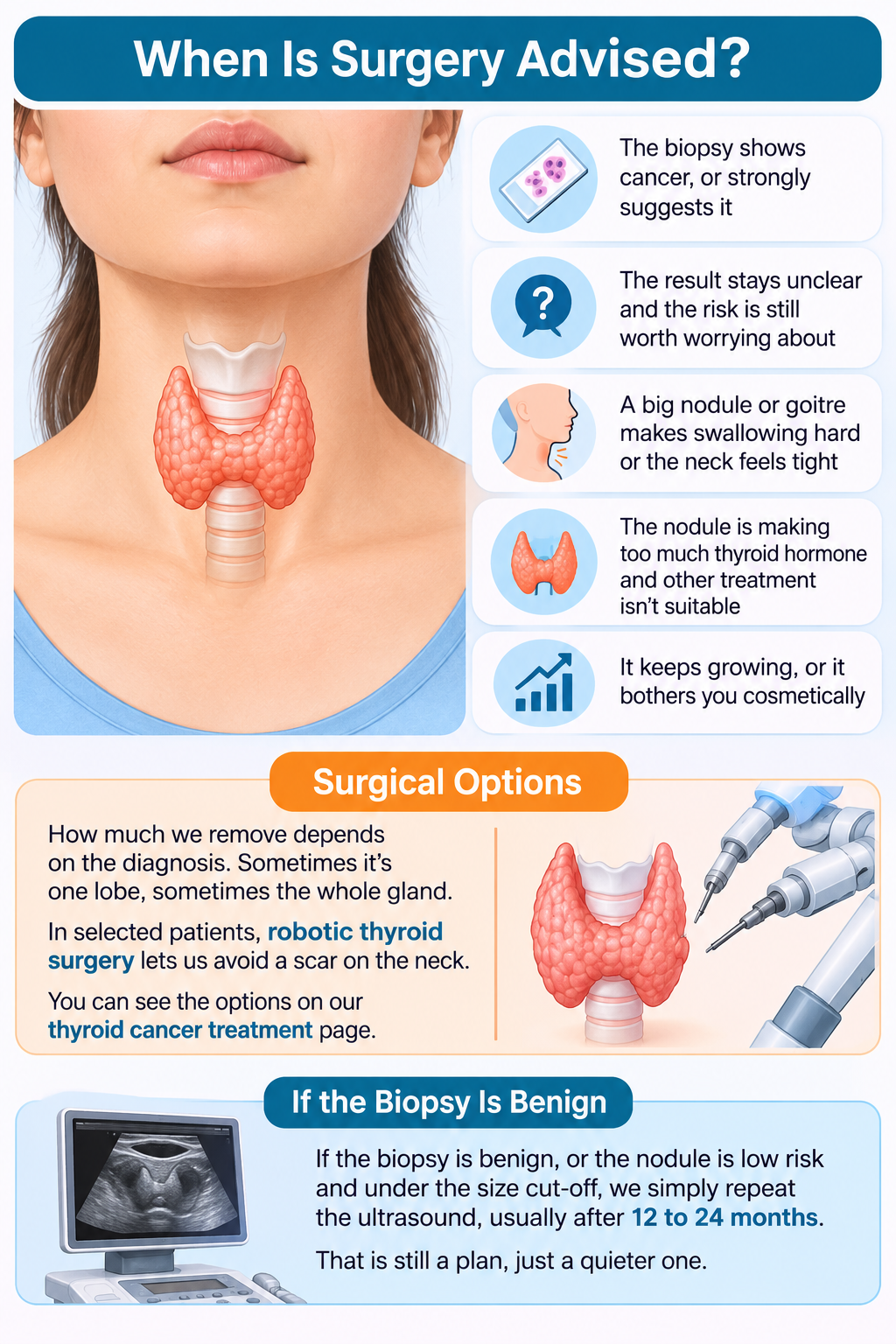
Surgery makes sense in a handful of situations:
- The biopsy shows cancer, or strongly suggests it
- The result stays unclear and the risk is still worth worrying about
- A big nodule or goitre makes swallowing hard or the neck feels tight
- The nodule is making too much thyroid hormone and other treatment isn’t suitable
- It keeps growing, or it bothers you cosmetically
How much we remove depends on the diagnosis. Sometimes it’s one lobe, sometimes the whole gland. In selected patients, robotic thyroid surgery lets us avoid a scar on the neck. You can see the options on our thyroid cancer treatment page.
If the biopsy is benign, or the nodule is low risk and under the size cut-off, we simply repeat the ultrasound, usually after 12 to 24 months. That is still a plan, just a quieter one.
What Determines the Treatment Decision?
It comes down to the ultrasound, the size, the biopsy result and your hormone levels. Your history counts too. Radiation to the neck in the past, thyroid cancer in the family, a nodule that has grown fast, or a change in your voice all make us less willing to wait.
The heart is part of this as well. Thyroid hormone controls how fast the heart beats, and too much of it can cause palpitations or atrial fibrillation. That is why doctors check thyroid function when they assess heart failure. If you are under a cardiologist, bring those reports along, as they help us decide whether a thyroid procedure is safe and when to schedule it.
Key Takeaways
- More than nine in ten thyroid nodules are benign.
- Ultrasound pattern and size decide who gets a thyroid biopsy.
- A hot nodule usually gets a scan first, not a biopsy.
- Surgery is for cancer, unclear results, pressure symptoms or a nodule making extra hormone.
- A benign nodule is followed with repeat ultrasound.
- If you have a heart condition as well, show your thyroid and heart reports together.
Frequently Asked Questions
Do all thyroid nodules need a biopsy?
No. We recommend one when the ultrasound looks suspicious, the nodule is large enough, or you have risk factors. Small, low-risk nodules are often just watched.
Is a thyroid biopsy painful?
It feels like pressure and a quick sting. Some doctors use a little local anaesthetic. You may be sore or bruised for a day or two.
What if my biopsy result is indeterminate?
It means the pathologist couldn’t say for sure whether the cells are benign or cancerous. We may repeat the biopsy, send a sample for molecular testing, or talk about removing the nodule to get a clear answer.
Does every thyroid cancer need the whole thyroid removed?
No. Depending on the size, spread and risk, we may take out only one lobe. We decide after a full evaluation.
References
- National Cancer Institute (NCI). Thyroid Cancer Treatment. https://www.cancer.gov/types/thyroid/patient/thyroid-treatment-pdq Explains thyroid nodule evaluation, ultrasound, fine-needle aspiration biopsy and surgical treatment options.
- National Cancer Institute (NCI). Thyroid Cancer Screening. https://www.cancer.gov/types/thyroid/hp/thryoid-screening-pdq Discusses the evaluation of suspicious thyroid nodules, biopsy findings and the risks of unnecessary investigations.
Disclaimer: The information shared in this content is for educational purposes only and not for promotional use. It is not a substitute for consultation with a qualified doctor.
