
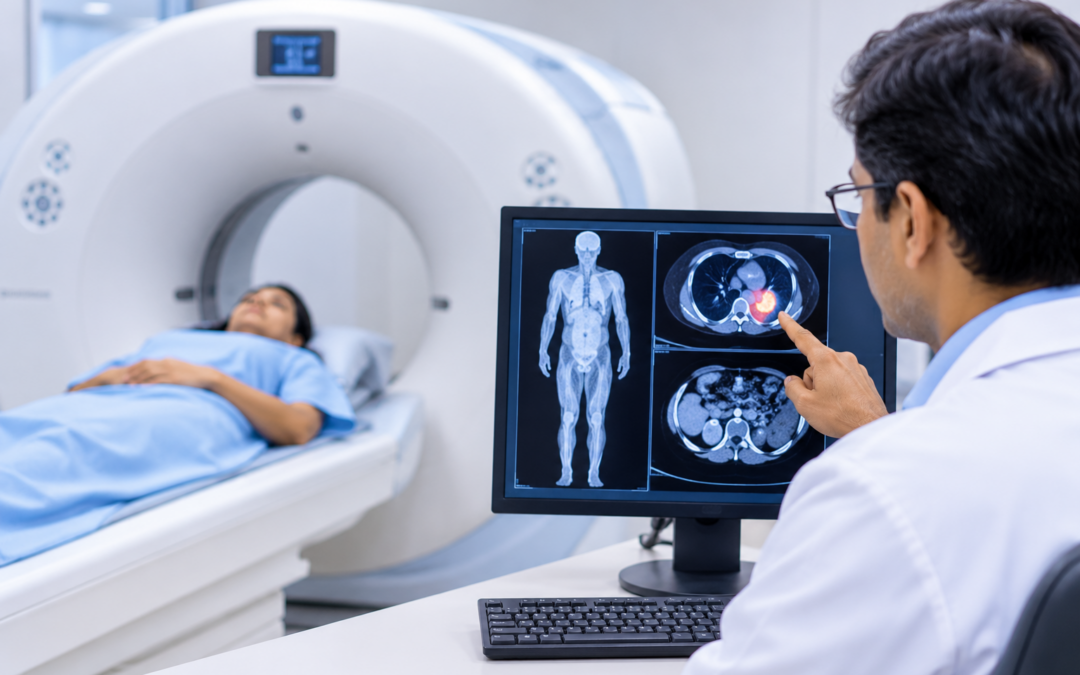
No. A general full-body health check-up and a PET-CT scan are not reliable stand-alone tools for finding cancer in people who have no symptoms. A routine package of blood tests and scans can miss early tumours and can also flag harmless findings that lead to further testing, while a PET-CT is designed to stage a known cancer, not to search a healthy body. Early detection depends on proven cancer screening tests offered to the right people at the right age.
According to Prof. Dr. Sandeep Nayak, Surgical Oncologist in Bengaluru at MACS Clinic, many patients assume that a more expensive or more extensive check-up must be a safer one, and are surprised to learn that it can be less useful than a single targeted test. A normal full-body report can also give false reassurance and delay attention to symptoms that need review.
Unsure which cancer screening tests you need? Consult a surgical oncologist for advice suited to your age and risk.
Can a Full-Body Health Check-Up or PET-CT Scan Reliably Detect Cancer Early?
- A general check-up. Packages of blood tests, ultrasound and X-ray are not designed to find early cancer. Tumour markers such as CA-125, CEA and CA 19-9 can be normal in early cancer and raised in harmless conditions, so they are unreliable for screening.
- What PET-CT can miss. It picks up tissue that takes up sugar quickly. Very small tumours, slow-growing ones and some cancers that take up little sugar, including many prostate, kidney and bladder cancers, can be missed.
- False alarms. Infection, inflammation and normal tissue can also light up. The result is repeat scans, biopsies, cost and anxiety, sometimes over something that was never a threat.
- Radiation. A PET-CT combines a radioactive tracer with a CT scan. The FDA notes that CT has never been approved for screening the whole body, and that the radiation carries a small cancer risk of its own.
- No proven benefit. Professional medical societies do not recommend whole-body scanning for people without symptoms, because harm from over-investigation can outweigh any gain.
- Where PET-CT does help. In staging a known cancer, checking how it responds to treatment and looking for a recurrence
Which Cancer Screening Tests Are Proven to Work?
- Breast. Mammography, generally from the age of 40 to 45 onwards, with a clinical breast examination.
- Cervix. An HPV test or a Pap smear at the intervals advised for your age.
- Colon and rectum. A stool-based test or a colonoscopy, usually starting at about 45 to 50 years. See the colon cancer treatment page for symptoms that should not wait for screening.
- Mouth. A visual oral examination for people who use tobacco or areca nut, which is where oral cancer screening matters most.
- Lung. A low-dose CT scan, but only for long-term heavy smokers in roughly the 50 to 80 age group. A PET-CT is not a substitute.
- Prostate and high-risk groups. A PSA test is discussed with a doctor rather than done as a blanket test. People with a strong family history or an inherited syndrome such as BRCA or Lynch syndrome need earlier and more specific screening.
What Determines Which Cancer Screening Tests You Need?
Four things decide it.
Your age and sex. Each screening test is proven for a certain age range and for certain people, and starting too early or too often adds harm without benefit.
Your personal risk factors. Tobacco and areca nut use, alcohol, HPV infection, obesity, hepatitis and earlier radiation each raise the risk of particular cancers.
Your family and genetic history. Close relatives with breast, ovarian, colon or other cancers can move your screening to an earlier age or to a different test.
Whether you have symptoms. Screening is for people who feel well. A lump, bleeding, a cough that persists or unexplained weight loss needs a proper diagnostic work-up, not a screening package. More cancer topics are on the Dr. Nayak blogs page.
Frequently Asked Questions
Can a full-body health check-up detect cancer early?
Not reliably, as general check-ups are not designed to find early cancer and can miss tumours or raise false alarm
Can a PET-CT scan detect cancer before symptoms appear?
Not reliably, as it can miss small or slow-growing tumours and is meant for staging a known cancer, not for screening healthy people.
Which cancer screening tests are proven to work?
Mammography for breast cancer, HPV or Pap tests for cervical cancer, stool tests or colonoscopy for colorectal cancer, and low-dose CT for high-risk smokers.
When is a PET-CT scan useful?
When cancer is already suspected or diagnosed, to stage it, check the response to treatment and look for recurrence.
References
- U.S. Food and Drug Administration (U.S. Government). Whole-Body CT Screening: Should I or shouldn’t I get one? https://www.fda.gov/radiation-emitting-products/medical-x-ray-imaging/whole-body-ct-screening-should-i-or-shouldnt-i-get-one
Explains the risks and lack of proven benefit of whole-body scans for people without symptoms. - National Cancer Institute (U.S. Government). Cancer Screening. https://www.cancer.gov/about-cancer/screening
Describes the screening
Disclaimer: This blog is for informational and educational purposes only and is not a substitute for professional medical advice or diagnosis.
