
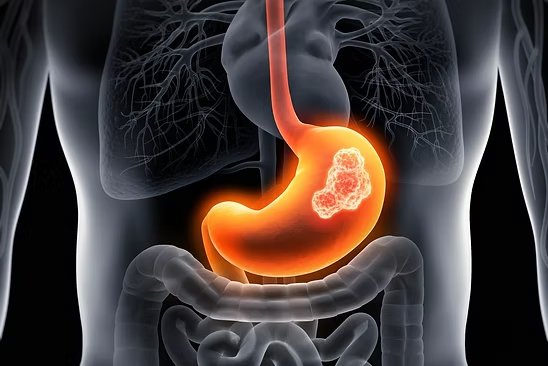
Gastric adenocarcinoma and gastrointestinal stromal tumour arise in the same organ but represent entirely distinct diseases. Separate cellular origins, separate molecular drivers, separate treatment protocols. Chemotherapy that works for stomach cancer has no activity in GIST. Imatinib that works for GIST has no role in gastric adenocarcinoma. The pathology report determines which treatment the patient receives, and getting that wrong has direct clinical consequences.
According to Prof. Dr. Sandeep Nayak, Surgical Oncologist in India, “GIST and gastric adenocarcinoma are two separate malignancies arising in the same anatomical location. Immunohistochemistry must confirm the diagnosis before any systemic treatment decision is made. Applying gastric chemotherapy to a GIST produces no response. The pathology drives everything here and it cannot be assumed.”
Accurate pathological diagnosis determines the entire treatment pathway. It cannot be assumed.
What Makes Stomach Cancer and GIST Clinically Distinct?
The distinction runs across cellular origin, molecular biology, surgical scope and systemic treatment response.
- Cellular origin: Gastric adenocarcinoma arises from the glandular epithelium of the mucosal lining. GIST arises from the interstitial cells of Cajal within the muscle wall. Different cell. Entirely different tumour biology.
- Molecular driver: Gastric cancer is driven by H. pylori, HER2 amplification and chromosomal instability. GIST is driven by KIT or PDGFRA tyrosine kinase mutations in over 85 percent of cases — that targetable mutation is what makes imatinib work. Gastric cancer has nothing equivalent.
- Lymph node involvement: Gastric adenocarcinoma spreads to regional lymph nodes consistently, making D2 lymphadenectomy standard. GIST rarely involves lymph nodes at all. Dissecting them in a GIST resection adds morbidity with no oncological return.
- Chemotherapy response: FLOT, FOLFOX and DCF are active in gastric adenocarcinoma. GIST is chemoresistant. Standard cytotoxic chemotherapy has no meaningful activity in GIST and should not be used.
For patients with either diagnosis requiring minimally invasive surgical resection, robotic cancer surgery enables precise D2 lymphadenectomy for stomach cancer and margin-negative wedge resection for GIST.
Stomach Cancer vs GIST: Treatment Comparison
|
Feature |
Gastric Adenocarcinoma |
GIST |
|
Cell of origin |
Mucosal epithelium |
Interstitial cells of Cajal |
|
Molecular driver |
HER2, TP53, chromosomal instability |
KIT or PDGFRA mutation |
|
Surgical approach |
Gastrectomy with D2 lymphadenectomy |
Wedge resection, no lymphadenectomy |
|
Systemic treatment |
FLOT chemotherapy, trastuzumab if HER2 positive |
Imatinib tyrosine kinase inhibitor |
|
Chemotherapy response |
Responds to standard cytotoxic regimens |
Chemoresistant |
|
Prognosis determinants |
Stage, nodal burden, surgical margins |
Tumour size, mitotic rate, location |
- Surgical scope differs significantly: Gastric cancer needs D2 lymph node clearance because nodal metastasis determines both staging and prognosis. GIST needs only a clear surgical margin. Adding lymphadenectomy to a GIST resection is unnecessary and harmful.
- Imatinib works only in GIST: It blocks the mutant KIT or PDGFRA driving tumour proliferation. High-risk GIST patients take it for three years after surgery and advanced disease responds in over 80 percent of cases. In gastric adenocarcinoma it has no role whatsoever.
- HER2 is gastric cancer territory: Around 15 to 20 percent of gastric adenocarcinomas overexpress HER2, qualifying those patients for trastuzumab alongside chemotherapy. In GIST, HER2 testing carries no clinical relevance.
- Both can occur together: GIST and gastric adenocarcinoma can present simultaneously in the same patient. Each needs independent pathological confirmation and its own treatment plan even when a single surgical operation addresses both.
For patients wanting to recognise early clinical warning signs that prompt the endoscopic investigations identifying these tumours, our blog on stomach cancer warning signs covers the symptom profile in clinical detail.
Why Choose Dr. Sandeep Nayak for Stomach Cancer and GIST Treatment?
Dr. Sandeep Nayak has spent 24 years in surgical oncology. He holds DNB qualifications in Surgical Oncology and General Surgery, plus a fellowship in Laparoscopic and Robotic Onco Surgery. He has published clinical research on GIST and imatinib in locally advanced cases in Indian patients, performs robotic gastrectomy with D2 lymphadenectomy for gastric adenocarcinoma and margin-negative wedge resection for GIST, and presents every upper gastrointestinal tumour to the tumour board before treatment planning begins.
Misclassifying GIST as gastric adenocarcinoma is not a documentation error — it is a treatment error. Whether the patient receives imatinib or FLOT depends entirely on immunohistochemistry including CD117, DOG1 and HER2, and that distinction is confirmed at the first consultation at MACS Clinic. Call +91 8104310753 to book your consultation.
Frequently Asked Questions
Is GIST the same as stomach cancer?
No, GIST arises from muscle cells and stomach cancer from the mucosal lining.
Is chemotherapy used for GIST?
No, GIST does not respond to standard chemotherapy but responds to imatinib.
Can GIST and stomach cancer occur together?
Yes, they can coexist simultaneously in the same stomach.
What is the main treatment difference between GIST and stomach cancer?
Stomach cancer uses surgery plus chemotherapy while GIST uses surgery plus imatinib.
References:
- National Institutes of Health — Imatinib Treatment for Gastrointestinal Stromal Tumour: https://pmc.ncbi.nlm.nih.gov/articles/PMC3837608/
- PubMed Central — 2023 GEIS Guidelines for Gastrointestinal Stromal Tumors: https://pmc.ncbi.nlm.nih.gov/articles/PMC10467260/
Disclaimer: This blog is intended for educational and informational purposes only and does not substitute professional medical advice, diagnosis or treatment.
