
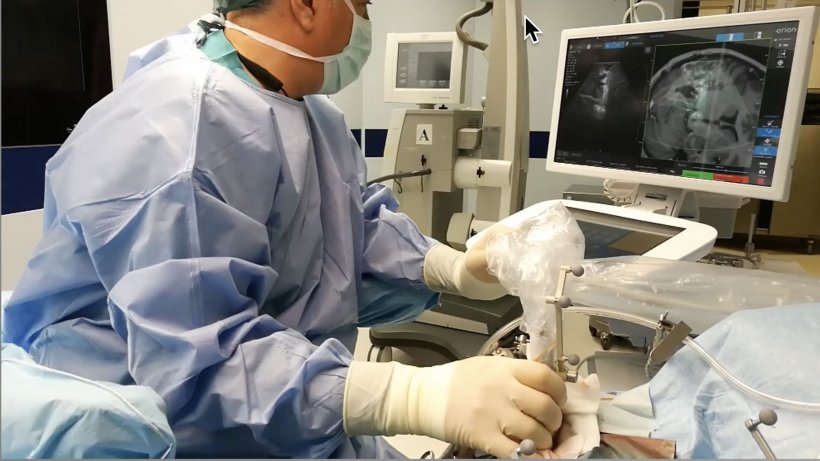
Intraoperative ultrasound is imaging done live, during the operation itself. The surgeon places an ultrasound probe directly on the organ to see inside it in real time. It shows tumours, blood vessels and structures that scans before surgery can’t fully map. The point is simple: see exactly what’s there, right when it matters most.
According to Dr. Sandeep Nayak, Surgical Oncologist in India, “Scans done before surgery are a plan, not a live map. Once we’re operating, things shift, and a small tumour deep in the liver can be impossible to feel. Intraoperative ultrasound lets us look inside the organ as we work. It finds what the hands can’t, and it keeps us off the vessels we need to protect.”
Want to understand how modern cancer surgery achieves its precision?
How Does It Work?
A probe goes straight onto the organ, and the surgeon reads the picture as the operation unfolds.
- Direct contact : The sterile probe touches the organ itself, not the skin. That closeness gives far sharper images than a scan from outside.
- Real time : The picture updates live as the surgeon moves. No waiting, no guessing from an image taken hours earlier.
- No radiation : It uses sound waves, not X-rays. So it can be used freely during surgery without any radiation worry for anyone in the room.
- Finds the hidden : A small tumour buried deep in tissue, invisible and impossible to feel, shows up clearly on the screen.
This kind of precision underpins modern robotic cancer surgery, where seeing inside the organ in real time changes what the surgeon can safely do.
Where Is It Most Useful?
Some operations lean on intraoperative ultrasound far more than others, usually where tumours hide.
- Liver surgery : The biggest user. The liver hides tumours deep in its substance, and the probe finds every one before the surgeon cuts.
- Pancreas : Small tumours and the vessels around them are mapped precisely, which matters enormously in such a delicate area.
- Brain : Surgeons use it to locate tumours and judge how much has been removed, all without moving the patient for a scan.
- Protecting margins : By showing the tumour edge in real time, it helps the surgeon take enough tissue without taking too much.
This is exactly how a clean surgical margin gets achieved in practice, by seeing the tumour boundary rather than estimating it.
Why Choose Dr. Sandeep Nayak for Cancer Surgery?
Dr. Sandeep Nayak is a surgical oncologist with 24 years behind him and a fellowship in laparoscopic and robotic onco-surgery. He uses real time imaging tools like intraoperative ultrasound where they genuinely improve precision, particularly in liver and complex abdominal cancer surgery. The approach is built on seeing clearly before cutting, since a tumour you can locate exactly is one you can remove completely. That clarity is what separates a good resection from an incomplete one.
Precision tools only matter in trained hands. Reading an ultrasound image mid surgery and acting on it instantly takes experience that comes from volume. Used well, it means smaller margins of error, better protection of healthy tissue, and a cleaner removal of the cancer. That combination of skill and the right technology is what drives a good surgical outcome.
Frequently Asked Questions
What is intraoperative ultrasound?
It’s real time ultrasound imaging used during surgery to locate tumours and guide the operation.
Why is intraoperative ultrasound used?
It finds tumours, maps blood vessels and helps the surgeon achieve clear margins.
Where is intraoperative ultrasound most useful?
It’s especially valuable in liver, pancreas and brain surgery where tumours sit hidden.
Does intraoperative ultrasound use radiation?
No. Ultrasound uses sound waves, so it adds no radiation during the operation.
References
- Intraoperative ultrasound applications and value — National Library of Medicine
- Intraoperative ultrasound implementation guide — National Library of Medicine
Disclaimer: This blog is for informational and educational purposes only and is not a substitute for professional medical advice or diagnosis.
