
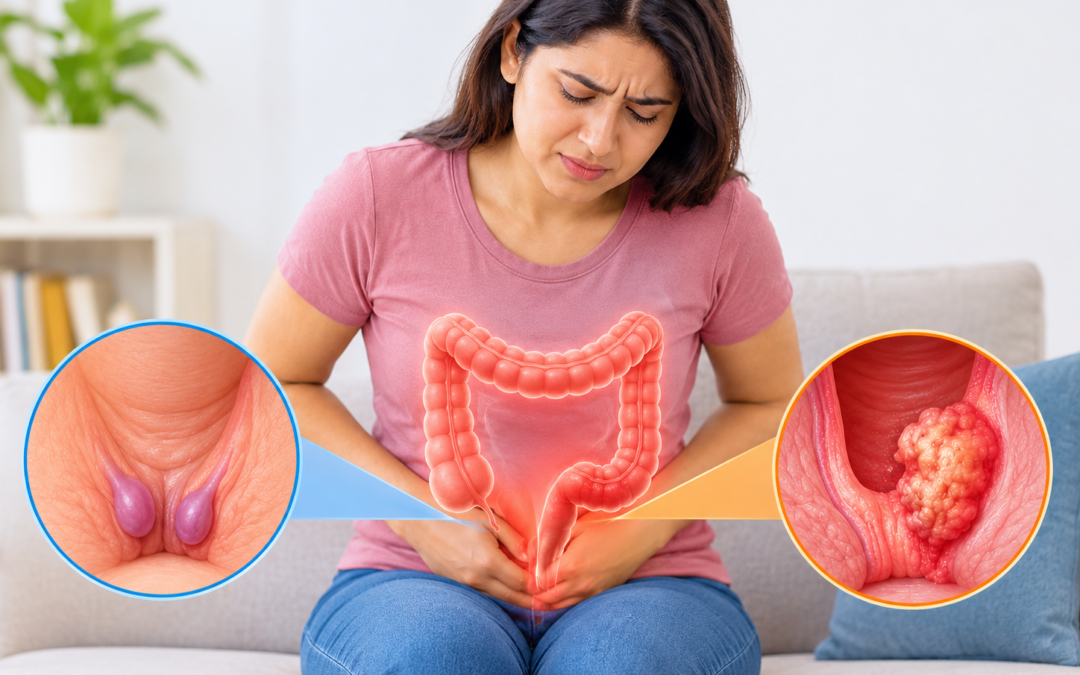
Rectal bleeding is a common symptom of piles and rectal cancer, which is why the two are often confused. They can also give discomfort around the anus, or the feeling of fullness in the rectum; however, their symptoms and onset are different. Symptoms are not sufficient to determine a clear diagnosis and can only be distinguished by a physical examination by a physician. Knowing how they differ makes it easier to decide when to seek an evaluation. This article will highlight those differences, the rectal cancer symptoms to monitor, and the factors that inform diagnosis and treatment.
According to Dr. Sandeep Nayak, Surgical Oncologist at MACS Clinic, Bangalore, “Blood in the stool is most often caused by piles, but it should never be assumed to be so. Bleeding that persists, comes with a change in bowel habit, or is accompanied by weight loss or tiredness needs to be examined. An early check is simple, and it is far easier on the patient than a late diagnosis.”
Seek advice on the evaluation and treatment of rectal cancer
How Is It Possible to Differentiate Between Piles and Rectal Cancer?
There are a few patterns that point in different directions. None of them is a substitute for an examination.
-
- The blood itself. Often toilet paper or the toilet is stained with fresh red blood when piles occur. The blood from the higher part of the bowel may be dark red or black. Colour alone is not a useful indicator as either condition can result in dark or bright blood.
- The link with straining. Bleeding from piles typically occurs during or immediately after stools, and is often accompanied by hard stools. Sometimes bleeding from a growth occurs without a trigger, and without pain.
- Pain and itching. Piles often cause itching, soreness and lumps around the anal area. Early rectal cancer may not cause any pain.
- Bowel habit. Piles rarely alter the way of going to the toilet. A permanent alteration of frequency, passing stool more often, constipation or the sensation of incomplete bowel movements are signs to look deeper.
- Other symptoms. Tiredness or breathlessness due to anaemia, weight loss and tummy pain may occur in patients with rectal cancer. These are not caused by piles.
- How long it lasts. Piles can flare up and may resolve on their own. A cancer shows signs or symptoms that do not go away or gradually become worse. N
When to Talk to the Doctor About Rectal Bleeding?
Although most cases of rectal bleeding will be due to piles, one should not assume this. In these cases an examination is needed.
-
- If bleeding occurs for the first time, especially after age 40. Bleeding for the first time should be checked, more especially in older folks or in combination with other symptoms. It happens less often in younger adults, but age doesn’t matter.
- Those symptoms that persist for 3 weeks or more. If this is the case, bleeding, altered bowel movement or abdominal pain must be evaluated.
- Bleeding plus a change in bowel movements. This is a heightened level of concern.
- Loss of weight, fatigue or shortness of breath. These may be the first signs of anaemia caused by a slow loss of blood.
- A relevant history. If there is a family history of bowel cancer (or your own family history of ulcerative colitis, Crohn’s disease or Lynch syndrome) then it is even more important to check early.
- Excessive bleeding requires immediate attention. If there are large clots, black/dark red stools or bleeding that does not stop, go to the hospital immediately.
What Is the Diagnosis and Treatment Plan Based On?
The evaluation process begins in the same manner for all, and the planning process that follows is based on the evaluation results.
- Examination. History, abdominal examination and a digital rectal examination (and sometimes proctoscopy) examine for the presence of piles as well as any growth in the lower part of the rectum.
- Scope test. When the cause is not apparent, colonoscopy or sigmoidoscopy allows the doctor to examine the rectum and colon and obtain a tissue sample.
- Biopsy. A tissue sample is the only way to determine if cancer is present.
- Scans and blood tests. If a diagnosis of cancer is made, an MRI scan of the pelvis, a CT scan and blood tests identify the extent of spread.
- If it is piles. The grade and symptoms determine the approach. Most piles can be treated with fibre, fluids and medicines and only banding or surgery is reserved for bigger or reoccurring piles.
- If it is rectal cancer. Treatment is dependent on the stage, distance from the anus and overall health of the individual. It can be combined with surgery and/or radiation or chemotherapy and, in some patients, can be performed to avoid a permanent stoma. There is a related page on colon cancer, which has some of the same symptoms.
Frequently Asked Questions
Do piles become cancer of the rectum?
No, piles don’t become cancer, but both can bleed simultaneously, so a check might be necessary.
What are the symptoms of rectal cancer?
Blood in poo, changes in bowel movement, incomplete bowel emptying, tummy pain, weight loss and fatigue.
Does all bright red blood come from piles?
No, bright red blood is not unusual when you have piles, but can also be when you have rectal cancer, so colour alone doesn’t prove it.
How can it be determined if it is piles or rectal cancer?
With a doctor’s examination and a scope test and biopsy if the cause is not known.
References
- Hemorrhoids. MedlinePlus, National Library of Medicine, National Institutes of Health. https://medlineplus.gov/ency/article/000292.htm
- Bowel cancer. nidirect, Northern Ireland Government. https://nidirect.gov.uk/node/10906
Disclaimer: This blog is for informational and educational purposes only and is not a substitute for professional medical advice or diagnosis.
