
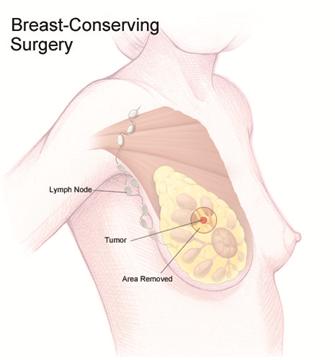
Breast conserving surgery removes the cancer and a margin of surrounding healthy tissue while leaving the rest of the breast in place. It’s also called lumpectomy or wide local excision and it’s the preferred surgical option for early-stage breast cancer when the tumour size, location and patient factors allow it. Radiation to the remaining breast tissue typically follows to bring local recurrence risk down to a level comparable with mastectomy.
According to Prof. Dr. Sandeep Nayak, Surgical Oncologist in India,
“Breast conserving surgery isn’t a compromise for the right patient it delivers the same survival outcome as mastectomy while preserving the breast, which matters significantly for quality of life after treatment.”
Want to know whether breast conserving surgery is possible for your case?
How Does Breast Conserving Surgery Work?
The operation focuses on removing the cancer with clear margins while keeping the breast shape as intact as possible throughout.
- Tumour Excision: The surgeon removes the tumour plus a rim of normal tissue around it called the surgical margin, which goes straight to pathology if cancer cells are found at the edge, a second operation to clear the margins is performed before radiation begins.
- Sentinel Node Assessment: Axillary lymph nodes are assessed through sentinel node biopsy in the same operation, giving the team nodal staging information without removing all nodes unless the sentinel node comes back positive and dissection criteria are met.
- Radiation Follows: Breast cancer treatment after breast conserving surgery almost always includes radiation to the remaining breast tissue, reducing local recurrence risk to a level that matches mastectomy outcomes in appropriately selected patients.
- Oncoplastic Techniques: When the tumour removal would leave a noticeable defect, oncoplastic reshaping rearranges surrounding tissue to restore breast form in the same operation, which produces significantly better cosmetic results than standard excision alone achieves.
Achieving clear margins is the non-negotiable oncological requirement everything else in the procedure is planned around meeting that standard without removing more tissue than necessary.
Who Qualifies for Breast Conserving Surgery?
Not every breast cancer patient is suitable and the clinical team assesses several specific factors before confirming conservation as the surgical plan.
- Tumour Size and Breast Volume: A small tumour in a reasonably sized breast where excision leaves enough tissue for an acceptable result is the ideal scenario when the tumour takes up too much of the available breast volume, achieving clear margins while preserving meaningful shape becomes technically unrealistic.
- Single Tumour Location: Breast conservation works best when disease is confined to one area multiple separate tumours in different quadrants of the same breast generally cannot be addressed through a single excision that preserves the breast adequately.
- No BRCA Mutation Driving Ongoing Risk: Women with confirmed BRCA mutations face continued high risk in the remaining breast tissue after conservation many choose mastectomy instead, though conservation remains an option for those who understand and accept that ongoing risk.
- Ability to Receive Radiation: Radiation to the remaining breast is standard after conservation and patients who cannot receive it due to prior chest radiation, pregnancy or connective tissue disease may not be suitable candidates regardless of tumour characteristics, and robotic cancer surgery teams assess this as part of pre-operative planning.
Patient preference matters too and women who qualify for conservation but prefer mastectomy for personal reasons are fully supported in that decision, and for more on what reconstruction involves after breast surgery, our blog on latissimus dorsi covers post-surgical options in detail.
Why Choose Dr. Sandeep Nayak for Breast Cancer Treatment ?
Dr. Sandeep Nayak brings 24 years of surgical oncology experience, DNB qualifications in Surgical Oncology and General Surgery and a fellowship in Laparoscopic and Robotic Onco-Surgery to every breast cancer surgical decision including conservation versus mastectomy planning. He heads Oncology Services across Karnataka and leads breast cancer surgery at KIMS Hospital, Bangalore, with originator credits for RABIT and over 25 published clinical studies. Patients wanting clarity on whether breast conservation is genuinely achievable for their case are seen here with every decision going through tumour board review. Call +91 8104310753 to book your consultation.
Frequently Asked Questions
Is breast conserving surgery as effective as mastectomy for survival?
For appropriately selected patients survival outcomes are equivalent between the two when radiation follows conservation.
How long does recovery from breast conserving surgery take?
Most patients return to normal activity within two to three weeks, considerably faster than mastectomy recovery.
Does breast conserving surgery leave visible scarring?
Some scarring is inevitable but oncoplastic techniques minimise visible deformity by reshaping the breast at the time of excision.
Can breast conserving surgery be offered after neoadjuvant chemotherapy?
When chemotherapy shrinks a tumour that was previously too large for conservation, the option becomes available after treatment response is confirmed.
References
-
- National Cancer Institute — Breast Cancer Surgery Options
- World Health Organization — Breast Cancer Treatment
- Disclaimer: The information shared in this content is for educational purposes and not for promotional use.
