
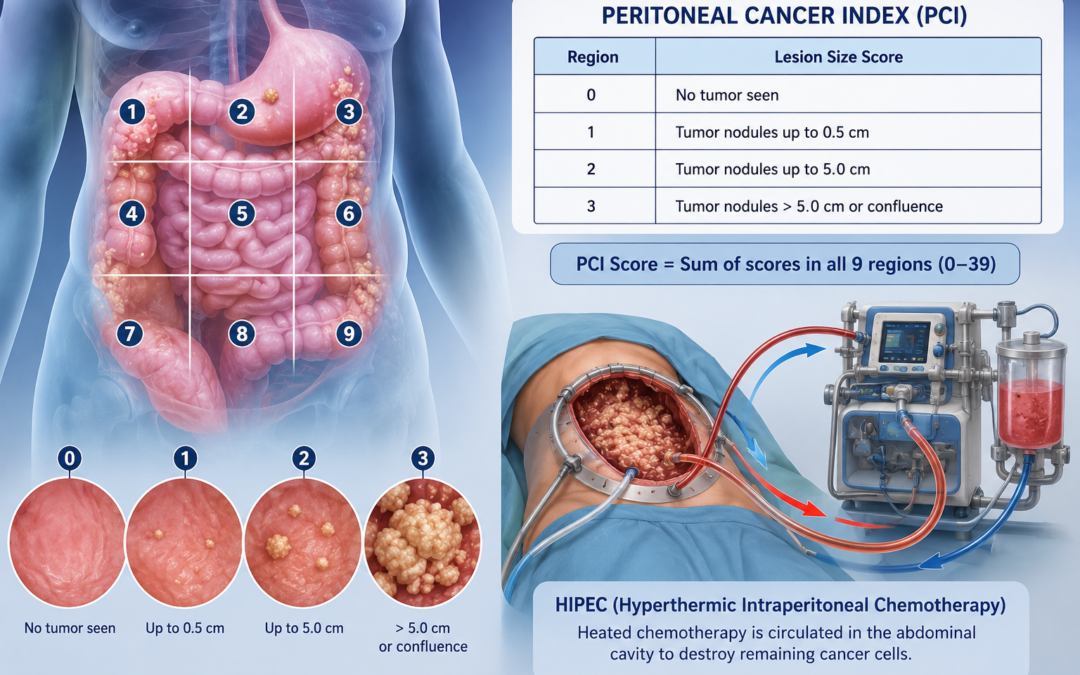
The Peritoneal Cancer Index, PCI for short, is a scoring system that runs from 0 to 39, and it’s how surgeons measure exactly how far cancer has spread across the inside of the abdomen. It’s not just a number for the file. This score is what actually decides whether cytoreductive surgery combined with HIPEC is a realistic option for a patient, or whether it isn’t.
According to Dr. Sandeep Nayak, surgical oncologist in Bangalore with over 24 years of experience treating solid tumors, “Patients hear HIPEC and assume it’s something we can just decide to do. It’s not that simple. PCI tells us how much disease is actually there, and past a certain point, surgery stops helping and starts adding risk without benefit. That number genuinely shapes the whole conversation.”
Wondering if your PCI score makes you a HIPEC candidate?
How the PCI Score Actually Works?
- The abdomen gets divided into 13 regions, and each one is scored from 0 to 3 based on the size of tumour deposits found there.
- Those 13 scores get added together, giving a total that lands somewhere between 0 and 39.
- A lower PCI generally means disease that’s more limited and contained, which is a better position for surgery to actually help.
- A higher PCI usually points to more widespread disease, and past a certain threshold, complete removal becomes unlikely.
This scoring directly shapes eligibility for HIPEC treatment, it’s one of the first things assessed before that conversation even goes further.
Why PCI Matters for Surgical Decision-Making?
- The whole goal of cytoreductive surgery is complete removal of visible disease, called CC-0, and PCI helps predict whether that’s realistically achievable.
- Cancer type matters too, the same PCI score can mean different things depending on whether it’s colorectal, ovarian, or appendix cancer.
- PCI is assessed through imaging first, then confirmed during surgery itself, since scans don’t always catch everything.
- A high PCI doesn’t automatically rule someone out, but it does change the conversation around risk, benefit, and realistic outcomes.
We’ve written more about what actually happens once someone’s confirmed as a HIPEC candidate in Life Expectancy After HIPEC Surgery, worth reading if PCI scoring already came up in your consultation.
Why Choose Dr. Sandeep Nayak ?
Dr. Sandeep Nayak has spent more than two decades in surgical oncology, and HIPEC candidacy assessments, PCI scoring included, have been a consistent part of that work. He currently serves as Chairman of Oncology Services for Karnataka and heads Surgical Oncology and Robotic Surgery at KIMS Hospital, Bangalore. What tends to matter most to patients isn’t the title though, it’s that he’ll tell you honestly if HIPEC is or isn’t the right path for your specific PCI and disease pattern, rather than offering a procedure that isn’t actually going to help. That honesty is often where things get missed elsewhere.
Not sure if your case qualifies for HIPEC based on your scans so far? Don’t wait to find out. Call +91 9482202240 and get someone to actually walk you through it.
Frequently Asked Questions
What PCI score is too high for HIPEC?
There’s no single universal cutoff, it varies by cancer type and centre, but very high scores generally mean complete removal becomes unlikely, which changes the risk-benefit picture significantly.
Is PCI the only thing that decides HIPEC eligibility?
No, cancer type, overall health, and how the disease has responded to any prior treatment all factor in alongside the PCI score.
Can PCI be measured before surgery?
Imaging gives an estimate beforehand, but the final, accurate score usually gets confirmed once surgeons can actually see inside during the operation.
Does a low PCI guarantee HIPEC will work?
No guarantee in medicine ever works that way, but a lower PCI generally means a better chance of complete removal, which is strongly linked to better outcomes.
References
- NCI — HIPEC (Hyperthermic Intraperitoneal Chemotherapy)
- Journal of Surgical Oncology — Patient Selection for CRS/HIPEC
Disclaimer: This blog is for informational and educational purposes only and is not a substitute for professional medical advice or diagnosis.
