
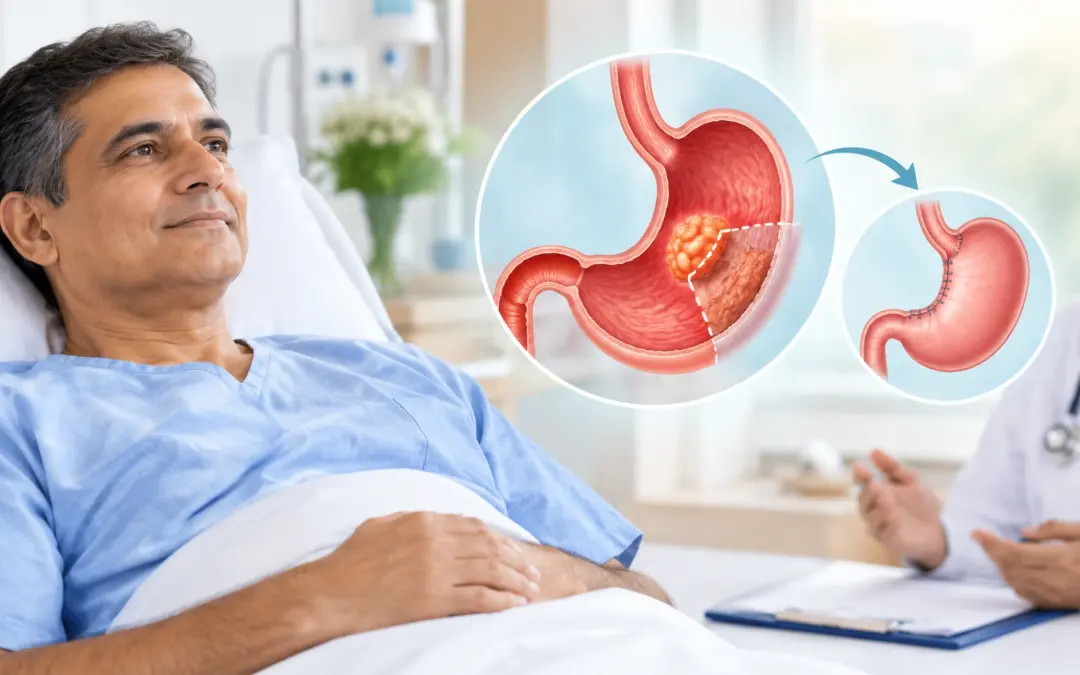
Yes, stomach cancer treatment without full stomach removal may be possible in some cases, but it depends largely on how early the cancer is detected and how deeply it has grown into the stomach wall. Early-stage cancers confined to the lower or upper portion of the stomach can often be treated with a partial gastrectomy, which removes only the affected section rather than the entire stomach.
According to Dr. Sandeep Nayak, surgical oncologist in Bangalore with over 24 years of experience treating solid tumors, “Patients assume a stomach cancer diagnosis automatically means losing the whole stomach, and that fear stops some of them from even getting evaluated properly. Location and depth decide this, not the diagnosis itself. A tumour confined to one part of the stomach, caught early, often doesn’t need total removal at all.”
Diagnosed with stomach cancer and unsure if full removal is really necessary? Book Appointment
Partial vs. Total Gastrectomy, What Decides Which?
|
Partial Gastrectomy |
Total Gastrectomy |
|
|
When it’s used |
Tumour confined to lower or upper stomach |
Tumour spans a large portion or is centrally located |
|
How much is removed |
Affected portion only, rest reconnected |
Entire stomach, oesophagus connected to small intestine |
|
Eating afterward |
Smaller meals, largely normal digestion over time |
Bigger adjustment, smaller frequent meals become essential |
|
Best candidates |
Early-stage, localised disease |
Larger, more advanced, or multi-site tumours |
|
Recovery |
Generally shorter |
Longer adjustment period, ongoing nutritional monitoring |
This decision runs through the same Stomach and Oesophageal Cancer treatment pathway, where imaging and staging determine which approach actually applies to a given case.
What Actually Gets Assessed Before Deciding?
- Tumour location matters most, cancers in the lower stomach are far more likely to be candidates for partial removal than ones in the middle or spanning multiple regions.
- Depth of invasion into the stomach wall changes the calculation significantly, deeper invasion generally pushes toward more extensive removal.
- Lymph node involvement, checked during staging, factors heavily into how much surrounding tissue needs to come out along with the tumour.
- Overall health and nutritional status also weigh into what a patient can safely tolerate and recover well from.
This staging and decision process ties closely into how laparoscopic and minimally invasive approaches are increasingly used for early and locally advanced gastric cancer, worth reading if you’re weighing surgical approach as well as extent of removal.
Why Choose Dr. Sandeep Nayak for Cancer Care in Bangalore??
Dr. Sandeep Nayak has spent more than two decades in surgical oncology, and stomach cancer cases, from early localised disease to more extensive tumours, have been part of that work throughout. He currently serves as Chairman of Oncology Services for Karnataka and heads Surgical Oncology and Robotic Surgery at KIMS Hospital, Bangalore. What tends to matter most to patients isn’t the title though, it’s that the extent of surgery gets decided by what the disease actually requires, not by defaulting to the most extensive option out of caution. That precision is often where things get missed elsewhere.
Not sure if your case allows for partial removal instead of the whole stomach? Get clarity before assuming the worst. Call +91 9482202240 and get someone to actually walk you through it.
Frequently Asked Questions
Can I eat normally after a partial gastrectomy?
Largely yes, over time. Smaller, more frequent meals become the norm initially, but most patients adjust well within a few months.
Does a smaller surgery mean a lower chance of cure?
Not if it’s the right fit for the case. Partial gastrectomy for appropriately staged, localised disease achieves similar outcomes to total removal in the right candidates.
How is the decision between partial and total gastrectomy made?
Through imaging, endoscopic evaluation, and often confirmed further during surgery itself, tumour location and depth are the main deciding factors.
Is nutritional support needed after either type of surgery?
Yes, though total gastrectomy typically needs more structured long-term nutritional monitoring compared to partial removal.
References
- National Cancer Institute — Stomach Cancer Treatment: NCI: Stomach Cancer Treatment
- American Cancer Society — Surgery for Stomach Cancer: American Cancer Society: Surgery for Stomach Cancer
Disclaimer: This blog is for informational and educational purposes only and is not a substitute for professional medical advice or diagnosis.
