
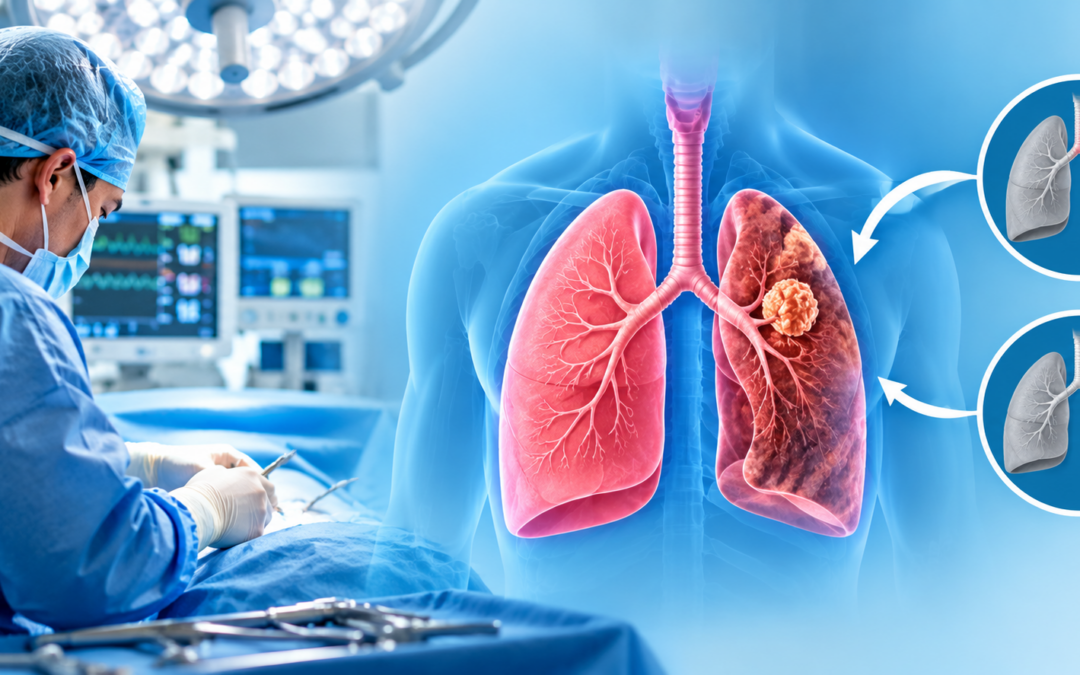
Not necessarily Lung cancer surgery only removes the entire lung, a procedure called pneumonectomy, in specific situations, usually when a tumour is large or sits too centrally to spare surrounding lung tissue. Most operations aim to remove as little healthy lung as possible while still clearing the cancer completely.
According to Dr. Sandeep Nayak, surgical oncologist in Bangalore with over 24 years of experience treating solid tumors, “Patients hear lung cancer surgery and assume they’re losing the whole lung, and that fear alone stops some of them from even pursuing surgery. That’s genuinely not the usual outcome. Most cases only need a lobe removed, sometimes even less, and a well-planned operation protects as much breathing capacity as the cancer allows.”
Facing lung cancer surgery and worried about losing the whole lung?
Types of Lung Cancer Surgery : How Much Gets Removed ?
| Procedure | What Gets Removed | When It’s Used |
| Wedge resection | A small, localised piece of lung tissue | Very small, early tumours in select cases |
| Segmentectomy | One or more segments, more than a wedge, less than a lobe | Small tumours, roughly 2cm or under |
| Lobectomy | One full lobe of the lung | Standard approach for most operable lung cancers |
| Pneumonectomy | The entire lung | Large or centrally located tumours where lesser removal isn’t safe |
If lung cancer surgery is already on the table for your case, our Lung Cancer treatment page covers how the extent of surgery actually gets decided.
What Determines How Much Lung Gets Removed
- Tumour size and location matter most, a small tumour tucked in one segment allows far more lung to be preserved than one sitting near major airways.
- Lung function testing beforehand checks whether a patient can safely tolerate losing more tissue, this genuinely shapes what’s offered as an option.
- Lymph node involvement and how the cancer has spread locally also factor into how much surrounding tissue needs to come out.
- Minimally invasive approaches like VATS don’t change how much lung gets removed, but they do reduce the trauma of getting there.
We’ve written more about how this minimally invasive approach actually works in What Is VATS Surgery for Lung Cancer?, worth reading if the surgical approach itself is what’s on your mind.
Why Choose Dr. Sandeep Nayak for Cancer Care in Bangalore?
Dr. Sandeep Nayak has spent more than two decades in surgical oncology, and lung cancer surgery, planned specifically to preserve as much healthy tissue as the disease allows, has been a consistent part of that work throughout. He currently serves as Chairman of Oncology Services for Karnataka and heads Surgical Oncology and Robotic Surgery at KIMS Hospital, Bangalore. What tends to matter most to patients isn’t the title though, it’s that removing the whole lung only happens when it’s genuinely necessary, not as a default starting point. That precision is often where things get missed elsewhere.
Worried surgery means losing your whole lung? That’s rarely the case.
Call +91 9482202240 and get someone to actually walk you through it.
Frequently Asked Questions
Can someone live normally with just one lung?
Yes, many people adjust well after a pneumonectomy, though activity levels and breathing capacity do change, your team will guide what to expect specifically.
Is a lobectomy the most common lung cancer surgery?
Yes, it’s the standard approach for most operable lung cancers, offering a strong balance between removing the disease and preserving lung function.
Does minimally invasive surgery mean less lung gets removed?
Not necessarily, the amount removed depends on the tumour itself, VATS and robotic techniques change how surgeons access the lung, not how much tissue needs to come out.
How do doctors decide I'm fit enough for lung surgery?
Through lung function tests, cardiac evaluation, and overall fitness assessment, done before any surgical plan gets finalised.
References
- American Cancer Society — Surgery for Non-Small Cell Lung Cancer
- National Cancer Institute — Types of Lung Cancer Surgery
Disclaimer: This blog is for informational and educational purposes only and is not a substitute for professional medical advice or diagnosis.
