
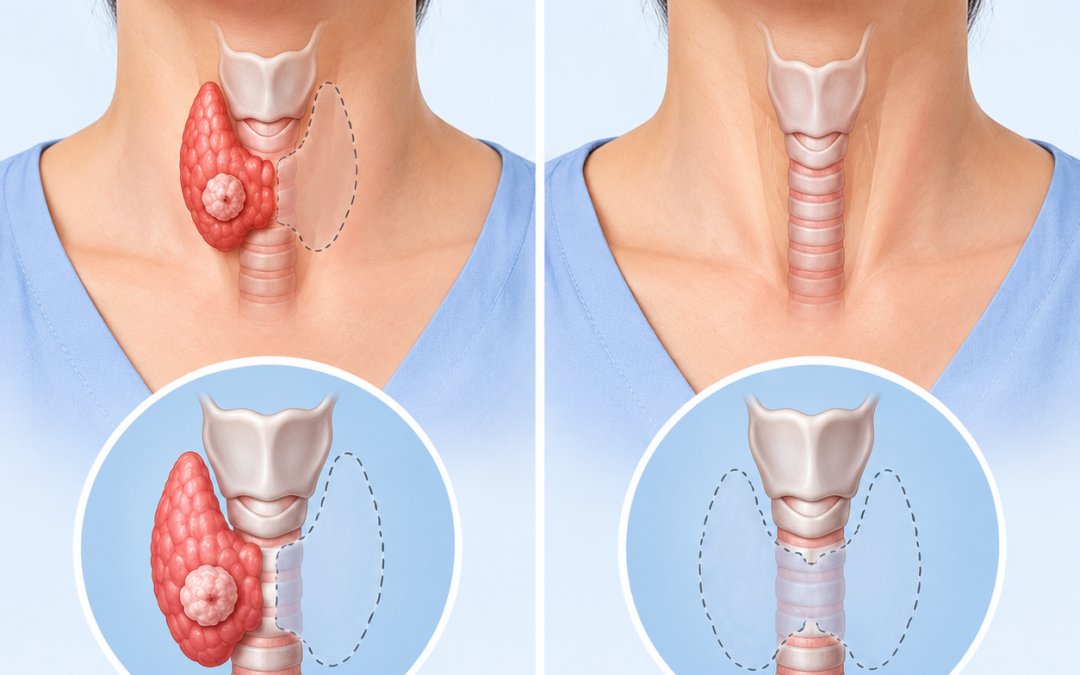
Which operation is needed depends mainly on the size of the tumour, the risk level and whether it has spread. Hemithyroidectomy removes one lobe of the thyroid, and total thyroidectomy removes the whole gland. Small, low risk papillary thyroid cancers often need only the lobe with the tumour. Larger tumours, spread beyond the thyroid or involved lymph nodes usually call for total thyroidectomy. The final advice is made case by case.
Prof. Dr. Sandeep Nayak, Surgical Oncologist at MACS Clinic, Bangalore, explains how the extent of thyroidectomy is decided for papillary thyroid cancer. “The operation is matched to the cancer. Tumour size, spread beyond the thyroid and lymph node findings guide the extent of surgery. A smaller operation suits some low risk tumours. A larger one suits others. Neither is the better choice in every case.”
For information about keyhole and open surgery options for cancer, you can contact the clinic at +91 9482202240.
What Is the Difference Between Hemithyroidectomy and Total Thyroidectomy?
Both remove thyroid tissue. What differs is how much, and what follows.
Hemithyroidectomy: One lobe, and sometimes the narrow bridge of tissue joining the lobes, is removed. The other lobe stays and often keeps making enough thyroid hormone.
Total thyroidectomy: The whole gland is removed. Daily thyroid hormone tablets are needed for life afterwards.
Radioactive iodine: This treatment is given after total thyroidectomy when it’s needed. It generally isn’t given after hemithyroidectomy alone.
Second operation: If the final pathology report shows higher risk features, the other lobe may be removed in a second operation, called completion thyroidectomy. For low risk findings it’s not always needed.
Risks: Low calcium and voice changes are more likely after total thyroidectomy than after removing one lobe. These risks are part of the planning. Our page on thyroid cancer treatment covers the options.
How Do the Two Operations Compare?
The table sets out the main differences side by side.
|
Feature |
Hemithyroidectomy |
Total thyroidectomy |
|
Thyroid removed |
One lobe, sometimes with the isthmus |
The whole gland |
|
Usually considered for |
Small, low risk tumours confined to the thyroid, with no node spread |
Larger tumours, spread beyond the thyroid, involved nodes or tumours in both lobes |
|
Thyroid hormone tablets afterwards |
Sometimes |
Always |
|
Radioactive iodine afterwards |
Generally not given |
Can be given when needed |
|
Risk of low calcium and voice changes |
Lower |
Higher |
Under 1 cm: For a small tumour confined to the thyroid, with no node spread, guidelines advise removing one lobe unless there’s a clear reason to remove both.
Between 1 and 4 cm: Either operation can be appropriate when the tumour hasn’t spread beyond the thyroid and no nodes are involved. Other risk factors and patient preference decide the choice.
Over 4 cm, or spread: A tumour over 4 cm, visible spread beyond the thyroid, involved lymph nodes or distant spread usually means total thyroidectomy.
Evidence: Studies of carefully selected low risk patients found limited surgery to be an equivalent strategy. Our blog on whether thyroid cancer is curable with surgery covers the outlook after treatment.
What Determines the Extent of Thyroid Surgery?
Several findings are weighed together before one operation is advised.
Tumour size and extent: Size, and whether the tumour has grown beyond the thyroid, are the main starting points.
Lymph nodes: Nodes that look involved on ultrasound or scans point toward total thyroidectomy.
Both lobes: Papillary cancer is often present in more than one spot. Tumours in both lobes, or nodules in the other lobe, make removing the whole gland more likely.
Other risk factors: Earlier radiation to the head or neck, a family history of thyroid cancer, or concerning findings on final pathology can change the advice. Patient preference counts too.
Surgical route: Robotic vs open thyroidectomy is a separate choice from the extent of surgery. Either route can be used for a lobe or the whole gland. Robotic surgery uses remote access, may take longer and suits selected patients. Our blog on robotic thyroidectomy covers this route.
Key Takeaways
- Hemithyroidectomy removes one lobe, and total thyroidectomy removes the whole gland.
- Small, low risk papillary thyroid cancers often need only the lobe with the tumour. Larger tumours, spread beyond the thyroid or involved nodes usually need total thyroidectomy.
- Total thyroidectomy needs lifelong thyroid hormone tablets and allows radioactive iodine when it’s needed.
- The right operation depends on the individual case, so it’s worth discussing the options with a specialist.
Frequently Asked Questions
Is hemithyroidectomy enough for papillary thyroid cancer?
Sometimes. It can be enough for small, low risk tumours confined to the thyroid.
When is total thyroidectomy advised for papillary thyroid cancer?
For tumours over 4 cm, spread beyond the thyroid, or involved lymph nodes.
Will I need thyroid hormone tablets after hemithyroidectomy?
Some people do. After total thyroidectomy, tablets are always needed.
Can a second operation be needed after hemithyroidectomy?
Yes, if final pathology shows higher risk features, the other lobe may be removed.
References
- National Center for Biotechnology Information — 2015 American Thyroid Association Management Guidelines for Adult Patients with Thyroid Nodules and Differentiated Thyroid Cancer: https://pmc.ncbi.nlm.nih.gov/articles/PMC4739132/
- National Center for Biotechnology Information — New Recommendations for Extent of Thyroidectomy and Active Surveillance for the Treatment of Differentiated Thyroid Cancer: https://pmc.ncbi.nlm.nih.gov/articles/PMC5538727/
Disclaimer: This blog is for informational and educational purposes only and is not a substitute for professional medical advice or diagnosis.
