
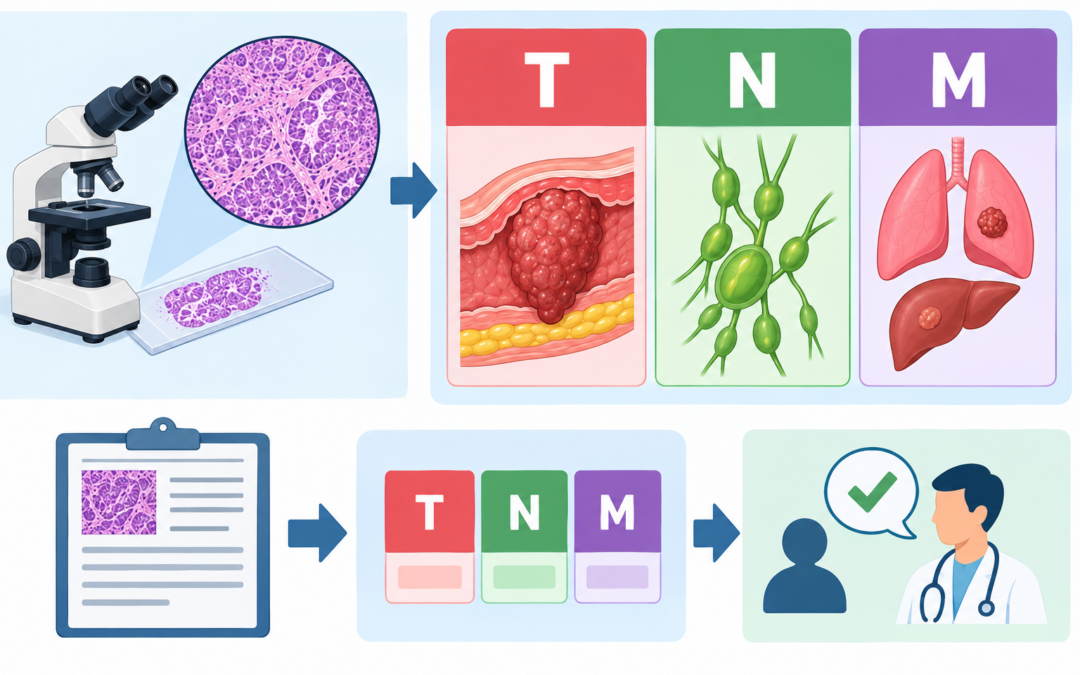
A histopathology report provides important information about a cancer diagnosis, including the tumour type, grade, margins, lymph node involvement, and TNM stage. TNM staging describes the extent of cancer by assessing the primary tumour (T), nearby lymph nodes (N), and whether the cancer has spread to distant parts of the body (M). Understanding these sections can help patients interpret their report and discuss the results more clearly with their doctor.
According to Prof. Dr. Sandeep Nayak, a surgical oncologist who reviews TNM staging codes on pathology reports daily, “Patients read the diagnosis line. Then stop. That’s the mistake. Grade, margins, lymph node count, all of it shapes the treatment plan, not just that one word at the top. I’d rather sit with a patient and go through their own report than send them home with a label and nothing else.”
Holding a histopathology report full of codes you can’t quite decode?
What Are the Key Sections of a Histopathology Report?
A pathology report follows a fairly consistent structure, even though the medical terms inside it vary by cancer type.
Gross description. What the tissue sample actually looked like, physically, before anyone put it under a microscope. Size, weight, colour, any visible masses.
Microscopic description. How the cells look once magnified. This includes differentiation, basically how much the cancer cells still resemble normal ones.
Tumour grade. A score for how abnormal the cells look, and how fast the cancer’s likely to grow. Says nothing about how far it’s spread though.
Margins and lymph nodes. Did cancer cells reach the cut edge of the tissue. How many lymph nodes were checked, and how many came back positive.
Making sense of all this, alongside imaging, is really what a full evaluation comes down to. Our page on surgical oncology consultation covers how that gets put together.
How Does TNM Staging Appear on Your Report?
T, N and M each answer a different question, with a number attached to each.
T for tumour. A number, 1 through 4, for the size and local extent of the tumour. Tis marks very early, non-invasive disease.
N for nodes. Whether nearby lymph nodes contain cancer. N0 means none, higher numbers mean more spread.
M for metastasis. M0, no distant spread found. M1, the cancer’s reached other organs.
Clinical versus pathological staging. Lowercase c before TNM means staging from scans and exams. Lowercase p means it’s confirmed from tissue after surgery.
Staging doesn’t end at the report. It directly shapes what surgery can and can’t do. Our blog on cancer staging and how it determines surgery goes further into that connection
Why Choose Prof. Dr. Sandeep Nayak for Cancer Diagnosis and Treatment Planning in Bangalore?
Prof. Dr. Sandeep Nayak has over 24 years in surgical oncology. Much of it spent turning complex pathology findings into treatment plans patients can actually follow. DNB, Surgical Oncology and General Surgery. MRCS from the UK. A fellowship in Laparoscopic and Robotic Onco Surgery too. He chairs Oncology Services across Karnataka now, and serves as Executive Director of Surgical Oncology and Robotic Surgery at KIMS Hospital, Bangalore. Every case goes through full tumour board review. Imaging, pathology, clinical findings, discussed together. Never read in isolation.
Patients get walked through their own report in plain language here, not handed a diagnosis line and left to figure out the rest alone. Call +91 9482202240 to book your consultation.
Frequently Asked Questions
What's actually in a histopathology report?
Everything the pathologist found after examining your tissue under a microscope.
What does T, N and M mean, exactly?
Tumour size, lymph node spread, distant metastasis. That’s the order.
What counts as a clear margin?
No cancer cells at the tissue’s edge. Suggests the whole tumour came out.
Can my stage change after the report?
Yes. Surgical findings sometimes push it up or down.
References
- National Cancer Institute — Pathology Reports Fact Sheet: https://cancer.gov/about-cancer/diagnosis-staging/diagnosis/pathology-reports-fact-sheet
- National Center for Biotechnology Information — Clinical and Pathological Staging Discrepancies in Laryngeal Cancer: A Systematic Review: https://pmc.ncbi.nlm.nih.gov/articles/PMC11815896/
Disclaimer: This blog is for informational and educational purposes only and is not a substitute for professional medical advice or diagnosis.
