
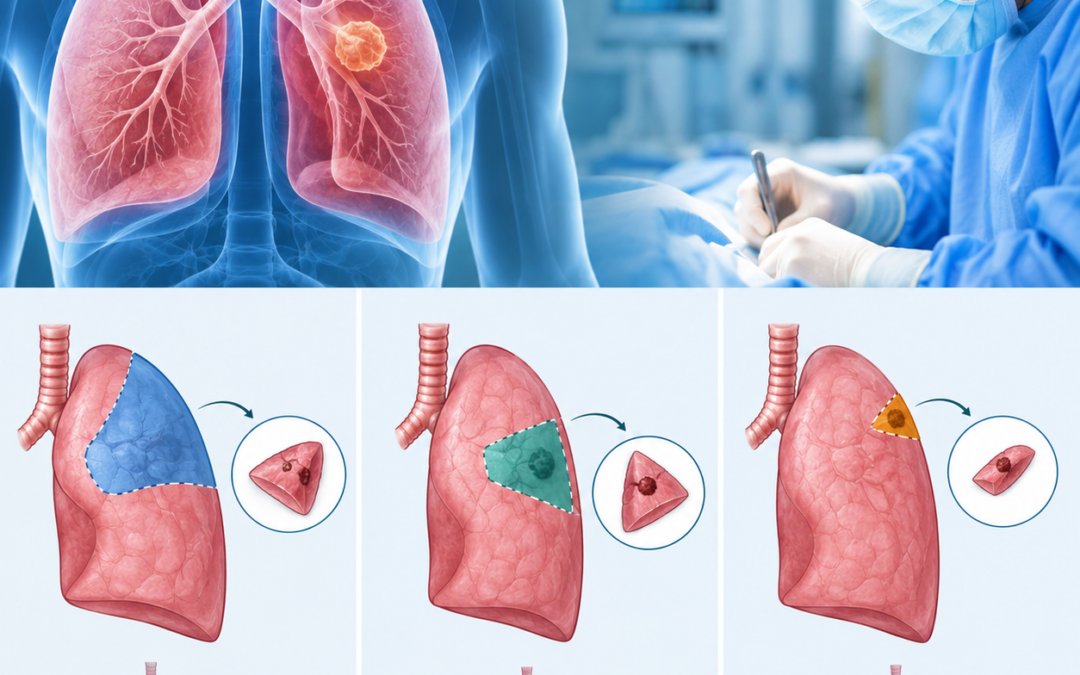
Most people hear “lung cancer surgery” and picture one operation. There are really three common ones, and what separates them is simple: how much lung leaves the body. A lobectomy takes a whole lobe. A segmentectomy takes a smaller piece of a lobe, a self-contained section with its own airway and blood supply. A wedge resection takes a small chunk around the tumour and doesn’t follow any of the lung’s natural lines.
Dr. Sandeep Nayak, a surgical oncologist in India, puts it this way: the operation should be cut to fit the tumour and the lungs, not the other way round. He won’t suggest a plan until the scans, the lymph node findings and the breathing tests are all on the table together.”
Confused by your scan or biopsy report? Call Clinic on +91 9482202240.
What Lobectomy, Segmentectomy and Wedge Resection Remove?
When the cancer hasn’t left the lung, surgery is usually the first option on the table in lung cancer treatment. Think of the lung as a tree. A lobectomy takes off a whole major branch. A segmentectomy prunes a smaller limb at the point where it joins. A wedge resection just cuts out the damaged part without worrying about where the branches split.
A lobectomy is the long-standing standard. The right lung has three lobes and the left has two, and the surgeon removes the one that holds the tumour. It’s the biggest of the three, and for years it was the default for any operable early cancer.
A segmentectomy is trickier to perform. The surgeon has to find that segment’s own bronchus, artery and vein, divide them one by one, and lift the segment out cleanly. The reward is that more healthy lung stays behind.
A wedge resection is the quickest and smallest. A stapling device cuts a wedge out and seals the edge as it goes. The catch is that nothing guarantees a generous rim of healthy tissue, so it depends heavily on where the tumour sits.
In all three, nearby lymph nodes are usually sampled or removed. What they show can change what happens next, so the surgeon doesn’t skip them.
And the technique is a separate question from the extent. Open surgery, VATS keyhole surgery or a robot can be used for any of the three.
Lobectomy vs Segmentectomy: What Guides the Choice?
Picture a typical case. A patient in their sixties has a 1.5 cm nodule near the outer edge of one lung, the lymph nodes look clear, and breathing tests are on the weak side after years of smoking. For that person, a segmentectomy often makes more sense than a lobectomy. Change one detail, say the nodule is 3.5 cm and close to the main airway, and the answer flips.
So what actually tips the decision?
Size and position matter most. Small tumours of around 2 cm or less in the outer lung are the best candidates for a smaller operation. Large ones, or ones near the centre of the chest, usually aren’t.
Lymph nodes come next. If they look involved on a scan, or turn out to be involved during surgery, the surgeon will often move to a lobectomy and clear the nodes more thoroughly.
The look of the tumour on CT counts too. A hazy “ground glass” appearance often means slow growth, which can justify taking less lung.
Then there’s the patient. Weak breathing reserve, heart trouble or other illness can make a smaller operation the safer choice, even when a lobectomy would otherwise be on the cards.
The research backs this up for carefully chosen cases. A large randomised trial looked at tumours up to 2 cm in the outer lung with clear nodes, and patients who had a smaller resection did about as well on disease-free survival as those who had a lobectomy.
Whether surgery can cure the cancer at all depends on stage, which our guide on whether lung cancer can be cured explains.
Where Wedge Resection Fits and What to Expect After Surgery?
How you recover depends on two things: how much lung came out, and how it was done. Robotic surgery and other keyhole methods mean smaller cuts and usually an easier few weeks than an open chest operation.
Wedge resection has a narrow but real role. It works for very small nodules near the edge of the lung, for cases where the surgeon needs tissue to confirm what the nodule actually is, and for patients too frail for anything bigger.
The margin is the whole story here. Take less tissue and you need a clear rim of healthy lung around the tumour. If that rim comes back too thin, the surgeon may extend the operation to a segmentectomy or lobectomy on the spot, which is why you’ll be asked to consent to that possibility beforehand.
When researchers went back to the data from the same North American trial, wedge resection came out worse on survival than either segmentectomy or lobectomy. The two bigger operations weren’t meaningfully different from each other. That’s a big reason surgeons lean toward segmentectomy over a wedge when a smaller operation is on the table and the patient can handle it.
Key Takeaways
- Lobectomy takes a whole lobe, segmentectomy takes one defined section of it, and wedge resection cuts out a small piece without following the lung’s structure.
- Size, position, lymph nodes and breathing ability do most of the work when choosing between lobectomy vs segmentectomy.
- For small tumours in the outer lung with clear nodes, smaller operations have held up well in trials.
- Wedge resection is only as good as its margin, so it’s reserved for carefully chosen patients.
- No one decides this from a single scan. The oncology team looks at the scans, the biopsy and the breathing tests together.
Frequently Asked Questions
Is segmentectomy as effective as lobectomy for lung cancer?
For the right patient, yes. That means a small tumour in the outer lung with clear lymph nodes. Outside that group, lobectomy is still usually the safer bet.
When is wedge resection used for lung cancer?
Mostly for very small nodules near the edge of the lung, or when a bigger operation simply wouldn’t be safe for the patient.
Does segmentectomy also remove lymph nodes?
Usually it does. The surgeon samples or removes the nearby nodes during the operation, since what they show helps decide the next step.
Can the planned lung surgery change during the operation?
It can. If the margin turns out too close, or the nodes look involved once the surgeon is inside, the operation may be extended. You’ll normally discuss this before you go in.
References
- NHS. Treatment for lung cancer (NHS Health A to Z). https://www.nhs.uk/conditions/lung-cancer/treatment
- Altorki N, Wang X, Kozono D, et al. Lobar or Sublobar Resection for Peripheral Stage IA Non-Small-Cell Lung Cancer. N Engl J Med. 2023;388(6):489-498. https://pubmed.ncbi.nlm.nih.gov/36780674/
Disclaimer: This blog is for informational and educational purposes only and is not a substitute for professional medical advice or diagnosis.
