
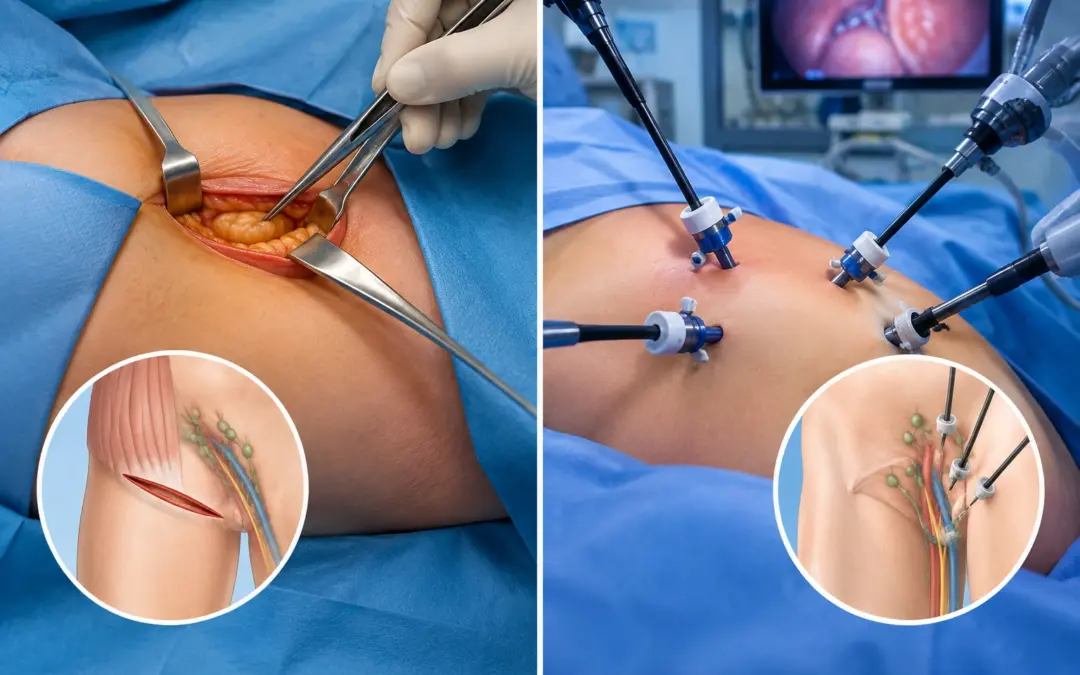
Compared with traditional open inguinal lymphadenectomy, endoscopic surgery is associated with fewer wound-related complications. The open procedure requires a long incision in the groin and the creation of skin flaps, increasing the risk of infection, skin breakdown, and fluid collection. In contrast, endoscopic surgery uses small incisions in the thigh, helping preserve the skin over the groin and reduce wound complications. However, it is not suitable for every patient, and the choice of approach depends on the type of cancer, the extent of lymph node involvement, and the patient’s overall condition.
According to Prof. Dr. Sandeep Nayak, a surgical oncologist who has worked on modified endoscopic techniques for inguinal lymphadenectomy, “The groin is an unforgiving place to cut. The skin is thin over the nodes, it folds and it moves, and the open operation puts all of that at risk. Going in through small cuts on the thigh protects the skin. In the right patient, that one change removes many of the wound problems we used to accept. The cancer still has to be cleared completely, though. That comes first.”
For Further Information about groin Lymph Node Dissection and its treatment options, call +91 9482202240.
Why Do Wounds Struggle After Open Groin Node Surgery?
The nodes sit just under a thin layer of skin, and open surgery has to lift that skin to reach them.
The skin flap: A large flap is raised off the nodes beneath. Its blood supply is disturbed, and the edges can die back.
The groin itself: Skin folds, moisture and constant hip movement make this a hard place for a wound to heal.
Lymph leakage: Cutting lymph channels lets fluid collect under the skin as a lymphocele or seroma.
Who needs it: Nodes are removed in penile cancer, vulvar cancer and melanoma of the leg when spread is present or likely.
In published open series, wound complications have been reported in roughly one in five to one in two patients. Our page on groin lymph node dissection explains who needs the operation and how it’s planned.
How Do Open and Endoscopic Inguinal Lymphadenectomy Compare?
|
Feature |
Open |
Endoscopic |
|
Incision and skin |
Long groin incision with a raised skin flap |
Small cuts on the thigh, groin skin left intact |
|
Wound infection |
Higher |
Lower in pooled studies |
|
Skin flap necrosis |
A recognised risk |
Lower in several meta-analyses |
|
Lymphocele and lymphedema |
Common |
Lymphocele similar, lymphedema lower in some analyses |
|
Hospital stay |
Longer |
Shorter in pooled data |
Wound infection: The clearest difference. Pooled studies show fewer infections after endoscopic surgery.
Skin necrosis: Fewer flap problems in several meta-analyses, since no large flap is raised. One recent review found no significant gap, so the picture isn’t uniform.
Lymph related problems: Lymphocele rates look similar between the two. Lymphedema is lower in some pooled results, not all.
Cancer control: Recurrence looks comparable in studies so far, but the evidence comes from small studies. Bulky nodes or skin involvement usually mean open surgery is still the safer choice.
For a fuller account of the operation itself, see our blog on what groin lymph node dissection involves
What Factors Determine the Choice Between Open and Endoscopic Surgery?
The choice between open and endoscopic inguinal lymphadenectomy depends on the type of cancer, the extent of lymph node involvement and the patient’s overall health. The surgeon also considers whether the lymph nodes are bulky, whether the surrounding skin is involved and whether adequate cancer clearance can be achieved using a minimally invasive approach.
Endoscopic techniques may reduce wound-related complications in selected patients by avoiding a large incision in the groin. However, they can also have limitations, particularly in cases involving extensive nodal disease. Open surgery may be more appropriate when the disease requires wider access or when the overlying skin is affected.
Both approaches have potential risks, including infection, fluid collection and lymphedema. The primary consideration is to select a technique that provides appropriate cancer treatment while taking the patient’s individual circumstances into account.
Frequently Asked Questions
Which has fewer wound complications, open or endoscopic?
Endoscopic. Pooled studies show fewer wound infections and often less skin necrosis.
Is endoscopic inguinal dissection as safe for cancer control?
Recurrence looks comparable so far, though the evidence comes from small studies.
Who needs inguinal lymph node dissection?
Patients with penile cancer, vulvar cancer or leg melanoma when groin nodes are involved.
Can everyone have the endoscopic approach?
No. Bulky nodes or skin involvement usually mean open surgery is safer.
References
- National Center for Biotechnology Information — Comparing the Perioperative and Oncological Outcomes of Open Versus Minimally Invasive Inguinal Lymphadenectomy in Penile Cancer: A Systematic Review and Meta-Analysis: https://pmc.ncbi.nlm.nih.gov/articles/PMC12468625/
- National Center for Biotechnology Information — Video Endoscopic Inguinal Lymphadenectomy for Radical Management of Inguinal Nodes in Patients With Penile Squamous Cell Carcinoma: https://pmc.ncbi.nlm.nih.gov/articles/PMC4944619/
Disclaimer: This blog is for informational and educational purposes only and is not a substitute for professional medical advice or diagnosis.
