
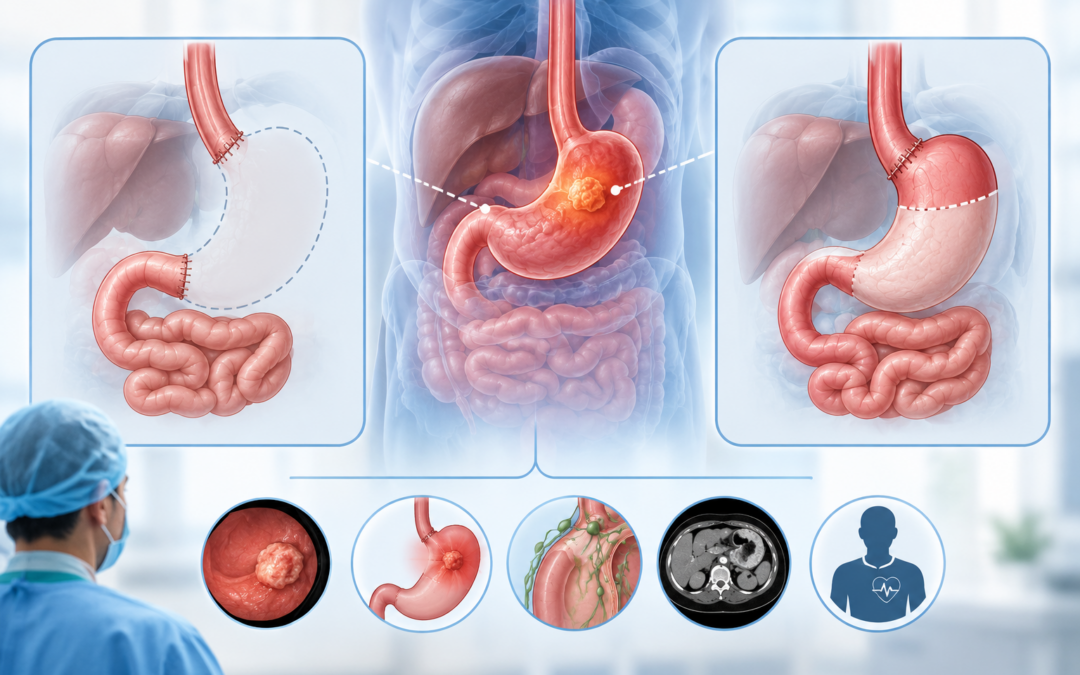
Most patients ask the same thing when surgery is advised for stomach cancer: how much of my stomach will be taken out? Put simply, there are two answers. Either all of it (total gastrectomy) or a part of it, usually the lower part (subtotal gastrectomy). Which one you get depends mostly on where the tumour is, how big it is and how it’s behaving. Doctors would rather save some stomach, because it helps with eating and nutrition later. But removing all the cancer always comes first. This is how total vs subtotal gastrectomy is decided.
According to Dr. Sandeep Nayak, a surgical oncologist in Bangalore, says you can’t name the exact operation from a diagnosis alone. The endoscopy, CT scan and biopsy come first, and even then the plan can still change during surgery, if the cut edge shows cancer.
If you have an endoscopy or biopsy report and want it explained, you may contact MACS Clinic on +91 9482202240.
What Total and Subtotal Gastrectomy Involve?
Surgery is a big part of stomach cancer treatment. Here is what each operation actually takes out.
- Total gastrectomy: Here the whole stomach goes, top to bottom, cardia and pylorus included. The food pipe is joined directly to the small intestine.
- Subtotal gastrectomy: A good part of the lower stomach is taken out together with the pylorus. What remains, a small upper pouch, is joined to the intestine.
- Lymph nodes: Neither operation is only about the stomach. The glands lying along its curves are cleared as well, since that is where the disease tends to travel first.
- Reconstruction: The intestine has to be reconnected after the stomach is out, otherwise food has nowhere to go. How? That depends on how much stomach is left.
- Proximal gastrectomy: Ever heard of a proximal gastrectomy? Only the upper stomach is removed. It is rare. Only a few early tumours high up are suitable for it.
Total vs Subtotal Gastrectomy: What Decides the Extent?
What does the oncology team look at? A few things, and always together.
- Tumour location: Low in the stomach? Then a subtotal gastrectomy is often possible. Middle or upper stomach? You’re more likely to need a total gastrectomy.
- A clear margin: The cut edge must be free of cancer. If a clear margin cannot be reached by removing only the lower stomach, the surgeon moves to a total gastrectomy. A frozen section, reported while you are still on the table, is sometimes sent to check.
- Size and depth: Big tumours need a wider cut, and so do tumours that have grown deep into the wall. Sometimes that leaves too little healthy stomach worth keeping.
- Pattern of spread: Some cancers, the diffuse type for instance, spread along the stomach wall. What you see on the surface may not show how far they have gone. So a larger resection may be needed.
- Nearby organs: If the tumour has reached the pancreas and surgery needs to remove part of it along with the spleen, a total gastrectomy is advised, wherever the tumour began.
What Determines Recovery and Nutritional Needs After Gastrectomy?
Recovery after gastrectomy depends on how much of the stomach is removed, the patient’s nutritional status and how well the body adapts to changes in digestion.
-
Extent of surgery: After subtotal gastrectomy, some stomach capacity remains. Total gastrectomy requires the digestive system to adapt to food passing directly from the oesophagus into the small intestine.
-
Meal planning: Small, frequent meals may help patients manage reduced food capacity and maintain adequate nutrition.
-
Vitamin and mineral levels: Vitamin B12 replacement is necessary after total gastrectomy. Iron, calcium and other nutritional levels may also need monitoring.
-
Digestive symptoms: Some patients experience dumping syndrome, cramps, sweating or diarrhoea after meals. Dietary adjustments can help manage these symptoms.
-
Follow-up care: Regular medical reviews, blood tests, weight monitoring and nutritional assessment help identify deficiencies and support recovery.
Key Takeaways
- Total gastrectomy means the whole stomach is removed; subtotal removes only the lower part.
- Where the tumour is, how big and deep it is, and how it spreads decide total vs subtotal gastrectomy.
- Removing all the cancer comes before saving stomach.
- Your surgeon may switch from subtotal to total during the operation if the margin isn’t clear.
- Eating and vitamin B12 needs change after both operations, so follow-up matters.
Frequently Asked Questions
Is subtotal gastrectomy always safer?
Not always. A clear margin matters more than how much stomach is saved.
Can the surgeon change the plan during the operation?
Yes. If the margin isn’t clear, more is removed
Can I live without a stomach?
Yes, with small meals, diet advice and vitamin B12 replacement.
Is subtotal the same as distal gastrectomy?
Mostly. Both mean the lower stomach is removed.
References
- Japanese Gastric Cancer Association. Japanese gastric cancer treatment guidelines 2018 (5th edition). Gastric Cancer. 2021;24(1):1-21. https://pmc.ncbi.nlm.nih.gov/articles/PMC7790804/
- Impact of Surgical Margins on Overall Survival after Gastrectomy for Gastric Cancer: A Validation of Japanese Gastric Cancer Association Guidelines on a Western Series. https://pmc.ncbi.nlm.nih.gov/articles/PMC8989928/
Disclaimer: This blog is for informational and educational purposes only and is not a substitute for professional medical advice or diagnosis.
