
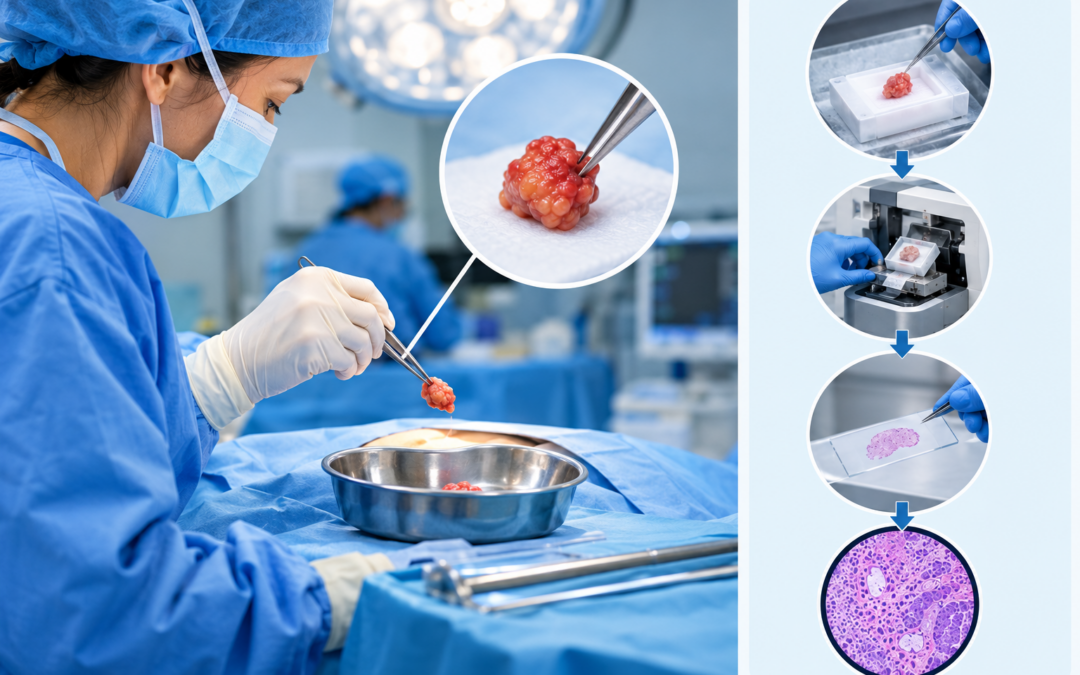
A frozen section is a quick tissue test performed during cancer surgery. A small sample is frozen, sliced very thin, and examined under a microscope while the patient is still in the operating room. It gives the surgeon a preliminary answer within minutes. This can help guide important decisions during the procedure and, in some cases, avoid the need for another surgery.
According to Prof. Dr. Sandeep Nayak, Surgical Oncologist in India, “A frozen section helps us make an important decision during surgery. It gives us a quick idea of what we’re dealing with at that moment. In some cases, this information can help us avoid another operation. It can make a real difference in planning the right treatment.”
Scheduled for cancer surgery and feeling unsure about what really happens in that operating room?
What Exactly Is a Frozen Section?
It helps to stop thinking of it as a biopsy you go home and wait on, and start seeing it as a test that’s racing the clock.
The Process Tissue is removed, quickly frozen, cut into very thin slices and stained, then read while your operation is still underway.
The Timing Usually ten to twenty minutes, next to a day or more for a standard pathology report.
The Purpose A quick, working answer the surgeon can act on straight away, not the final word on your diagnosis.
Pulling this off smoothly takes an experienced pathology team working shoulder to shoulder with skilled cancer surgeons, not a lab quietly doing its own thing somewhere down the corridor.
When Do Surgeons Actually Use It?
Most of the time, there’s one question that just can’t wait for tomorrow’s report.
Checking the Margins Did they get it all? The surgeon has to be sure the edge of the tissue they removed is clean. If cancer cells are still sitting at that edge, they take a little more out then and there.
Confirming the Diagnosis A lump nobody planned for sometimes shows up during an operation. Cancer or not? The surgeon won’t guess. The sample goes to the lab, and the frozen section comes back with a clear answer before anything else is done.
Lymph Node Status Has the cancer reached the nearby nodes? This one matters hugely in breast cancer. The answer often decides whether the surgery stays small or needs to go further.
Unknown Tissue Now and then something odd appears that doesn’t fit. One look under the microscope and the surgeon knows what it is. No guesswork, no operating blind.
That ability to get answers on the spot is a big part of why robotic and minimally invasive cancer surgery can be so precise. The surgeon works off facts, not a best guess.
Why Choose Prof. Dr. Sandeep Nayak?
Dr. Sandeep Nayak operates across breast, thyroid, head and neck and a lot more, the kinds of cases where a frozen section can change the plan halfway through. Where it fits, he uses a robotic and minimally invasive approach. The pathology side is sorted out in advance, not rushed on the day. And the calls he makes in the moment come from doing this work for years. He also heads Oncology Services across Karnataka.
Wanting to know what will actually happen once you’re in that operating room is a fair thing to ask before any cancer surgery. Call +91-9482202240 to book your consultation.
Frequently Asked Questions
What is a frozen section used for?
It gives the surgeon a fast diagnosis during the operation, usually to check margins, look at lymph nodes, or identify a piece of tissue nobody expected.
How long does a frozen section take?
About ten to twenty minutes. A standard pathology report takes a day or more.
Is a frozen section result final?
No. It guides what happens during the surgery. The permanent section done over the next few days gives the final diagnosis.
Is a frozen section biopsy accurate?
Yes, it’s right in the big majority of cases. The finer details just get confirmed later on permanent slides.
References
- National Cancer Institute (NCI) – Surgical Pathology Reports: Explains frozen sections, how tissue is rapidly frozen and examined during surgery, and how they provide a quick preliminary diagnosis.
NCI – Surgical Pathology Reports - College of American Pathologists (CAP) – Digital Frozen Sections in Surgical Pathology Practice: Provides professional information on frozen-section procedures and intraoperative consultation.
CAP – Digital Frozen Sections in Surgical Pathology Practice
Disclaimer: This blog is for informational and educational purposes only and is not a substitute for professional medical advice or diagnosis.
