
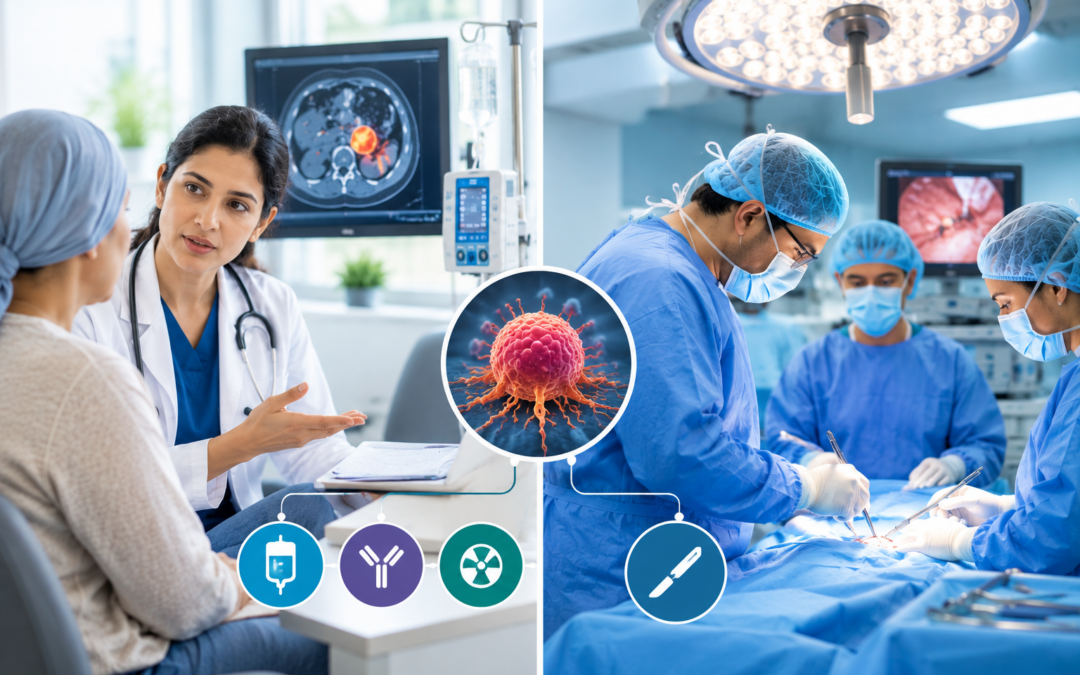
Ask a newly diagnosed patient what is troubling them and one question comes up early: oncology vs surgery, which one do I need? It is a fair question, but it is not a contest. Oncology is the whole subject of cancer care. Surgery is one of the things it uses. What separates them is reach: drugs go round in the blood and find cancer cells wherever they are hiding, while surgery works on one spot, the solid tumour and a little healthy tissue around it. The surgical oncologist sits where the two meet, and that is why oncology and surgical oncology get talked about together.
According to Dr. Sandeep Nayak, a surgical oncologist in Bangalore, nobody is really asked to pick between the two. Many solid tumours need both at some point. What changes from case to case is the sequence, and the cancer type, the stage and the patient’s fitness for surgery decide it.
Have a biopsy report or a scan and unsure what the next step is? You may contact Clinic on +91 9482202240.
Oncology vs Surgery: The Core Difference
Oncology is the field. Surgery is one tool inside it. At a cancer centre they sit side by side in one team of oncologists.
- Oncology: All of cancer care, from the first scan to the last follow-up visit. It has three main arms: medical, radiation and surgical.
- Medical oncology: The drug arm. Chemotherapy, targeted tablets, immunotherapy and hormone treatment go round in the blood, so they reach the main tumour, the lymph nodes and any organ it may have spread to, in one go.
- Surgery: The operating arm. The surgeon takes the tumour out from where it started, with a rim of normal tissue and the lymph nodes next to it.
- Radiation oncology: Beams of radiation aimed at one area. Local, like surgery, but with no incision.
- Why both exist: A drug can reach cells that scans can’t see, but it can’t take out a solid lump. Surgery gets the lump out, but a cell that has already moved on is beyond its reach.
Oncology and Surgical Oncology: Where They Meet?
A surgical oncologist is a surgeon who looks at cancer cases day in and day out. The job is bigger than the operation, and surgical oncology takes in the steps before and after it too.
- Biopsy: First, a piece of the tumour has to be taken out and looked at under a microscope. Quite often the surgeon does this, with a needle, an endoscope or a small cut.
- Staging: Once the scans and biopsy are in, the cancer gets a stage. The TNM system looks at three things: how big the tumour is, whether the nodes are involved, and whether it has spread. Every later decision leans on this.
- The operation: The surgeon wants a clear margin, which means healthy tissue all round the tumour, and the nearby lymph nodes out as well. Leaving cancer behind weakens the benefit of everything that follows.
- Function: Where it can be done, speech, swallowing and bowel or bladder function are kept safe, and what had to be removed is rebuilt.
- Relief of symptoms: Sometimes the cancer can’t be removed fully. An operation can still open a blocked bowel or stop a bleed, and the patient feels better for it.
How the Two Work Together in Your Treatment Plan?
So which comes first? There’s no single answer, and the pages under cancer treatment services show how differently each cancer is handled.
- Staging first: Many illnesses are staged before anyone picks a treatment; the stages of heart failure are a good example from cardiology. Cancer works the same way. The stage decides how much the surgeon will do and how much is left to drugs.
- Surgery first: Take early colon cancer. The tumour is removed first. Then the pathology report is read. If the nodes show spread, or the tumour looks high-risk, chemotherapy is added.
- Drugs before surgery: Drugs given first are called neoadjuvant treatment. In locally advanced rectal cancer, chemoradiation is commonly given first. It can shrink a tumour so that it is easier to remove completely.
- Drugs after surgery: This is called adjuvant treatment. It targets cells that may be left behind after the operation.
- No surgery at all: Some cancers never reach an operating table. Leukaemia and lymphoma, for example, are treated mainly with drugs. For the rest, the site and the stage decide.
Key Takeaways
- Oncology vs surgery is not an either-or choice. Surgery is one treatment inside oncology.
- Drugs go through the whole body; surgery works on one spot.
- A surgical oncologist is a cancer surgeon who works with the drug and radiation specialists.
- Cancer type, stage and fitness for surgery decide what comes first.
- Neoadjuvant means drugs before surgery. Adjuvant means drugs after it.
Frequently Asked Questions
Is oncology the same as surgery?
No. Surgery is one of the treatments oncology uses.
What does a surgical oncologist do?
Confirms the cancer, stages it, and operates when surgery is needed.
Does everyone with cancer need an operation?
No. It depends on where the cancer is and how far it has gone.
Can chemotherapy alone treat a solid tumour?
Sometimes. More often it works alongside surgery or radiation.
References
- Recognizing the role of surgical oncology and cancer imaging in the multidisciplinary approach to cancer: an important area of future scholarly growth for BMC Cancer. https://pmc.ncbi.nlm.nih.gov/articles/PMC3724699/
- Delivering cancer services: a multi-disciplinary approach. https://pmc.ncbi.nlm.nih.gov/articles/PMC3097621/
Disclaimer: This blog is for informational and educational purposes only and is not a substitute for professional medical advice or diagnosis.
