
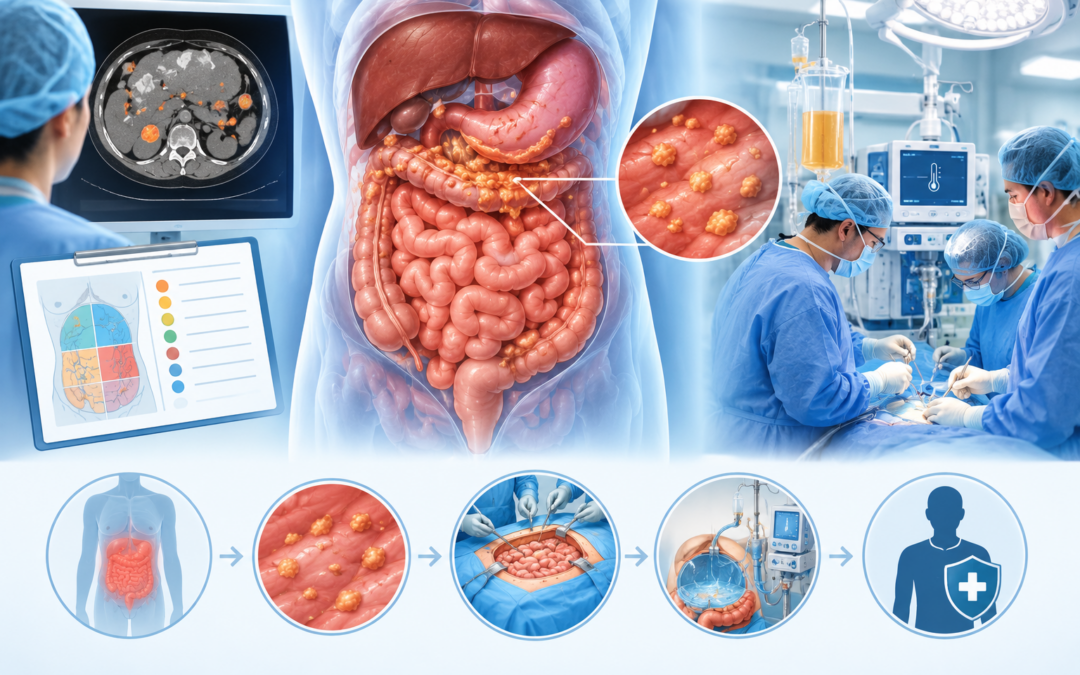
When cancer spreads to the peritoneum, the lining of the abdomen, the surgical team needs an objective way to measure it. The peritoneal cancer index (PCI) does that by scoring how much disease is present and how widely it has spread. It is one of the first things assessed when deciding whether cytoreductive surgery with HIPEC is a realistic option, though it is never the only factor.
According to Dr. Sandeep Nayak, a surgical oncologist in Bangalore, the number alone doesn’t settle anything. The scans, the type of cancer, how fit the patient is and what can actually be removed all go into the decision, and the final score is often confirmed only once the surgeon looks inside.
If you have a scan or biopsy report that shows spread in the abdomen and you’d like it explained, you can contact Clinic on +91 9482202240.
What the Peritoneal Cancer Index Measure?
Before anyone talks about HIPEC treatment, the first question is how far the disease has gone. The PCI is how that gets answered.
Thirteen regions: The surgeon divides the abdomen into 13 areas. Nine cover the abdomen and pelvis, and four cover the small bowel.
Lesion size score: Each area gets a score from 0 to 3, based on the biggest tumour deposit in it. Zero means nothing visible. A 3 means deposits bigger than 5 cm, or disease that has joined up into one sheet.
Total score: Add the 13 scores together and you land somewhere between 0 and 39. More disease, higher number.
How it’s measured: A scan gives you an estimate. The most reliable PCI is the one the surgeon sees with their own eyes at the start of the operation.
Completeness score: Once the surgery is done, a separate CC score records how much disease was left behind. The aim is CC-0 or CC-1.
Who Qualifies for Cytoreductive Surgery with HIPEC?
No single number decides this. The oncology team looks at several things together.
Where the cancer began: Cancers of the appendix, colon, ovary and the peritoneum itself are the usual ones considered. Stomach cancer comes into it in selected cases.
The PCI range: In colon and rectal cancer, a PCI above about 20 is usually seen as too high for surgery. Other cancers use different cut-offs, and in ovarian cancer the PCI isn’t a fixed rule.
Can it all come out? This is the real question. Can the surgeon remove all the visible disease and finish with a CC-0 or CC-1 result? If not, the operation usually doesn’t go ahead.
Fitness: It’s a long, major operation. How active you are day to day matters, and so do your heart, lungs, kidneys and liver.
Spread outside the abdomen: Disease that stays within the peritoneum is the ideal. Spread to distant organs, or deposits in places that can’t be removed, can rule surgery out even when the PCI is low.
Beyond the PCI Score: Assessment and What to Expect?
Scans can miss small deposits, so the team sometimes wants a direct look inside the abdomen. A staging laparoscopy, which falls under laparoscopic cancer surgery, does exactly that.
Scans first: A CT or PET-CT of the abdomen and pelvis gives an early estimate of the PCI. Small deposits, especially on the surface of the bowel, are easy to miss.
Staging laparoscopy: A few small cuts and a camera, so the surgeon can see all 13 regions. They can score the PCI and judge whether complete removal is possible.
The plan can change: The score in the operating theatre may differ from the scan estimate, and the plan shifts with it.
The operation: Cytoreductive surgery removes all the visible disease. HIPEC follows, with heated chemotherapy circulated inside the abdomen for a set time to treat whatever can’t be seen.
Recovery: It’s a major operation, so expect a hospital stay, nutrition support and regular follow-up scans. Your team will explain what applies to you.
Key Takeaways
-
Cytoreductive surgery: Removes all visible cancer deposits where complete removal is feasible.
-
HIPEC: Heated chemotherapy is circulated inside the abdomen for a set period to treat remaining microscopic cancer cells.
-
Recovery: Recovery may involve a hospital stay, nutritional support and regular follow-up scans. The care team will guide patients based on their individual needs.
Frequently Asked Questions
Is a high PCI always a reason to avoid surgery?
Not always, since the cut-off depends on the type of cancer.
What is the range of the PCI score?
From 0, meaning no visible disease, up to 39.
Can the PCI be worked out from a scan alone?
Only roughly, because the surgeon’s direct view is more accurate.
Is HIPEC given on its own?
Usually not. It follows cytoreductive surgery that removes the visible disease.
References
Peritoneal Cancer Index and Patient Selection for CRS and HIPEC Explains how PCI measures the extent and distribution of peritoneal disease and how it helps assess suitability for cytoreductive surgery. Read the reference – PubMed Central
Indications for Cytoreductive Surgery and HIPEC: Clinical Practice Guideline Reviews evidence and recommendations for CRS with HIPEC across ovarian, colorectal, gastric and other peritoneal cancers. Read the reference – Current Oncology / PMC
Disclaimer: This blog is for informational and educational purposes only and is not a substitute for professional medical advice or diagnosis.
