
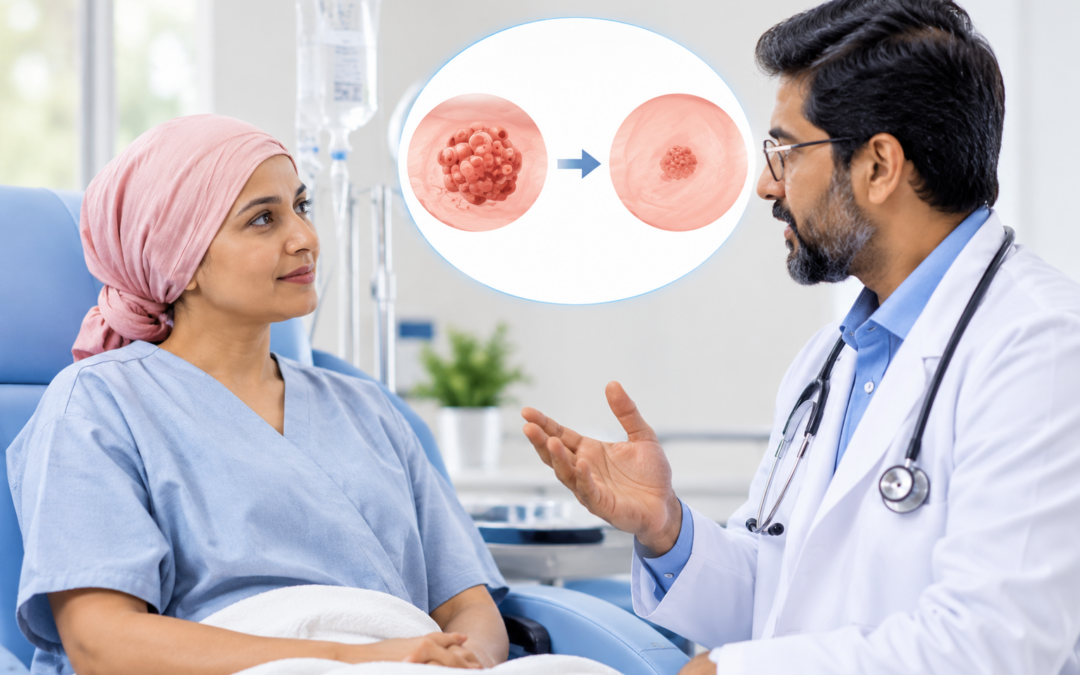
Chemotherapy treatment is sometimes given before surgery, which is called neoadjuvant therapy, for three main reasons. It can shrink a tumour so that removal is easier or less extensive, it begins treating microscopic cancer cells early, and it shows how the tumour responds to drugs. Whether this improves outcomes depends on the cancer type, its stage and its biology. Some cancers clearly benefit in surgical and survival terms, while others gain little from this sequence.
According to Dr. Sandeep Nayak, Surgical Oncologist at MACS Clinic, Bangalore “Giving chemotherapy first is not a sign that the cancer is worse, and it isn’t right for everyone. It’s a planned decision. For some tumours it makes surgery safer or smaller, and it tells us early whether the treatment is working. For others, operating first is still the better route.”
Wondering whether chemotherapy before surgery is right for your diagnosis?
Why Is Chemotherapy Given Before Surgery?
The idea is to use the time before the operation to do more than wait. Each reason below has a practical purpose.
Shrinking the tumour: Reducing the size of a tumour can make removal easier and sometimes allows a smaller, less invasive operation. In breast cancer, for example, neoadjuvant treatment can raise the chance of breast-conserving surgery.
Treating hidden disease early: Microscopic cancer cells may already be present in the body even when scans look clear. Starting systemic treatment early begins to address them without waiting for recovery from surgery.
Seeing how the tumour responds: The tumour is still in place, so doctors can judge response through scans and, later, the surgical specimen. This helps guide what treatment should follow.
Making borderline tumours operable: Some tumours are too large or too close to vital structures to remove safely at first. Chemotherapy treatment beforehand can sometimes bring them within reach of surgery.
Neoadjuvant therapy is one part of a wider plan. Our Chemotherapy Treatment page explains how systemic treatment is chosen and coordinated
Does Neoadjuvant Therapy Improve Outcomes?
The honest answer is that it depends. Evidence is stronger for some cancers than others.
Survival compared with adjuvant treatment: In breast cancer, trials comparing the same chemotherapy before and after surgery found similar overall survival. The advantage is mainly in surgical options and in learning how the tumour responds.
Response as a signal: In triple-negative and HER2-positive breast cancer, a strong response to chemotherapy is a powerful predictor of lower recurrence risk. This lets doctors adjust treatment afterward.
Gastrointestinal cancers: Neoadjuvant and perioperative approaches have substantially improved outcomes in oesophageal and gastric cancer. In colon cancer the evidence is still emerging, and in resectable pancreatic cancer it is still considered experimental in many centres.
Lung cancer: Neoadjuvant chemotherapy alone gave modest benefit and no clear survival difference over adjuvant treatment, though newer combinations with immunotherapy are changing this picture.
Outcomes are never decided by timing alone. Our article What Is Neoadjuvant Therapy and How Does It Work? walks through how these decisions are made.
What Does the Process Look Like?
A predictable sequence helps patients know what to expect.
Evaluation and biopsy: Imaging and tissue diagnosis define the cancer and its stage before any decision is made.
Team planning: Surgeon, medicalaoncologist and sometimes radiation oncologist agree the order of treatment together.
Chemotherapy cycles: Treatment is given in cycles over weeks to months, with scans along the way to check response.
Surgery afterwards: The operation is typically planned a few weeks after the last cycle, once blood counts have recovered.
Further treatment: What follows depends on the response seen in the removed tissue, and may include more chemotherapy, radiation or other therapy.
If you have a tumour in the head, neck or elsewhere and are weighing your options, our guide When Is Surgery the First Step in Cancer Treatment? explains the other side of the decision.
Frequently Asked Questions
Why is chemotherapy given before surgery?
Mainly to shrink the tumour, treat hidden cancer cells early and see how the cancer responds to treatment.
Does neoadjuvant chemotherapy improve survival?
It depends on the cancer. It clearly helps in several settings, but for many cancers survival is similar to giving chemotherapy after surgery.
Does chemotherapy before surgery delay the operation?
Surgery is planned after treatment, usually a few weeks after the last cycle. The delay is deliberate, and response is monitored throughout.
Is neoadjuvant therapy suitable for every cancer?
No. Cancer type, stage, biology and overall health all decide whether it is the right approach.
References
- PMC (NIH): Neoadjuvant Chemotherapy for Breast Cancer: Past, Present, and Future: https://pmc.ncbi.nlm.nih.gov/articles/PMC7747102
- PMC (NIH): Neoadjuvant Chemotherapy, Endocrine Therapy, and Targeted Therapy for Breast Cancer: ASCO Clinical Practice Guideline: https://pmc.ncbi.nlm.nih.gov/articles/8274745
Disclaimer: This blog is for informational and educational purposes only and is not a substitute for professional medical advice or diagnosis.
