
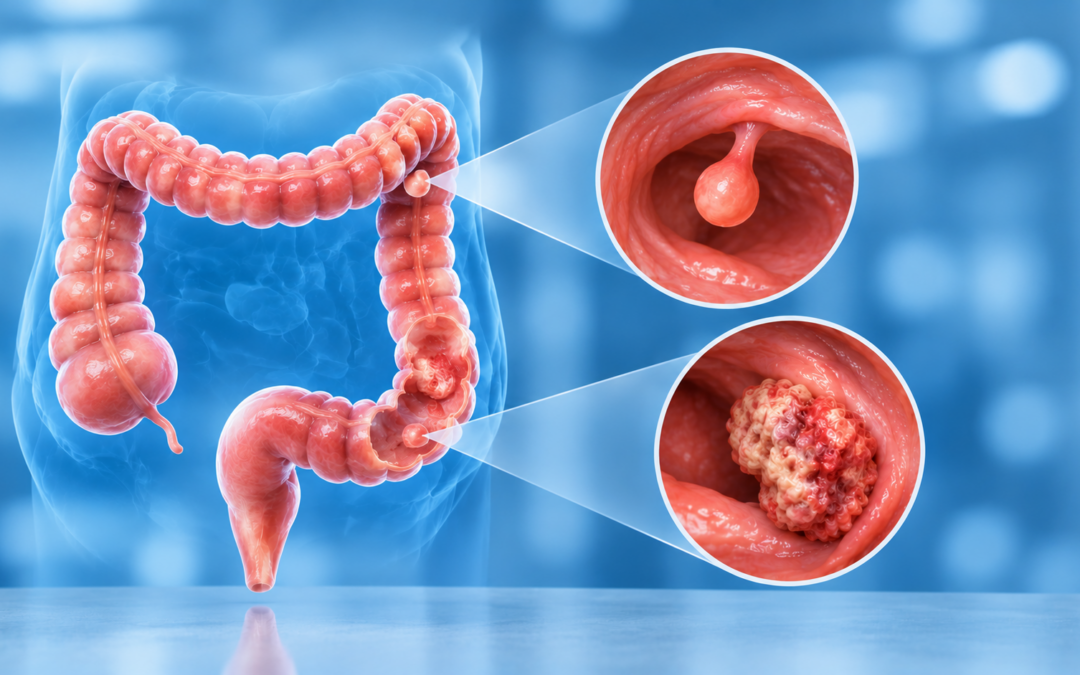
A colon polyp isn’t cancer. Not yet, anyway. It’s a small clump of extra tissue growing on the lining of the colon, mostly harmless, mostly silent. Colon cancer is different. That’s when cells inside a polyp break through the wall they’re supposed to stay behind and start invading deeper tissue. Most polyps never get there. Some do, and it usually takes years, not weeks.
According to Prof. Dr. Sandeep Nayak, Surgical Oncologist in India, “A Polyp is the warning, not the disease, remove it in time and colon cancer simply never gets the chance to happen.”
Had a Polyp before, or never been screened at all?
What Actually Makes a Polyp Different From Cancer?
Same starting point. Very different endings, most of the time.
- Definition : A polyp is just tissue growing where it shouldn’t, sitting on the surface, minding its own business until someone finds it.
- The Line : Cancer starts the moment those cells push through the muscularis mucosae, that thin wall a polyp is never supposed to cross.
- Timeline : Ten to fifteen years, on average. That’s roughly how long it takes a polyp to turn, and plenty never turn at all.
- Not All Polyps : Tubular ones barely worry anyone. Villous ones? Different story, malignancy risk climbs to around 40 percent depending on size.
Regular colonoscopy screening is what catches a polyp while it’s still just a polyp, before that ten-year clock ever finishes running.
So When Should a Polyp Actually Worry You?
Size matters here. So does type. So does what the biopsy actually says.
- Size Risk : Under a centimetre? Risk sits around 1 percent. Past two centimetres, it jumps to roughly 50.
- Symptoms : Polyps rarely announce themselves. Cancer does, eventually, bleeding, anemia, bowel habits that just won’t settle.
- Removal Changes Everything : Take the polyp out during colonoscopy and that’s usually the end of the story, no further treatment needed at all.
- Multiple Polyps : More polyps, more mutations happening at once, and that pushes overall risk higher even if each one looks small on its own.
That’s exactly the window screening is built to exploit, something covered in more depth in early screening for colon cancer.
Why Choose Dr. Sandeep Nayak for Colon and Rectal cancer?
Prof. Dr. Sandeep Nayak has been treating colon and rectal cancer for over 24 years now. Polyps, early tumours, advanced disease, he’s seen the whole spectrum. Chairman of Oncology Services across Karnataka. Runs Surgical Oncology and Robotic Surgery at KIMS Hospital, Bangalore. Every case still goes through tumour board first.
Patients get looked at properly, not rushed through a checklist. Catch it as a polyp, and surgery might not even come up. Call +91-9482202240 to book your consultation.
Frequently Asked Questions
Is a colon polyp the same as colon cancer?
No, a polyp is benign tissue that can sometimes turn cancerous over time.
How long does it take a polyp to become cancer?
Usually five to fifteen years, though many polyps never progress at all.
Do all colon polyps need to be removed?
Most are removed during colonoscopy regardless, since removal prevents future risk.
What type of polyp is most likely to become cancer?
Villous adenomas carry the highest risk, especially when larger than two centimetres.
References
- National Cancer Institute, Colorectal Cancer Screening (PDQ)
- American Cancer Society, Understanding Colon Polyps in a Pathology Report
Disclaimer: This blog is for informational and educational purposes only and is not a substitute for professional medical advice or diagnosis.
