
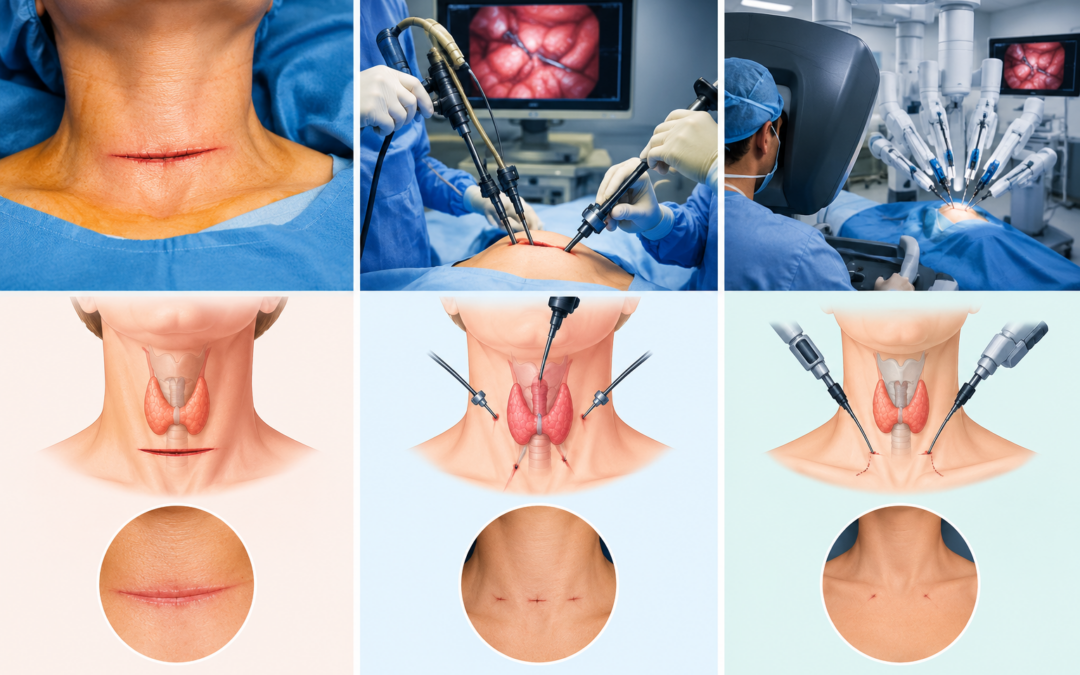
All three remove the thyroid, either part of it or the whole gland. What changes is how the surgeon gets in, what they see while working, and how they move the instruments. Open surgery goes through a cut on the front of the neck. Endoscopic and robotic thyroid surgery reach the gland from somewhere else, like the armpit, the breast or the mouth, so the neck stays clear of a scar.
Prof. Dr. Sandeep Nayak, surgical oncologist in Bangalore with over 24 years of experience, says it’s less about which one is “best” and more about which one fits the person on the table: “Patients usually walk in having already picked a favourite, mostly based on the scar. The scar matters, and I take it seriously. But tumour size, the thyroid itself, and what the neck looks like on imaging have to lead to the decision, and the technique follows from that.”
Not sure which thyroid surgery suits your case?
Which Approach Suits Which Patient?
There’s no single winner here. A few things usually push the decision one way or the other:
- A larger tumour, or one that has spread to nearby tissue, often points toward open surgery
- Suspicious lymph nodes in the neck can make open access the safer route
- A small, well-contained nodule is where robotic thyroid surgery tends to work best
- Someone who is very concerned about a visible neck scar may lean toward a remote access approach
- A very large thyroid gland can make remote access harder to do safely
- Budget and hospital availability matter too, and it’s fair to bring them up in the consultation
Whichever way it goes, cure comes first and cosmetic outcome second. If you’d like to understand how surgery fits into the bigger picture of thyroid cancer care, our post on whether thyroid cancer is curable with surgery is a good place to start.
How Do the Three Types of Thyroidectomy Compare?
Here’s the side by side view of the thyroidectomy types, so you can see where they actually differ.
|
Feature |
Open Thyroidectomy |
Endoscopic Thyroidectomy |
Robotic Thyroidectomy |
|
Incision and access |
Direct cut on the front of the neck |
Remote access through the armpit, breast or mouth |
Remote access through the armpit, breast or face and mouth, using a console |
|
View |
Direct view with the naked eye or surgical loupes |
2D video monitor |
High definition 3D magnified view |
|
Instruments |
Standard handheld tools |
Rigid, straight endoscopic tools |
Robotic wrists that bend and rotate, with tremor filtering |
|
Operative time |
Shortest, usually 1 to 2 hours |
Longer, since handling is more restricted |
Longest, often 2 to 3 hours or more |
|
Cost |
Lowest |
Moderate |
Highest, because of the system setup and upkeep |
|
Neck scar |
Yes, on the front of the neck |
No |
No |
The extra operating time with remote approaches isn’t a flaw. It’s the price of working through a small, hidden entry point. If you want to see how these options fit into a full treatment plan, our thyroid cancer treatment page walks through them.
What Should You Ask Before Choosing a Thyroid Surgery?

Most people only think of these questions after the decision is made, so it helps to have them ready beforehand. Dr. Nayak’s own technique, RABIT, goes in through the breast and armpit and has been used for removing thyroid tumours under about 4 cm, which is exactly the kind of detail worth asking any surgeon about their own method.
- Do my tumour size and scan findings actually allow a remote approach, or is open surgery the safer fit?
- How many of these specific surgeries do you do in a year? Volume matters more than the title here.
- Under what circumstances would you switch to open surgery during the operation?
- How long is the usual hospital stay, and what should the neck and shoulder feel like in the first few weeks?
- When are the follow-up scans and blood tests, and who explains the results?
- What is the total cost, including the facility, and what might change it?
Why Choose Prof. Dr. Sandeep Nayak for Neck Dissection Surgery in Bangalore?
Dr. Sandeep Nayak has spent over 24 years in robotic and minimally invasive cancer surgery, head and neck tumors included. His training in robotic technique means he can reach and remove tumors through the mouth without disturbing much of the surrounding muscle or tissue. That precision is the whole point.
Patients under his care generally get back to normal swallowing and speech faster than with open surgery. Less visible scarring too, and a shorter hospital stay. Recovery still depends on tumor size and where exactly it sits, but the outcomes hold up. No exaggeration needed here.
Frequently Asked Questions
What's the main difference between selective and modified radical neck dissection?
Selective dissection removes specific node levels, modified radical clears all five with structures spared.
Is shoulder dysfunction the same after both procedures?
No, shoulder dysfunction is more common and more severe after modified radical dissection.
What decides which type of neck dissection a patient needs?
Tumour location, nodal involvement on imaging, and disease extent decide which one applies.
Does modified radical dissection work as well as classical radical dissection?
Yes, studies show comparable oncological outcomes between modified radical and classical radical dissection.
References
- National Center for Biotechnology Information — Shoulder Dysfunction and Quality of Life Following Modified Radical and Selective Neck Dissection: A Prospective Comparative Study: https://pmc.ncbi.nlm.nih.gov/articles/PMC11306493/
- National Center for Biotechnology Information — Impact of Modified Radical Neck Dissections on the Number of Retrieved Nodes, Recurrence and Survival: https://pmc.ncbi.nlm.nih.gov/articles/PMC9442232/
Disclaimer: This blog is for informational and educational purposes only and is not a substitute for professional medical advice or diagnosis.
