
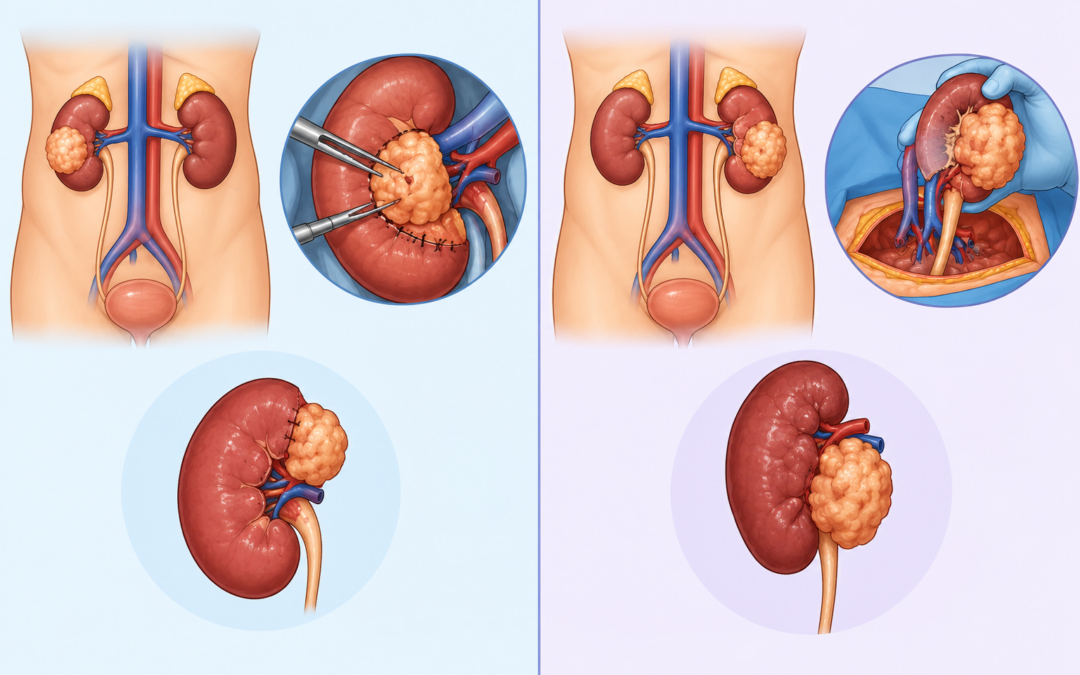
A partial nephrectomy removes only the tumour along with a thin margin of healthy tissue, leaving the rest of the kidney working.
A radical nephrectomy takes out the whole kidney, usually with the surrounding fat and, in some cases, nearby lymph nodes.
Where the tumour is small and well placed, preserving the kidney is generally preferred, since it protects long term kidney function.
Larger or more complex tumours, and those reaching into the main vessels, often leave radical removal as the safer route.
According to Prof. Dr. Sandeep Nayak, a surgical oncologist who performs robotic and laparoscopic partial nephrectomy for kidney cancer, “Patients often think removing the whole kidney is the safer cancer operation. For a small tumour, it usually isn’t. Cancer control is comparable, and saving the kidney protects you for decades. The tumour’s size and position decide what’s possible, not the label on the operation.”
Facing a kidney tumour and unsure whether the kidney can be saved?
When Is a Partial Nephrectomy the Right Choice?
Sparing the kidney is preferred whenever it can be done safely. Several things decide whether it can.
Tumour size. Smaller tumours, especially under 4 cm, are the classic candidates. Larger ones are sometimes still manageable, depending on position.
Tumour position. A tumour sitting on the outer surface is far easier to remove cleanly than one buried deep near the central collecting system.
Kidney function. In patients with one kidney, tumours in both kidneys, or existing kidney disease, saving as much tissue as possible matters even more.
Surgical approach. Robotic and laparoscopic techniques allow precise removal of the tumour with small incisions and a faster return to normal activity.
Whether a kidney can be saved is worked out from imaging before surgery, not decided on the table. Our page on kidney cancer treatment covers how that evaluation is done.
When Is a Radical Nephrectomy Needed?
Radical nephrectomy isn’t a default. It’s chosen when keeping any part of the kidney isn’t safe or technically possible.
Large tumours. Bigger masses often leave too little healthy kidney to preserve, so the whole organ comes out with the surrounding fat.
Central location. Tumours close to the main vessels and collecting system can make a partial removal unsafe, even when the tumour itself is not especially large.
Vein involvement. When cancer has grown into the renal vein, or further toward the main vein leading to the heart, complete removal is needed.
Lymph node spread. Nearby nodes that are involved may be taken out along with the kidney as part of an extended procedure.
The remaining kidney carries the load afterward, which is why most people do well with one. Our blog on radical nephrectomy surgery explains when and how that operation is carried out.
Why Choose Prof. Dr. Sandeep Nayak for Kidney Cancer Surgery in Bangalore?
Prof. Dr. Sandeep Nayak brings over 24 years of surgical oncology experience to kidney cancer care, including robotic and laparoscopic partial and radical nephrectomy. He holds DNB qualifications in Surgical Oncology and General Surgery, an MRCS from the UK, and a fellowship in Laparoscopic and Robotic Onco Surgery. He currently serves as Chairman of Oncology Services across Karnataka and Executive Director of Surgical Oncology and Robotic Surgery at KIMS Hospital, Bangalore. Every case is reviewed at the tumour board, with a clear lean toward sparing the kidney wherever it can be done without compromising cancer control.
The choice between the two operations affects kidney function for years afterward, not just cancer control. That’s why the decision is made on imaging and tumour detail, before the date for surgery is fixed. Call +91 9482202240 to book your consultation.
Frequently Asked Questions
What is the difference between partial and radical nephrectomy?
Partial removes only the tumour and a small margin, radical removes the entire kidney.
Is partial nephrectomy as effective for cancer control?
Yes, for small tumours it controls cancer as effectively while preserving kidney function.
When is radical nephrectomy needed instead?
Large, centrally placed tumours or those invading veins usually need radical nephrectomy.
Can you live normally after kidney removal?
Yes, most people live normally with one healthy kidney after radical nephrectomy.
References
- National Center for Biotechnology Information — Partial vs Radical Nephrectomy for T1–T2 Renal Masses in the Elderly: Comparison of Complications, Renal Function, and Oncologic Outcomes: https://pmc.ncbi.nlm.nih.gov/articles/PMC5274548/
- National Center for Biotechnology Information — Comparison of Partial and Radical Nephrectomy for pT1b Renal Cell Carcinoma: https://pmc.ncbi.nlm.nih.gov/articles/PMC2941807/
Disclaimer: This blog is for informational and educational purposes only and is not a substitute for professional medical advice or diagnosis.
