
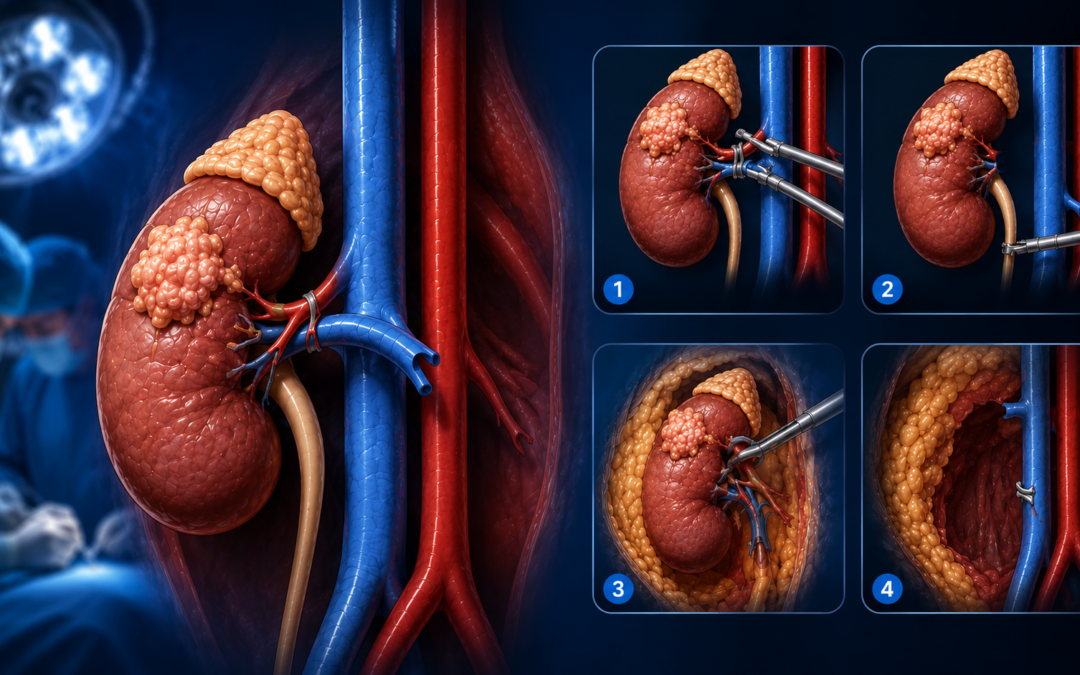
Radical nephrectomy surgery is the surgical removal of an entire kidney, along with the surrounding fat and nearby lymph nodes, used mainly for kidney cancer that’s too large or too centrally located for the kidney to be saved. Surgeons reserve it for tumours where partial nephrectomy isn’t technically feasible, since removing only part of the kidney is preferred whenever it’s safely possible. The procedure can be done through an open incision, laparoscopically, or robotically, and the approach chosen affects recovery time considerably.
According to Dr. Sandeep Nayak, whose surgical practice focuses on minimally invasive kidney cancer surgery, “even when the whole kidney has to come out, doing it through small incisions still gives patients the shorter hospital stay and faster recovery that used to only come with saving the kidney.”
Diagnosed with a large or centrally located kidney tumour?
When Is Radical Nephrectomy Needed?
Surgeons don’t default to radical nephrectomy, they choose it only when specific conditions rule out saving the kidney.
- Tumour Size — Larger tumours, generally those crossing a certain size threshold, often can’t be removed without taking the whole kidney along with them.
- Central Location — A tumour sitting deep near the kidney’s blood supply or collecting system frequently can’t be separated from healthy tissue safely.
- Vascular Involvement — When cancer extends into the renal vein or the inferior vena cava, the entire kidney and the involved vessel segment need removal together.
- Kidney Function — If the affected kidney is already poorly functioning and the other kidney is healthy, removing the whole organ carries less downside than attempting to save it.
A CT scan is usually enough to confirm the diagnosis and plan the extent of kidney surgery, and a biopsy is rarely needed beforehand. Deciding between radical and partial surgery happens well before the patient reaches the operating table.
How Is the Surgery Performed?
The surgery itself follows a fairly consistent sequence, though the access route varies by case.
- Vessel Control — Surgeons first isolate and control the renal artery and vein before touching the kidney, since bleeding risk is highest at this step.
- Kidney Removal — The entire kidney, along with Gerota’s fascia and surrounding fat, comes out as one specimen to keep the tumour fully contained.
- Lymph Node Sampling — Nearby lymph nodes are often removed at the same time if imaging suggests any risk of spread.
- Minimally Invasive Access — Laparoscopic or robotic approaches use a handful of small incisions instead of one large one, cutting blood loss and hospital stay.
This is a very different operation from the more conservative approach used when a kidney tumour can be removed without losing the whole organ, and the decision between the two shapes recovery and kidney function alike. Surgeons weigh oncologic safety and future kidney health before settling on either path.
Why Choose Dr. Sandeep Nayak For Kidney Cancer?
Dr. Sandeep Nayak is a surgical oncologist with over 24 years of experience who has performed radical and partial nephrectomies through laparoscopic and robotic approaches at MACS Clinic and KIMS Hospital. His minimally invasive techniques have earned him recognition including the K. Subhramanyam Robotic Innovation Award.
Choosing between radical and partial nephrectomy affects long-term kidney function, not just cancer control, so this decision deserves an experienced surgical opinion before the operation date is fixed. A radical nephrectomy done precisely the first time protects the remaining kidney’s workload for decades to come.
Frequently Asked Questions
When is radical nephrectomy chosen over partial nephrectomy?
When the tumour is too large, too central, or involves major blood vessels near the kidney.
Is radical nephrectomy always done through open surgery?
No, it can be performed laparoscopically or robotically in most eligible cases.
Can a patient live normally with one kidney?
Yes, most people maintain normal kidney function with a single healthy kidney.
Is a biopsy needed before radical nephrectomy?
Rarely, since CT imaging alone usually diagnoses kidney tumours with high accuracy.
References
Disclaimer: This blog is for informational and educational purposes only and is not a substitute for professional medical advice or diagnosis.
