
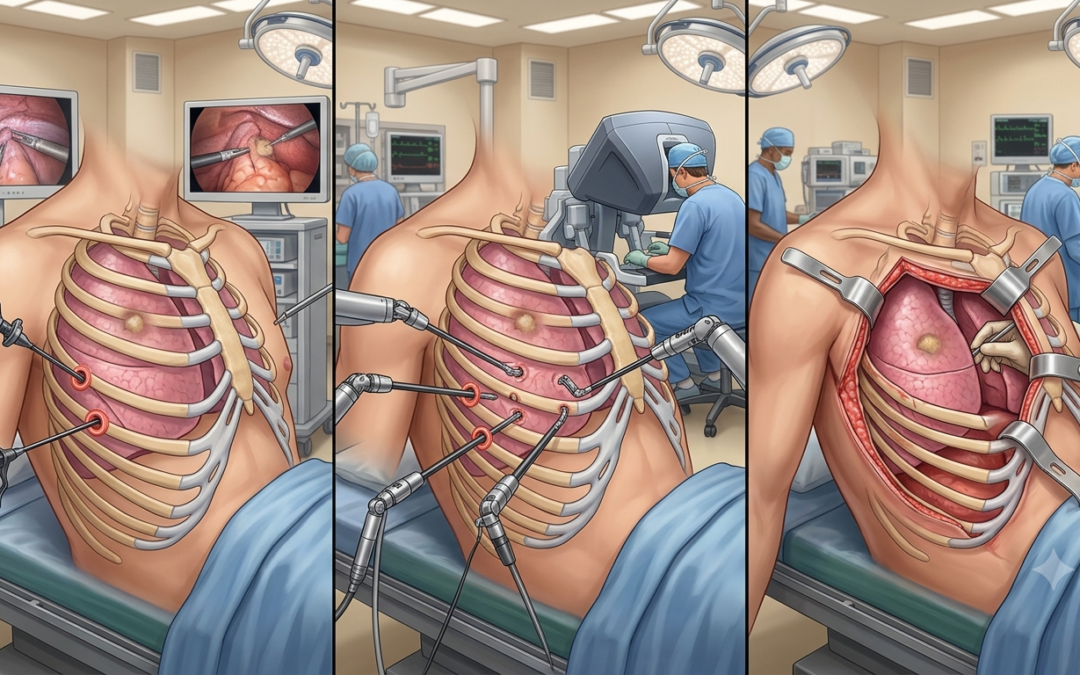
The three approaches differ mainly in the size of the cut and in how the surgeon sees and works inside the chest. Open thoracotomy uses one larger incision. VATS uses small cuts, a camera and long instruments, and RATS adds a robotic console with a three dimensional view. All three are used for lung cancer resections, including lobectomy. The right choice depends on the tumour, the patient’s health and the team’s experience.
According to Dr. Sandeep Nayak, a surgical oncologist in India, the choice between VATS vs RATS and open thoracotomy for lung cancer surgery depends on the tumour. “The approach is chosen to suit the tumour. Each one can remove a lung cancer completely when it is used in the right patient. Smaller cuts usually mean less pain and a quicker recovery. Some tumours still need an open operation to be removed safely. The route is only a means to the goal, and the goal is complete removal
For information about lung surgery options, you can contact the clinic at +91 9482202240.
What Are Open Thoracotomy, VATS and RATS?
All three reach the lung through the chest wall, but the access and the tools differ.
Open thoracotomy: One larger incision between the ribs, with the ribs spread for access. The surgeon works looking directly at the lung.
VATS: A few small cuts between the ribs. A camera and long instruments are used, and the surgeon works from a screen. The full name is video-assisted thoracoscopic surgery.
RATS: Small cuts again, this time with a robotic console. The surgeon controls the instruments from the console and sees a magnified three dimensional view. The instruments bend and rotate more freely than straight VATS tools.
What they can treat: All three can be used for lobectomy, segmentectomy and wedge resection, depending on the tumour.
The same operation by a different route: In principle the tumour and the lymph nodes are removed in each case. Only the way in changes. Our page on lung cancer treatment covers the operations used.
How Do the Three Approaches Compare?
The table sets out the main differences side by side.
|
Feature |
Open thoracotomy |
VATS |
RATS |
|
Incision |
One larger incision |
A few small incisions |
A few small incisions |
|
View |
Direct view |
Camera view on a screen |
Magnified three dimensional view |
|
Instruments |
Handheld |
Long handheld instruments |
Robotic arms with bending wrists |
|
Pain and recovery |
More pain, slower recovery |
Less pain, quicker recovery than open surgery |
Similar to VATS |
|
Lymph nodes removed |
Standard |
Standard |
Slightly more in some studies |
VATS vs open: Trials found less pain and better quality of life after VATS, and long term survival wasn’t significantly different. Our blog on VATS surgery for lung cancer explains how it works.
RATS vs VATS: A pooled analysis of randomised trials found equivalent cancer and complication outcomes. RATS showed less blood loss and more lymph nodes removed, but that hasn’t translated into better survival.
Cost: Robotic systems generally cost more to buy and run, so RATS usually costs more.
Switching during surgery: Any keyhole operation can be changed to open surgery if it isn’t safe to continue. It’s a safety step, not a failure.
What Determines Treatment Choice?
The choice is made case by case, using a few clear points.
Tumour size and position: Small tumours away from the main blood vessels suit keyhole surgery. Large tumours, or those close to the main vessels or airway, can make open surgery safer.
Spread: Tumours growing into the chest wall or nearby structures, or heavily involved lymph nodes, may need an open operation.
Earlier chest surgery or infection: Heavy scarring inside the chest can make keyhole access difficult.
Lung function and general health: Fitness for anaesthesia and surgery shapes how much lung can be removed and by which route. Our blog on whether lung cancer surgery removes the whole lung explains how much may come out.
Team experience and availability: Results depend on how often the team performs the chosen approach. Robotic surgery is available only at some centres.
Key Takeaways
- Open thoracotomy uses one larger incision. VATS and RATS use small cuts with a camera, and RATS adds a robotic console.
- Compared with open surgery, VATS usually means less pain and a quicker recovery, without worse cancer outcomes in suitable patients.
- Pooled randomised trials found RATS and VATS to be equivalent for cancer and complication outcomes, and RATS usually costs more.
- Some tumours still need open surgery. The right approach depends on the tumour, the patient’s health and the team’s experience, and is best discussed with a specialist.
Frequently Asked Questions
What is the main difference between VATS and RATS?
RATS uses a robotic console with a three dimensional view. VATS uses handheld instruments.
Is VATS as effective as open surgery for lung cancer?
Trials show similar cancer outcomes in suitable patients, with less pain and quicker recovery.
Does robotic surgery give better results than VATS?
Not clearly. Pooled randomised trials found equivalent cancer outcomes and complication rates.
When is open thoracotomy still needed?
For some large, central or advanced tumours, or when keyhole surgery isn’t safe.
References
- PubMed — Long-term survival from a randomized controlled trial of lobectomy by video-assisted thoracoscopic surgery versus thoracotomy for early-stage lung cancer: https://pubmed.ncbi.nlm.nih.gov/39873729/
- National Center for Biotechnology Information — Robotic vs. video-assisted thoracoscopic surgery for resectable non-small cell lung cancer: a systematic review and meta-analysis of randomized controlled trials: https://pmc.ncbi.nlm.nih.gov/articles/PMC13460117/
Disclaimer: This blog is for informational and educational purposes only and is not a substitute for professional medical advice or diagnosis.
