
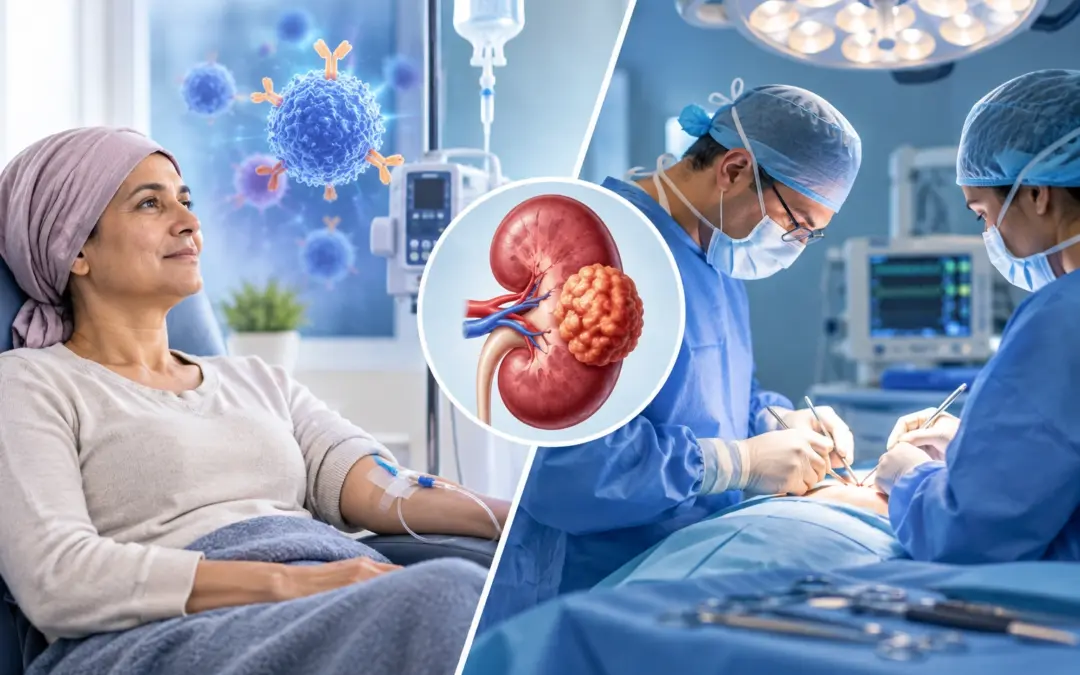
If the tumour is still confined to the kidney, surgery is what cures it, and no drug regimen has taken that job over outside clinical trials. Where immunotherapy does matter is around the operation: after it, for people whose pathology looks high risk, and as the main treatment once the cancer has spread.
According to Prof. Dr. Sandeep Nayak, Surgical Oncologist in India, “The question I hear most is whether a drug can save the operation. For a tumour still inside the kidney, no. Immunotherapy earns its place when the risk of the cancer coming back is high, or when it has already left the kidney.”
Not sure whether your scan points to an operation or a drug?
When Is Surgery Still the First Choice?
- If the cancer hasn’t left the kidney, taking it out is the treatment with a cure in mind. That hasn’t changed. This is what kidney cancer surgery is built around at this stage.
- Smaller tumours in a good position can often be removed with a partial nephrectomy, so the rest of the kidney keeps working. That matters more than people expect, especially years later.
- Big tumours, or ones that have grown into the renal vein, may need the whole kidney out. Robotic or laparoscopic routes are used when the anatomy allows, our robotic cancer surgery approach covers how that access actually works.
- Very small masses in older or frail patients? Sometimes we watch, or use ablation. But only after the imaging has been looked at properly.
Where Does Immunotherapy Fit In?
- After surgery, for selected high-risk patients. A year of pembrolizumab has been shown to lower the chance of recurrence, with longer follow-up suggesting a survival benefit too.
- When the cancer has spread, it has become the backbone of treatment, usually as a combination of two immunotherapy drugs or one paired with a targeted tablet.
- Do these patients still need surgery? Sometimes, but not automatically. Removing the kidney in advanced disease is decided case by case, and many people start with drugs first. This is where a surgical oncologist’s judgement counts.
- Side effects deserve respect. Immunotherapy can inflame the thyroid, gut, liver, skin or lungs, so a new symptom should be reported early rather than at the next visit.
Why Choose Prof. Dr. Sandeep Nayak?
Prof. Dr. Sandeep Nayak has performed over 10,200 cancer surgeries across 24 years , including robotic and laparoscopic work where saving kidney tissue matters. Treatment plans are reviewed at a tumour board, so the choice between surgery, immunotherapy or both isn’t one person’s hunch.Bring your CT report and any biopsy or pathology report to the first visit. Staging answers most of this question before we discuss anything else.
Frequently Asked Questions
Can immunotherapy get rid of kidney cancer without an operation?
For a tumour still inside the kidney, not reliably. Surgery remains the standard, and skipping it for drugs alone is something to consider only within a clinical trial.
Is immunotherapy given before or after the operation?
After, at present, and only for people whose pathology shows a higher risk of recurrence. Using it before surgery is still being studied.
If my cancer has spread, is surgery off the table?
Not necessarily. It depends on how much disease there is and how you respond to drug treatment, so the decision is usually made jointly with a medical oncologist.
Are the side effects worse than surgery?
They’re different, not milder. Rashes, thyroid changes, diarrhoea and inflammation of the liver or lungs can happen, and most are manageable when caught early.
References
- National Cancer Institute — Kidney Cancer Treatment: NCI: Renal Cell Cancer Treatment for Patients
- American Cancer Society — Surgery for Kidney Cancer: American Cancer Society: Surgery for Kidney Cancer
Disclaimer: This blog is for informational and educational purposes only and is not a substitute for professional medical advice or diagnosis.
