
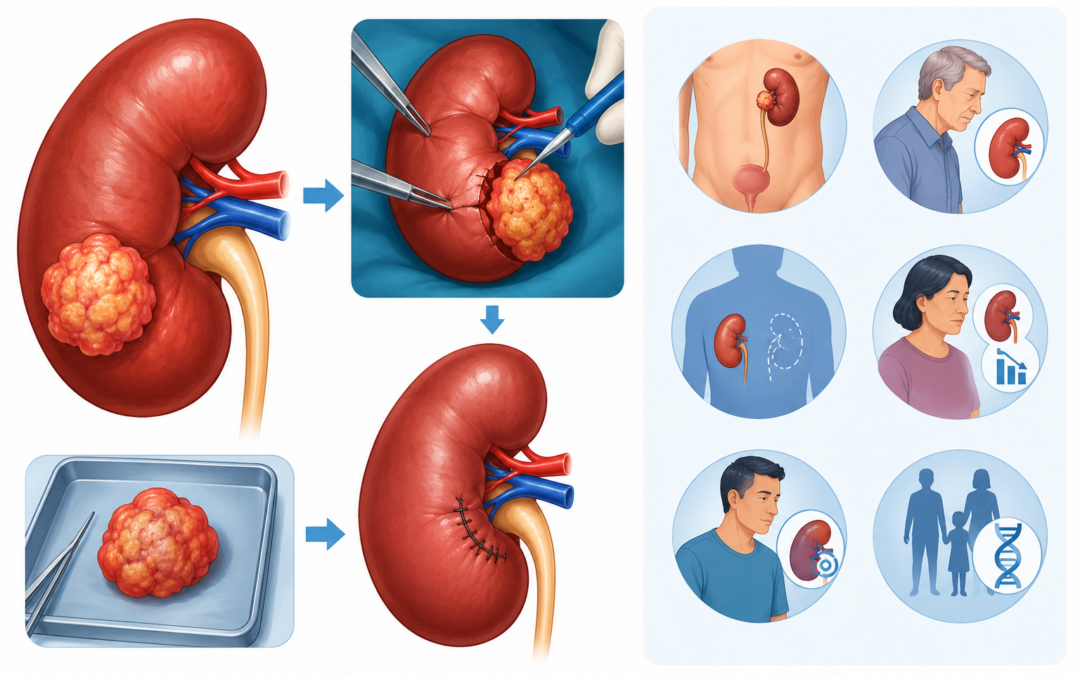
Partial nephrectomy is kidney surgery where only the tumour comes out, along with a narrow band of healthy tissue around it, and the rest of the kidney stays in the body. Once the tumour is out, the surgeon repairs the kidney with stitches so it keeps doing its job. Doctors mostly use it for small tumours, and for people who can’t afford to lose much kidney function. Surgeons can reach the kidney through an open cut, with keyhole instruments or with a robot.
Prof. Dr. Sandeep Nayak, Surgical Oncologist at MACS Clinic, Bangalore, explains who is considered for partial nephrectomy. “Think of it this way. Your kidneys have to see you through your whole life, so if we can take the tumour out and leave you with as much working kidney as possible, that’s what we aim for. Whether we can depends mostly on how big the tumour is and where it’s sitting. The other kidney counts too, because its health decides how much kidney we can afford to lose. Not every tumour is suitable, and removing the whole kidney is the right choice when it isn’t.”
Have questions about kidney surgery?
How Is a Partial Nephrectomy Done?
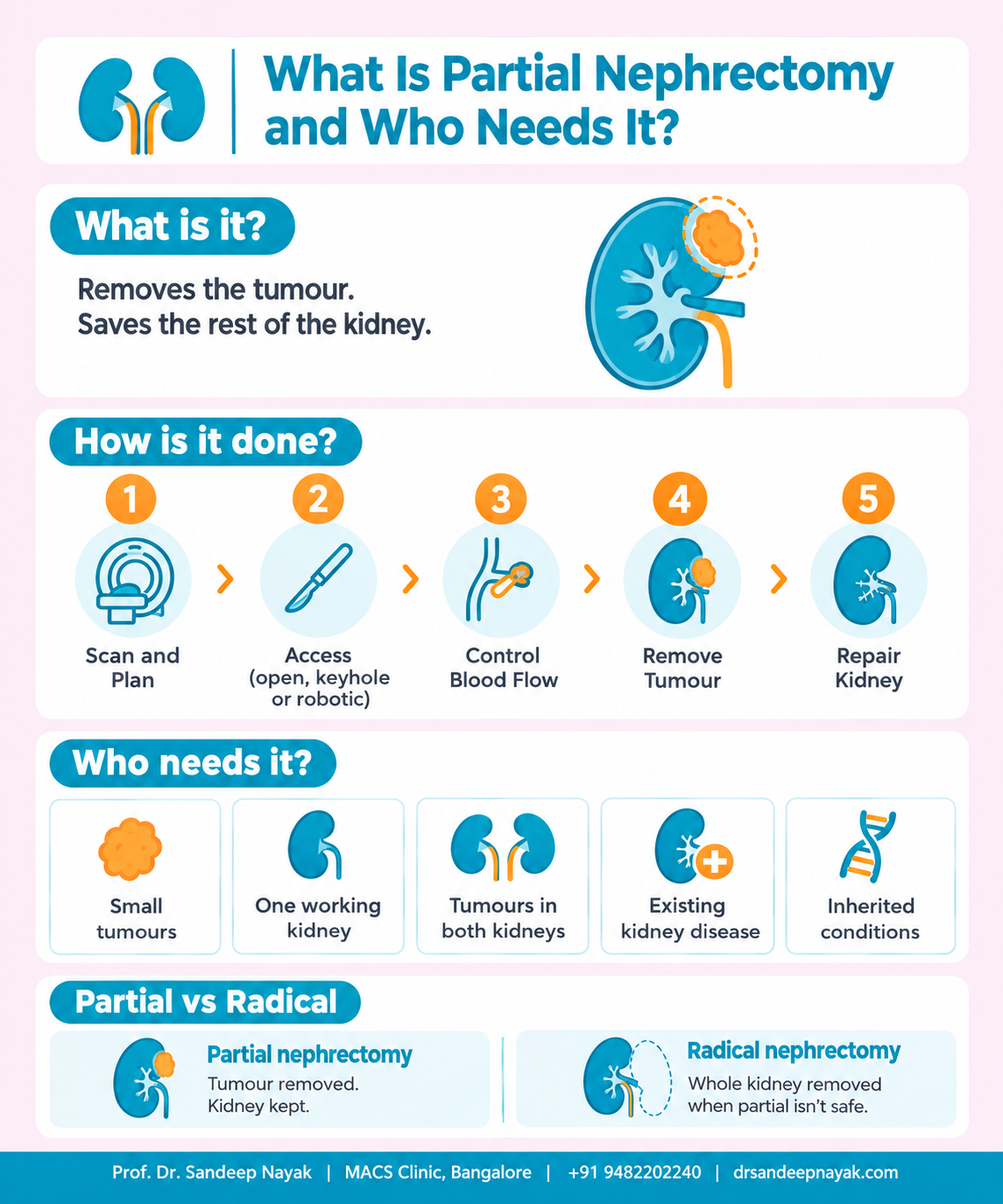
Open, keyhole or robotic, the surgeon goes through roughly the same steps.
Planning: It starts with a CT or MRI. That scan tells the surgeon how big the tumour is, where exactly it sits, and how near it comes to the blood vessels and the part of the kidney that drains urine, so the cut can be planned before anyone picks up a knife.
Access: Some surgeons go in through one larger cut (open surgery), others through a few small keyhole cuts, and some of those use a robot to hold and steer the instruments. Our page on kidney cancer treatment covers the routes used.
Controlling blood flow: The blood supply to the kidney may be clamped for a short time, so the tumour can be removed with less bleeding. This time is kept as short as possible to protect the kidney.
Removing the tumour: The tumour is cut out together with a thin rim of healthy tissue around it, so nothing is left behind at the edge. The piece removed goes for pathology, which checks the edges.
Repair: After that comes the repair. The surgeon stitches the kidney to stop the bleeding and to close off the drainage system. Bleeding and urine leaking are the two things surgeons watch for afterwards, so nobody rushes this part.
Who Needs a Partial Nephrectomy?
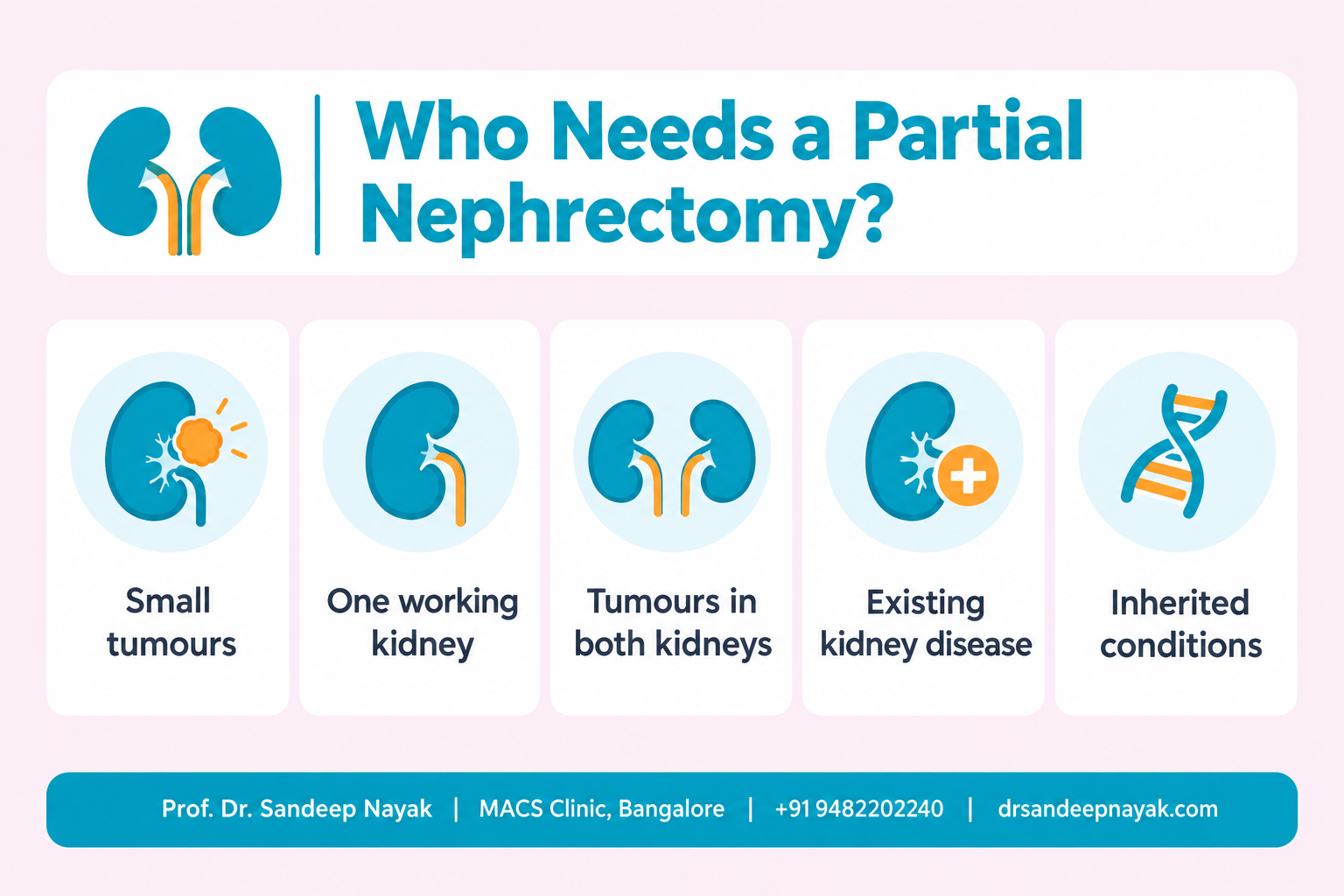
Small tumours come first on the list, and the case for it gets stronger when kidney function is at stake.
Small tumours: Mostly small ones, though a larger tumour can sometimes qualify if it’s sitting in a convenient spot.
One working kidney: With only one kidney, or a second one that barely works, there’s not much to spare, so saving tissue matters a lot.
Tumours in both kidneys: Take out each tumour separately and you can avoid losing an entire kidney. Our blog on kidney cancer in both kidneys covers this.
Existing kidney disease: If your kidneys are already weak, or you live with diabetes or high blood pressure, every bit of kidney tissue you keep is worth having.
Inherited conditions: A few people inherit a high risk of kidney tumours (von Hippel Lindau disease is one). They can end up needing surgery more than once, so each time the surgeon tries to take as little kidney as possible.
What Determines Treatment Choice?
No two cases are quite the same, so the call between a partial and a radical nephrectomy is made patient by patient.
Tumour size and position: Near the surface, a tumour usually comes out cleanly. One buried deep in the kidney, or sitting next to the main blood vessels, is trickier.
Spread: Once the cancer has pushed into the kidney vein, or gone beyond the kidney, a partial nephrectomy usually won’t be enough.
Kidney function: We check how well each kidney works, and the idea is to protect the combined total, not just one side.
General health: Fitness for surgery and anaesthesia shapes the route and the extent.
When the whole kidney comes out: If a partial nephrectomy isn’t safe, radical nephrectomy is advised. Our blog on partial vs radical nephrectomy explains the difference, and our blog on radical nephrectomy surgery covers that operation.
Key Takeaways
- Partial nephrectomy removes the tumour along with a thin rim of healthy tissue, so most of the kidney carries on working.
- It’s used mainly for small tumours, and when protecting kidney function matters most, for instance with one working kidney, tumours in both kidneys or existing kidney disease.
- Open, keyhole or robotic, the surgeon repairs the kidney once the tumour is out.
- Not every tumour suits it. What decides it is the size of the tumour, where it sits, whether it has spread and how well the kidneys work, so it’s best talked through with a specialist.
Frequently Asked Questions
What is a partial nephrectomy?
It’s surgery that takes the tumour out with a thin rim of healthy tissue around it and keeps the kidney.
Who is suitable for partial nephrectomy?
People with small tumours are the usual candidates, and so are those who have just one working kidney or tumours in both.
Is partial nephrectomy as effective as removing the whole kidney?
For tumours that suit it, yes, cancer control looks about the same in studies, and the kidney tends to work better afterwards.
Can partial nephrectomy be done by keyhole or robotic surgery?
Yes, it can be. Surgeons use open, keyhole or robotic routes, depending on the tumour.
References
National Center for Biotechnology Information — Are we along the path for laparoscopic partial nephrectomy?: https://www.ncbi.nlm.nih.gov/pmc/articles/PMC2721544/
National Center for Biotechnology Information — Partial nephrectomy using porcine small intestinal submucosa: https://www.ncbi.nlm.nih.gov/pmc/articles/PMC3233505/
Disclaimer: This blog is for informational and educational purposes only and is not a substitute for professional medical advice or diagnosis.
