
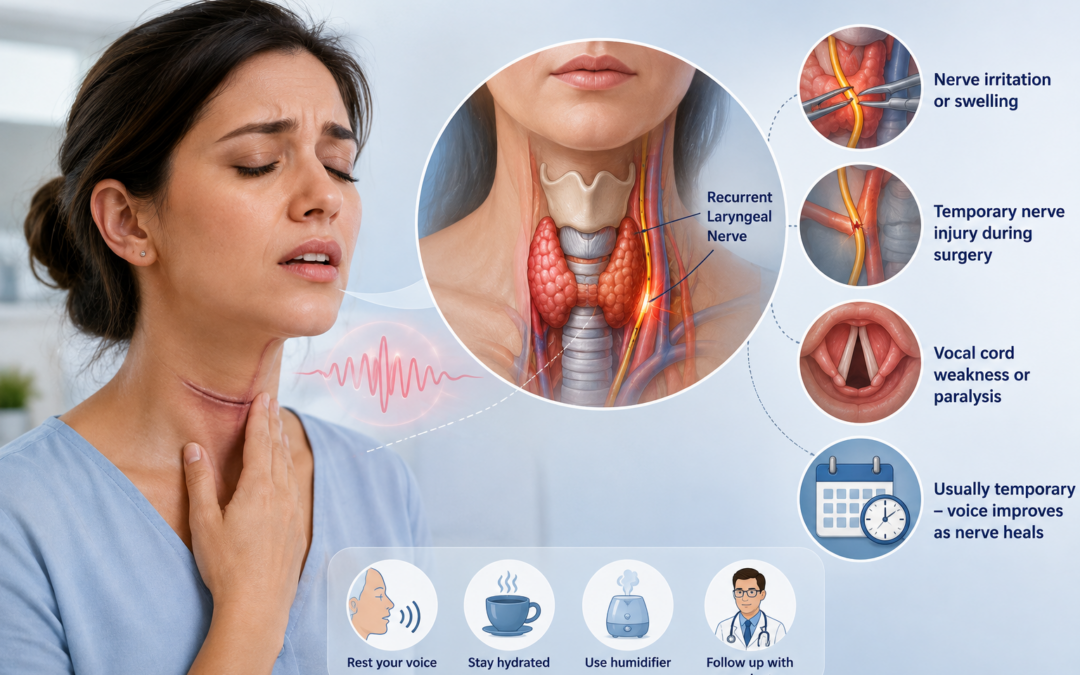
Hoarseness after thyroid surgery is genuinely common, and most of the time, it goes away on its own. Usually it’s one of three things at play. Swelling right around the surgical site, some irritation from the breathing tube used during anaesthesia, nothing to do with the surgery itself really, or the recurrent laryngeal nerve getting stretched or bruised a bit, that’s the nerve running past the thyroid that controls your vocal cords. Give it a few weeks. Most of this clears up as the tissue heals.
According to Dr. Sandeep Nayak, surgical oncologist in Bangalore with over 24 years of experience treating solid tumors, “This is one of the most common questions I get after thyroid surgery, and it worries patients more than it probably should. The recurrent laryngeal nerve sits right in the operative field, so some irritation is expected even in a clean, well-executed surgery. Permanent nerve injury is genuinely uncommon when the surgeon has real volume with this specific anatomy.”
Voice not back to normal after thyroid surgery?
What's Actually Causing the Hoarseness?
- Swelling around the surgical site is the most common cause, and it settles down naturally as healing progresses.
- The breathing tube placed during anaesthesia can irritate the vocal cords slightly, unrelated to the surgery itself.
- The recurrent laryngeal nerve runs directly alongside the thyroid, so some stretching or bruising during surgery is fairly routine, even in straightforward cases.
- True nerve injury is far less common, and when it happens, it’s usually identified and discussed with you directly after surgery.
Surgeon experience with this specific nerve matters here more than people realise, and it’s something we’ve written about separately in Is Thyroid Cancer Curable With Surgery?, worth reading if voice change is a concern you had going into surgery.
When the Hoarseness Should Actually Worry You?
- Most temporary hoarseness improves noticeably within two to three weeks, and continues improving from there.
- If your voice hasn’t shown any improvement after several weeks, that’s worth flagging to your surgical team rather than waiting it out further.
- Difficulty swallowing alongside voice changes deserves a proper look sooner rather than later.
- A weak or breathy voice that doesn’t budge at all past the expected healing window can point to nerve involvement that needs direct evaluation.
If you’re weighing thyroid surgery and this is part of what’s on your mind, our Thyroid Cancer treatment page covers how this risk gets managed as part of the surgical approach itself.
Why Choose Dr. Sandeep Nayak ?
Dr. Sandeep Nayak has spent more than two decades in surgical oncology, and thyroid surgery, voice preservation included, has been a consistent part of that work throughout. He currently serves as Chairman of Oncology Services for Karnataka and heads Surgical Oncology and Robotic Surgery at KIMS Hospital, Bangalore. What tends to matter most to patients isn’t the title though, it’s that recurrent laryngeal nerve protection is treated as a genuine surgical priority, not an afterthought once the tumour’s out. That focus is often where things get missed elsewhere.
Voice not improving the way you expected after thyroid surgery? Don’t just wait it out indefinitely. Call +91 9482202240 and get someone to actually walk you through it.
Frequently Asked Questions
How long does hoarseness usually last after thyroid surgery?
Two to three weeks is typical before you notice real improvement, then it keeps getting better over the following month, give or take.
Is permanent voice change common after thyroid surgery?
Not really, no. Genuinely rare, especially in the hands of a surgeon who’s done a lot of this specific anatomy. And on the off chance it does happen, it gets flagged and talked through with you directly, not left as a surprise.
Can robotic thyroid surgery reduce the risk of voice changes?
Not particularly. Comes down more to how careful the surgeon is around the nerve itself than which access method got used to get there.
Should I see a specialist if my voice hasn't improved after a month?
Yeah, at that point it’s worth getting looked at properly instead of just waiting around for it to sort itself out.
References
Disclaimer: This blog is for informational and educational purposes only and is not a substitute for professional medical advice or diagnosis.
