
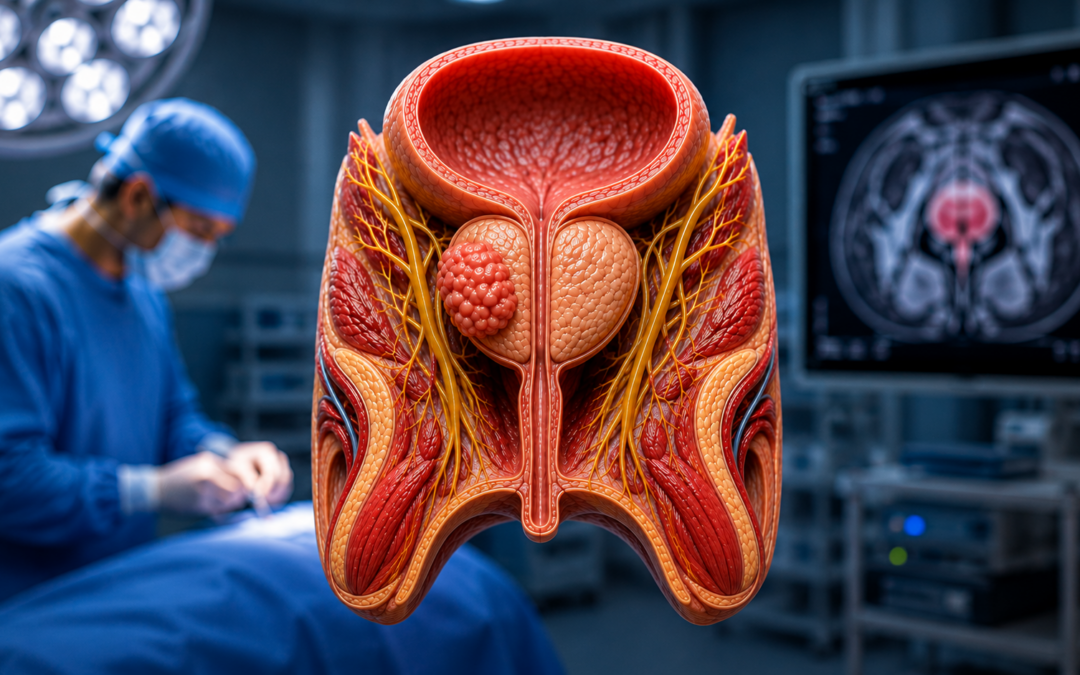
Yes, nerve-sparing surgery is possible for many prostate cancer patients, provided the tumour hasn’t grown into the neurovascular bundles running along either side of the gland. Not always, though. It’s a case-by-case call. The decision comes down to cancer stage, tumour location, and how aggressive things look on biopsy. When it’s feasible, surgeons preserve the nerves that handle erectile function and continence while still clearing the cancer completely. When it isn’t, complete removal wins. Every time.
According to Prof. Dr. Sandeep Nayak, Robotic Cancer Surgery in Bangalore, “Nerve sparing only works when the cancer’s location actually allows it, and that’s something the anatomy on the table decides, not the scan taken beforehand.”
Worried about losing function after prostate cancer surgery?
What Determines Whether Nerve-Sparing Is Possible?
A handful of concrete factors decide this. Case by case, never by default.
- Tumour location. If the cancer sits close to where the neurovascular bundles run, surgeons often sacrifice function on that side to stay ahead of the disease.
- Cancer stage. Early, organ-confined tumours leave far more room to work with than disease that’s already pushed past the capsule.
- Gleason score. Because leaving cancer behind costs more than losing function ever would, higher grade disease pushes surgeons toward a wider resection margin.
- Baseline function. Men with some erectile difficulty going in simply don’t gain as much from nerve sparing, so that gets weighed upfront, honestly.
A detailed prostate evaluation covering imaging and biopsy mapping decides this, not guesswork, before surgery ever begins.
How Well Does Nerve-Sparing Surgery Preserve Function?
Results vary considerably here. Worth being honest about that range instead of promising a number that won’t hold for everyone.
- Bilateral sparing. Preserving both neurovascular bundles pushes potency recovery meaningfully higher, sometimes well above 70% in younger, healthier men.
- Unilateral sparing. Saving just one bundle still helps, though the numbers drop and recovery tends to stretch out longer.
- Recovery timeline. Nerves heal slowly, and it can take six months to two years for function to return, which is normal, not a failure of the surgery.
- Robotic precision. So magnified 3D visualisation lets surgeons dissect closer to the nerves without the thermal damage older techniques often caused.
Much of this overlaps with what gets discussed during stage 2 prostate cancer planning too, where staging shapes strategy directly.
Why Choose Dr. Sandeep Nayak For Prostate Cancer?
Dr. Sandeep Nayak has performed over 10,200 cancer surgeries across 24 years, with deep experience in robotic and laparoscopic prostate cancer surgery where nerve preservation genuinely matters. His training spans several advanced minimally invasive techniques. And prostate cases get planned with that same precision, the kind built from thousands of other complex oncology surgeries.
Patients get a clear, individualised answer about their nerve-sparing candidacy before they’re ever on the table. Not a vague reassurance, and not a guess either. And when sparing isn’t safely possible, that gets said plainly too. Because oncological control always comes first. No exceptions.
Frequently Asked Questions
Can nerve-sparing surgery be done robotically?
Yes, robotic-assisted prostatectomy is commonly used for nerve-sparing surgery due to its precision.
How long does it take to recover erectile function?
Recovery can take six months to two years, varying by patient and nerve-sparing extent.
Does nerve-sparing surgery increase cancer recurrence risk?
When properly selected, it doesn’t significantly raise recurrence risk versus standard surgery.
Is nerve-sparing surgery suitable for all prostate cancer stages?
No, it’s typically reserved for early-stage, organ-confined tumours without extracapsular extension.
References
- National Cancer Institute: Prostate Cancer Treatment. https://www.cancer.gov/types/prostate
- World Health Organisation: Cancer. https://www.who.int/news-room/fact-sheets/detail/cancer
Disclaimer: This blog is for informational and educational purposes only and is not a substitute for professional medical advice or diagnosis.
