
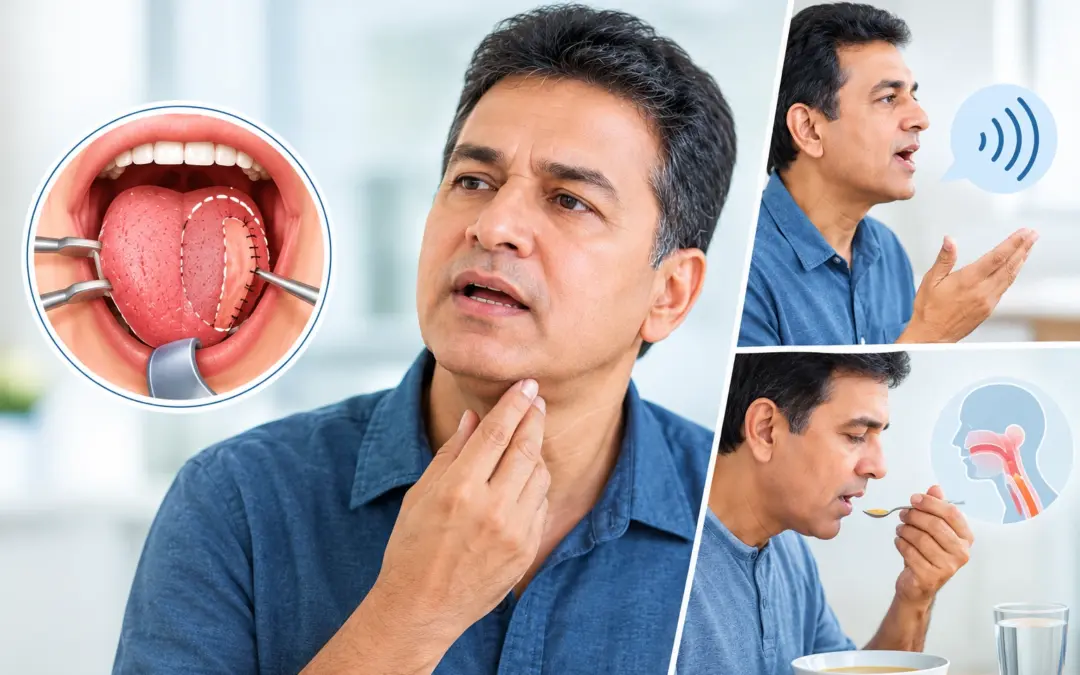
Surgery is the first and main treatment for most oral cavity cancers, including cancer of the tongue. Radiation usually comes later, after the operation, if the pathology report points to a higher risk, and it takes the lead only when surgery isn’t an option. Speech and swallowing are affected because the tongue is central to both. How much changes depends on how much of it is removed, which part, and whether it’s rebuilt.
According to Prof. Dr. Sandeep Nayak, Surgical Oncologist at MACS Clinic, Bangalore, talks patients through what to expect after a glossectomy. “The first question I get before tongue surgery is almost always the same: will I be able to talk and eat afterwards? With a small tumour, usually yes, with only a mild and brief change. If a bigger part has to go, the road is longer and rehab matters a lot. We plan the surgery and the recovery together.”
If you’d like to know more about tongue cancer surgery, call the clinic on +91 9482202240.
How Much of the Tongue Is Removed in Tongue Cancer Surgery?
That depends on the tumour: how big it is, how deep, and where it sits. The surgeon takes the cancer plus a small rim of healthy tissue around it, and tries not to take more than that.
Partial glossectomy: Most people with a small tumour on the side of the tongue need only this. A piece comes out and the rest of the tongue stays. Some of these small tumours can be reached through the mouth with robotic help, and our page on trans oral robotic surgery covers where that’s used.
Hemiglossectomy: Half the tongue. This is for larger or deeper tumours.
Total glossectomy: The whole tongue, or nearly all of it. Rare, and kept for advanced cancers.
The neck: Tongue cancer often spreads to the lymph nodes in the neck, so the surgeon usually clears those during the same operation.
Rebuilding: If a big part is taken, skin and tissue from the forearm or thigh can be used to build the tongue back up.
How Does Tongue Cancer Surgery Affect Speech?
Almost every sound you make involves the tongue. So yes, speech changes. How much is the real question.
Small removals: Many people notice very little. Some are a bit slurred for a short while, and then it settles.
Bigger removals: Clarity can drop. Sounds like t, d, l and s need the tip of the tongue to touch the roof of the mouth, so those suffer first.
Straight after surgery: Swelling makes everyone sound muffled for the first few days. It passes.
A rebuilt tongue: The tissue used to rebuild it gives the tongue enough bulk to reach the palate, and that helps with clearer sounds.
Speech therapy: This starts early. Exercises, practice, patience. Over weeks and months most people get clearer, even if it doesn’t sound exactly as it once did. Speech is a large part of head and neck cancer care, and our page on head and neck cancer treatment covers that.
What Determines Speech and Swallowing Outcomes After Tongue Cancer Surgery?
No two people recover alike. These are the things that shape it.
How big the tumour was: The more tongue that has to come out, the bigger the change.
Where it was: The tip and front mostly change how clearly you speak. The back mostly changes swallowing.
Whether it was rebuilt: And how.
Radiation afterwards: If you need it, it can leave you with a dry mouth and some stiffness, and that makes both speaking and swallowing harder.
The neck operation: In suitable cases, Dr. Nayak’s RIA-MIND approach to neck dissection is designed to cut complications and help function. You can read more on our expertise page.
Rehab: Early therapy and daily practice at home count for a great deal, and they’re as much your job as the surgeon’s.
Where you started from: Your age, your general health, and how you were speaking and eating before.
Key Takeaways
-
The tongue plays a vital role in both speech and swallowing, so surgery can affect these functions.
-
Smaller tissue removals usually cause milder changes, while larger surgeries may require longer recovery and therapy.
-
Surgical planning, reconstruction and rehabilitation help improve speech and swallowing after surgery.
-
Ask your care team what to expect based on your tumour and planned surgery.
-
To discuss your treatment options, book an appointment or call the clinic at +91 9482202240.
Frequently Asked Questions
How does tongue cancer surgery affect speech?
A small removal often changes little, while a bigger one can leave speech less clear for a time.
Can you swallow normally after tongue cancer surgery?
Many people do, though after bigger surgery you may need therapy and softer food at first.
Do you need speech therapy after a glossectomy?
Often, especially after bigger removals, and the earlier it starts the better.
Will I need a feeding tube after tongue cancer surgery?
Sometimes, briefly, after larger operations while the mouth heals.
References
National Cancer Institute (NCI) – Head and Neck Cancers: Side Effects and Rehabilitation https://www.cancer.gov/types/head-and-neck/head-neck-fact-sheet
PubMed – Voice Rehabilitation After Tongue Cancer Surgery: A Cohort Study in Indian Population https://pubmed.ncbi.nlm.nih.gov/39559020/
Disclaimer: This blog is for informational and educational purposes only and is not a substitute for professional medical advice or diagnosis.
