
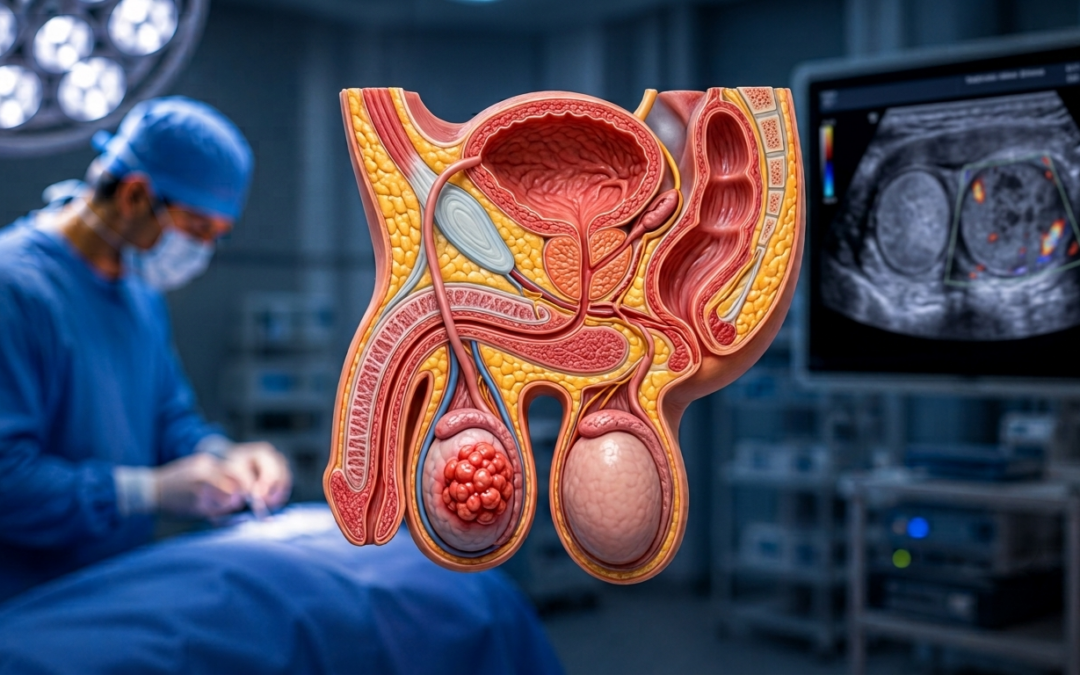
In some cases, yes. It’s called testis-sparing surgery, and it lets a surgeon remove just the tumour instead of the entire testicle. It’s not an option for everyone — it works best for small, well-defined tumours, for men with only one functioning testis, or for tumours affecting both sides, and only when hormone levels and tumour size fall within safe limits. For most patients, radical orchiectomy (removing the whole testicle) is still the standard, and it offers the most reliable cure rate. Testis-sparing surgery is kept for the specific situations where preserving hormone function and fertility potential is medically justified — not offered as a default alternative.
According to Prof. Dr. Sandeep Nayak, Robotic Cancer Surgery in Bangalore, the deciding factor isn’t how the tumour looks on imaging beforehand. It comes down to whether the tumour stays small and clearly contained — and that’s confirmed with a frozen section analysis during the surgery itself, not by the scan taken days or weeks earlier.
Not sure if your tumour qualifies for testis-sparing surgery?
What Makes a Tumour Suitable for Testis-Sparing Surgery?
Only a handful of clinical factors actually determine whether preserving the testicle is even on the table.
- Size matters most. As a general rule, the lesion needs to be under 2 centimetres and take up less than half the testicle’s volume before sparing surgery is realistically considered.
- A solitary testis changes the calculation. If the other testicle is missing or non-functional, losing the remaining one has a much bigger impact — so sparing surgery moves up the priority list whenever this is the case.
- Bilateral tumours push things the same direction. When both testicles are affected, either at the same time or one after the other, the goal shifts toward preserving as much healthy tissue as possible on at least one side.
- Hormones need to check out first. Testosterone and luteinizing hormone should sit within a healthy range going in. When they don’t, it’s usually a sign the disease is more diffuse than sparing surgery can address.
All of this gets worked out as part of a standard testicular cancer evaluation — well before anyone’s decided whether the testicle can be saved.
What Happens to Fertility After This Surgery?
Preserving testicular tissue puts the fertility conversation on very different footing than complete removal does.
- Hormone production usually holds up. Most patients keep normal hormone levels afterward, simply because enough healthy tissue stays behind and keeps functioning.
- About half go on to father children naturally. That number moves around a lot depending on how much tissue was preserved and how healthy the sperm was to begin with.
- Radiotherapy can complicate things. If residual pre-cancerous cells show up in what’s left of the tissue, adjuvant radiotherapy sometimes becomes necessary — and that step on its own can chip away at fertility further.
- Sperm banking is still worth discussing. Even when the surgery itself preserves fertility, chemotherapy later on can affect sperm independently, so it’s a conversation worth having upfront rather than after the fact.
For a lot of men, this whole conversation actually starts earlier — with questions about why testicular cancer shows up in young men in the first place.
Why Choose Dr. Sandeep Nayak For Testicular Cancer?
Dr. Sandeep Nayak holds DNB qualifications in Surgical Oncology and General Surgery, along with a fellowship in Laparoscopic and Robotic Onco-Surgery, and has spent over 24 years handling genuinely complex oncological cases. He currently heads Oncology Services across Karnataka and leads Surgical Oncology and Robotic Surgery at KIMS Hospital. He’s also the surgeon behind the RABIT, MIND, and L-VEIL techniques.
At MACS Clinic, every testicular cancer case is checked for organ preservation potential before radical surgery is assumed to be the only route forward — because a tumour that looks straightforward on a scan can still change the plan once the frozen section results come back mid-surgery. Patients leave the consultation understanding exactly why one option was chosen over another. Nobody’s left guessing.
Frequently Asked Questions
Is testis-sparing surgery available for all testicular tumours?
No — only small, well-contained tumours that meet strict size and hormone criteria qualify.
Does testis-sparing surgery affect testosterone production?
Not usually in any significant way, since enough healthy tissue typically stays functional afterward.
Can I still father children after testis-sparing surgery?
Many men can, though it really depends on how much tissue was preserved and the health of the sperm.
Is radiotherapy always needed after testis-sparing surgery?
No — only when residual pre-cancerous cells turn up in the leftover tissue.
References
- National Cancer Institute: Prostate Cancer Treatment. https://www.cancer.gov/types/prostate
- World Health Organisation: Cancer. https://www.who.int/news-room/fact-sheets/detail/cancer
Disclaimer: This blog is for informational and educational purposes only and is not a substitute for professional medical advice or diagnosis.
