What Is Lumpectomy and How Is It Different From Mastectomy ?

What Is Lumpectomy and How Is It Different From Mastectomy ?

Lumpectomy takes out the tumour and a margin of surrounding tissue, leaving the rest of the breast in place. Mastectomy removes the whole breast. Survival outcomes for early-stage breast cancer are equivalent between the two when the patient is chosen correctly for each approach  the difference isn’t about which is more aggressive, it’s about what works for that specific tumour in that specific breast.

According to Prof. Dr. Sandeep Nayak, Surgical Oncologist in India,
“Lumpectomy and mastectomy produce equivalent survival outcomes in the right patients the choice is never about being conservative or aggressive, it’s about what’s oncologically correct for that case.”

Unsure which surgical option is right for your diagnosis?

What Is Lumpectomy and Who Does It Work For?

Breast-conserving surgery works well for many patients but the clinical picture needs to support it before the team commits to it.

  • What’s Removed: The tumour plus a clear rim of healthy tissue around it that rim gets sent to pathology immediately after surgery and if cancer cells sit at the edge, going back in to take more tissue is what happens next.
  • Right Candidate: Small tumour relative to breast size, single lesion, no BRCA mutation driving ongoing risk in the remaining tissue, and located far enough from the nipple that clear margins are achievable without compromising the cosmetic result.
  • Radiation After: Standard practice after lumpectomy includes breast cancer treatment with radiation to the remaining breast, which brings local recurrence rates down to a level comparable with mastectomy in appropriately selected patients.
  • Recovery: Most patients go home the same day or within 24 hours and are back to normal activity in two to three weeks, considerably faster than what mastectomy recovery involves across the board.

When the selection criteria are met, lumpectomy with radiation is as oncologically sound as mastectomy and that’s not a compromise it’s the evidence.

How Is Mastectomy Different and When Does It Become Necessary?

Mastectomy steps in when lumpectomy genuinely can’t achieve what the surgery needs to deliver for that patient.

  • Tumour Takes Up Too Much: When there isn’t enough healthy breast tissue left after removing the tumour to produce a functional or acceptable result, mastectomy stops being the aggressive choice and starts being the practical one.
  • Multiple Lesions: Separate tumours sitting in different quadrants of the same breast can’t be addressed cleanly through breast conservation and mastectomy gives the patient a complete result rather than a series of partial ones.
  • High Genetic Risk: A confirmed BRCA mutation means the remaining breast tissue after lumpectomy still carries real ongoing risk, making prophylactic mastectomy sometimes on both sides a well-supported option rather than an extreme one.
  • Recurrence After Prior Treatment: When cancer returns in a breast that’s already had radiation, re-irradiation isn’t safe and robotic cancer surgery or conventional mastectomy becomes the only viable surgical path left for that patient.

Mastectomy often starts a longer process rather than ending one, and for more on what reconstruction involves afterward, our blog on breast reconstruction covers the options in detail.

Why Choose Dr. Sandeep Nayak for Breast Cancer Treatment ?

Dr. Sandeep Nayak brings 24 years of surgical oncology experience, DNB qualifications in Surgical Oncology and General Surgery and a fellowship in Laparoscopic and Robotic Onco-Surgery to every breast cancer surgical decision. He heads Oncology Services across Karnataka and leads breast cancer surgery at KIMS Hospital, Bangalore, with originator credits for RABIT and over 25 published clinical studies. Patients wanting a clear answer on whether lumpectomy or mastectomy is the right call for their specific case are seen here with every decision going through tumour board consensus. Call +91 8104310753 to book your consultation.

Frequently Asked Questions

Does lumpectomy give the same survival rate as mastectomy?

For appropriately selected early-stage patients survival outcomes are equivalent when radiation follows lumpectomy.

Is radiation always needed after lumpectomy?

In most cases yes, radiation to the remaining breast tissue is standard practice after lumpectomy.

Can a patient choose mastectomy even if lumpectomy is possible?

Yes, informed patient preference is a legitimate factor in the surgical decision and is fully supported.

How long does recovery take after lumpectomy versus mastectomy?

Lumpectomy recovery takes two to three weeks while mastectomy typically needs four to six weeks.

  1. References

    1. National Cancer Institute — Breast Cancer Surgery Options
    2. World Health Organization — Breast Cancer Treatment
  • Disclaimer: The information shared in this content is for educational purposes and not for promotional use.
What Is a Mastectomy and Who Needs It ?

What Is a Mastectomy and Who Needs It ?

A mastectomy removes the entire breast most often to treat breast cancer, sometimes to prevent it in women who carry a high genetic risk. It’s not the automatic choice for every diagnosis. Whether someone needs one depends on how big the tumour is relative to the breast, where it sits, whether multiple areas are involved and what the patient wants for their body after surgery.

According to Prof. Dr. Sandeep Nayak, Surgical Oncologist in India,
“Mastectomy isn’t about being aggressive  it’s recommended when removing the whole breast gives a better oncological result than trying to conserve it.”

Not sure whether mastectomy is what your case actually requires?

What Types of Mastectomy Are Performed?

Several mastectomy techniques exist and the one chosen depends on tumour characteristics, nodal involvement and whether breast reconstruction is part of the plan.

  • Total Mastectomy: All breast tissue, the nipple and areola are removed while the underlying chest muscle stays intact used when disease is confined to the breast itself without involvement of deeper structures beneath it.
  • Modified Radical Mastectomy: Breast tissue and axillary lymph nodes are cleared in a single operation, the standard approach when nodal involvement is confirmed and breast cancer treatment requires more than local resection alone.
  • Skin-Sparing Mastectomy: Breast tissue comes out but most of the overlying skin is preserved, which makes immediate reconstruction far more achievable and produces a noticeably better result for patients who plan to rebuild the breast afterward.
  • Nipple-Sparing Mastectomy: The breast tissue is removed while the nipple-areola complex stays, reserved for carefully selected patients where the tumour sits far enough from the nipple that keeping it doesn’t compromise what the surgery needs to achieve oncologically.

Which type gets performed is never a unilateral decision tumour board discussion, pathology findings and patient preference all feed into it before anything is finalised.

Who Actually Needs a Mastectomy?

Mastectomy isn’t automatically on the table for every breast cancer patient and the clinical team looks at several specific factors before recommending it.

  • Large Tumour to Breast Ratio: When the tumour takes up too much of the breast to leave adequate tissue behind after removal, trying to conserve the breast simply isn’t oncologically or cosmetically viable and mastectomy becomes the more honest surgical choice.
  • Multiple Disease Sites: Two or more separate tumours in different quadrants of the same breast can’t be addressed through a single lumpectomy, and when that’s what imaging and biopsy show, mastectomy is what gives the patient a genuinely clear result.
  • BRCA Mutation Carriers: Women with a confirmed BRCA1 or BRCA2 mutation carry a high enough lifetime risk that preventive mastectomy before cancer develops is a legitimate and well-supported clinical option rather than an extreme one.
  • Recurrence After Lumpectomy: When cancer comes back in a breast that’s already had radiation, the tissue can’t take another course of it and robotic cancer surgery or conventional mastectomy often becomes the only surgical path left that’s safe and effective.

Mastectomy is usually the beginning of a longer process rather than the end of one, and for more on what reconstruction involves after the breast is removed, our blog on latissimus dorsi covers this in detail.

Why Choose Dr. Sandeep Nayak for Breast Cancer Treatment ?

Dr. Sandeep Nayak brings 24 years of surgical oncology experience, DNB qualifications in Surgical Oncology and General Surgery and a fellowship in Laparoscopic and Robotic Onco-Surgery to every mastectomy decision. He heads Oncology Services across Karnataka and leads breast cancer surgery at KIMS Hospital, Bangalore, with originator credits for RABIT and over 25 published clinical studies. Patients wanting clarity on whether mastectomy is genuinely necessary or a second opinion on their surgical plan are seen here with every decision going through tumour board review.

Frequently Asked Questions

Is mastectomy always necessary for breast cancer?

No, lumpectomy works for many patients and mastectomy is only recommended when it produces a better oncological result.

Can reconstruction happen at the same time as mastectomy?

Yes, immediate reconstruction is planned before surgery for most patients who want it.

How long does mastectomy recovery typically take?

Most patients go home within two to three days with full recovery around four to six weeks.

Does mastectomy stop breast cancer from coming back?

It significantly reduces local recurrence but doesn’t prevent distant spread if cells have already left the breast.

References

    1. National Cancer Institute — Breast Cancer Surgery
    2. World Health Organization — Breast Cancer Treatment
  • Disclaimer: The information shared in this content is for educational purposes and not for promotional use.
What Is Cytoreductive Surgery in Cancer Treatment?

What Is Cytoreductive Surgery in Cancer Treatment?

Cytoreductive surgery, also known as debulking surgery, is a cancer treatment aimed at removing as much of a tumor as possible (ideally all visible disease) when a cancer has spread throughout the body, particularly the abdomen. It is commonly used for ovarian, peritoneal, and some gastrointestinal cancers to improve the effectiveness of subsequent treatments like chemotherapy and to relieve symptoms.

According to Prof. Dr. Sandeep Nayak, Surgical Oncologist in India, “the less disease we leave behind, the more effectively everything that follows can work cytoreduction is about setting up the next treatment to succeed.”

Want to know if cytoreductive surgery applies to your diagnosis?

What Does Cytoreductive Surgery Involve?

The procedure is one of the more extensive operations in cancer surgery and requires thorough pre-operative assessment before the team commits to it.

  • Pre-Surgical Assessment: CT and PET scans map where deposits sit and how widely they’ve spread. This tells the team whether the operation is technically worth doing for that patient at that stage.
  • Multi-Structure Removal: Bowel segments, peritoneal surfaces, parts of the diaphragm or spleen are removed where disease has attached, and laparoscopic cancer surgery is sometimes used for staging before the full open procedure is committed to.
  • Completeness Scoring: After surgery the team grades how much residual disease remains. No visible disease is the target and achieving it consistently produces better responses to follow-up chemotherapy.
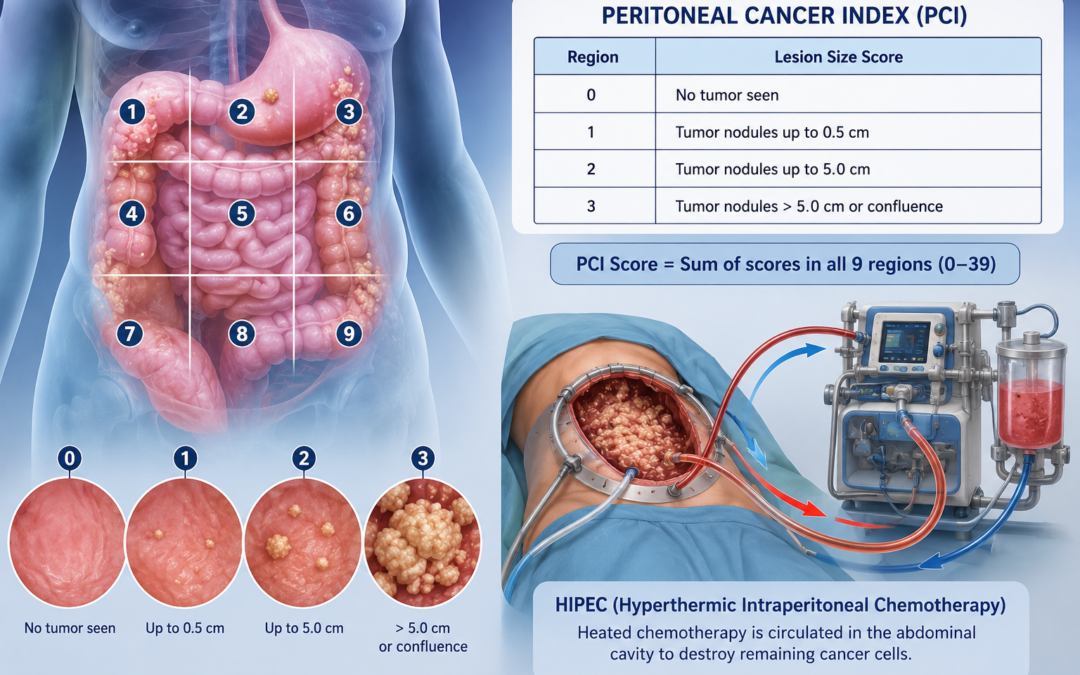
  • HIPEC Delivery: Heated chemotherapy goes directly into the abdominal cavity right after tumour removal, targeting microscopic deposits the surgical instruments couldn’t physically reach during the operation.

Patient fitness, disease extent and expected benefit all determine whether cytoreduction is appropriate and the decision always comes from tumour board review.

When Is Cytoreductive Surgery Recommended?

The procedure has a defined role in specific cancer types and isn’t applied broadly across all cases of advanced disease.

  • Ovarian Cancer: Cytoreduction is central to advanced ovarian cancer treatment. Residual disease volume after surgery is one of the strongest predictors of how well platinum-based chemotherapy works afterward.
  • Peritoneal Carcinomatosis: When colon, stomach or appendix cancer spreads to the peritoneal lining, robotic cancer surgery or open cytoreduction removes visible deposits before HIPEC targets microscopic residual disease.
  • Mesothelioma: Selected patients with peritoneal or pleural mesothelioma are considered when disease is contained enough that significant removal is achievable without putting the patient at excessive operative risk.
  • Patient Fitness: The procedure typically runs six to ten hours and the patient must be medically fit enough to tolerate that duration and recover from the significant physiological demands it creates.

Cytoreduction is never decided by one clinician alone and for broader context on how surgical decisions are reached, cancer surgery is covered separately.

Why Choose Dr. Sandeep Nayak for Cytoreductive Surgery?

Dr. Sandeep Nayak holds DNB qualifications in Surgical Oncology and General Surgery with a fellowship in Laparoscopic and Robotic Onco-Surgery and 24 years of experience performing cytoreductive surgery and HIPEC across ovarian, colorectal, gastric and peritoneal cancers. He leads surgical oncology at KIMS Hospital, Bangalore and heads Oncology Services across Karnataka, with originator credits for RABIT, MIND and L-VEIL techniques and over 25 published clinical studies. Patients with peritoneal disease or cases declined elsewhere are fully assessed here with every decision going through tumour board review. Call +91 8104310753 to book your consultation.

Frequently Asked Questions

Is cytoreductive surgery the same as debulking surgery?

The terms are often used interchangeably though cytoreduction implies a more systematic removal of all visible peritoneal disease deposits.

How long does the procedure typically take?

Most cytoreductive operations run between six and ten hours depending on disease spread and structures involved.

Is HIPEC always combined with cytoreductive surgery?

In most peritoneal cancer cases yes, delivered directly into the abdominal cavity immediately after tumour removal is complete.

Who is a suitable candidate for this surgery?

Patients with limited peritoneal spread, good performance status and organ function sufficient to tolerate a prolonged major abdominal operation.

Reference links:

  1. National Cancer Institute — Surgery to Treat Cancer
  2. National Institutes of Health — Cytoreductive Surgery and HIPEC
  • Disclaimer: The information shared in this content is for educational purposes and not for promotional use.
What Are the Stages of Breast Cancer Explained Simply ?

What Are the Stages of Breast Cancer Explained Simply ?

Breast cancer staging goes from 0 to 4 and where someone lands on that scale determines everything what surgery is possible, whether chemotherapy comes before or after, and whether the clinical goal is cure or long-term control. Stage 0 means abnormal cells haven’t invaded surrounding tissue. Stage 4 means disease has reached distant organs. Every decision the treatment team makes sits somewhere between those two points.

According to Prof. Dr. Sandeep Nayak, Surgical Oncologist in India,
“The stage tells us what’s actually achievable for that patient; it’s not just a label, it’s the clinical picture that determines the entire treatment sequence.”

Just got a diagnosis and want clarity on what your stage means?

What Does Each Breast Cancer Stage Actually Mean?

Each stage describes something specific about tumour size, lymph node involvement and whether disease has moved beyond the breast.

  • Stage 0: Abnormal cells are confined inside the milk ducts and haven’t broken through into surrounding tissue yet — this is DCIS, almost always found on mammography before any symptoms develop, and it’s the most favourable finding possible.
  • Stage 1: A small tumour under 2 cm with no significant lymph node spread. Breast cancer treatment at this point carries excellent outcomes and surgery with or without radiation is typically all that’s needed.
  • Stage 2: Either the tumour has grown beyond 2 cm or nearby nodes are now involved  disease is still localised to the breast and regional nodes but chemotherapy starts entering the treatment plan more consistently than at Stage 1.
  • Stage 3: Locally advanced disease. Cancer may have reached multiple nodes, the chest wall or the overlying skin, and chemotherapy almost always runs before surgery here to reduce what the surgeon has to deal with in theatre.

Staging isn’t based on size alone lymph node involvement and biological markers like receptor and HER2 status all feed into the final stage assigned.

How Does Stage Change the Treatment Approach?

Stage is what shapes the sequence of treatment and how aggressive the clinical team needs to be from the start.

  • Stages 0 and 1: Surgery comes first, almost always. Lumpectomy or mastectomy depending on tumour position and patient preference, with radiation added after to reduce local recurrence risk in the treated area.
  • Stage 2 Decisions: The operative approach looks similar to early stage but adjuvant chemotherapy or hormone therapy often follows based on what the final pathology report shows about receptor status and node involvement.
  • Stage 3 Sequencing: Neoadjuvant chemotherapy before surgery is now standard for most locally advanced cases it can shrink the tumour enough to turn what would have been a mastectomy into a breast cancer surgery where breast conservation becomes possible.
  • Stage 4 Reality: When disease has reached the liver, lungs or bone, systemic therapy leads the plan and surgery plays a selective supporting role occasionally removing the primary tumour, more often managing a specific complication rather than pursuing cure.

Stage can shift during treatment and restaging happens regularly to see whether the response has opened up new surgical possibilities, and for more on reconstruction options after surgery, our blog on breast reconstruction covers this in detail.

Why Choose Dr. Sandeep Nayak for Breast Cancer Treatment ?

Dr. Sandeep Nayak brings 24 years of surgical oncology experience, DNB qualifications in Surgical Oncology and General Surgery and a fellowship in Laparoscopic and Robotic Onco-Surgery to breast cancer cases across every stage from early detection through to locally advanced and recurrent disease. He heads Oncology Services across Karnataka and leads breast cancer surgery at KIMS Hospital, Bangalore, with originator credits for RABIT and over 25 published clinical studies. Patients at any stage seeking a second opinion or clear surgical plan are seen here with every decision going through tumour board consensus. Call +91 8104310753 to book your consultation.

Frequently Asked Questions

What is the most treatable stage of breast cancer?

Stage 0 and Stage 1 carry the best outcomes with surgery often achieving long-term disease control.

Can Stage 3 breast cancer be cured?

Yes, neoadjuvant chemotherapy followed by surgery achieves long-term remission in many Stage 3 cases.

Does Stage 4 breast cancer always mean terminal?

Not immediately many patients live years with systemic therapy effectively managing the disease.

How is breast cancer stage confirmed before treatment starts?

Through biopsy results, imaging findings and lymph node assessment reviewed together at the tumour board.

References

    1. National Cancer Institute — Breast Cancer Staging
    2. World Health Organization — Breast Cancer Overview
  • Disclaimer: The information shared in this content is for educational purposes and not for promotional use.
What Is Breast Cancer and How Is It Diagnosed in India ?

What Is Breast Cancer and How Is It Diagnosed in India ?

Breast cancer happens when cells in the breast start dividing abnormally and keep growing without stopping. It’s the most diagnosed cancer in Indian women and something has shifted — younger women in their 30s are now walking in with diagnoses that used to be rare at that age. Finding it early genuinely changes what treatment can offer.

According to Prof. Dr. Sandeep Nayak, Surgical Oncologist in India,
“We still see women coming in at a stage that could have been caught months earlier  that delay costs them options they simply can’t get back.”

Something feels off and you want a proper assessment?

What Should Women Know About Risk and Symptoms?

The signs aren’t always what people expect and some of the most important risk factors get dismissed until it’s too late.

  • What to Watch For: A new lump in the breast or armpit, skin that dimples or puckers, nipple discharge or breast pain that doesn’t follow the normal monthly cycle — none of these should be watched at home for weeks before getting assessed.
  • Hormonal History: Women who started periods early, went through menopause late or used hormone therapy long-term carry higher cumulative oestrogen exposure, and breast cancer treatment discussions in these cases often begin well before any diagnosis is confirmed.
  • BRCA Mutations: Carrying a BRCA1 or BRCA2 mutation significantly raises lifetime risk, and women with a strong family history of breast or ovarian cancer should talk to a specialist about testing before any symptoms show up.
  • Lifestyle Patterns: Post-menopausal weight gain, regular alcohol use and low physical activity are all independently linked to higher breast cancer incidence — patterns that have shifted considerably across urban India in the past fifteen years.

These factors don’t guarantee cancer will develop but they shape how early and how often screening needs to happen.

How Does Breast Cancer Diagnosis Actually Work?

Getting to a confirmed diagnosis takes a structured sequence of steps and each one builds on the last.

  • Examination First: A specialist physically checks for lump characteristics, skin changes and axillary lymph node enlargement — this hands-on assessment is what determines what imaging gets ordered and how quickly.
  • Imaging: Mammography works well for women above 40 while ultrasound suits younger women with denser tissue better, and MRI gets added when the surgical team needs precise tumour mapping before deciding on an operative approach.
  • Biopsy Confirms: A core needle biopsy is what actually tells the team whether cancer is present, what type and grade it is, and whether it’s hormone receptor positive or HER2 positive — results that determine the whole treatment plan.
  • Staging Scans: Once cancer is confirmed, CT and bone scan check for spread beyond the breast, with PET-CT used in locally advanced cases where the team needs the full disease picture before sequencing treatment.

Working through all of this at a centre where pathology, imaging and surgery genuinely operate together matters more than most patients realise, and for more on surgical options after diagnosis, our blog on breast reconstruction covers post-surgical care in detail.

Why Choose Dr. Sandeep Nayak for Breast Cancer Treatment ?

Dr. Sandeep Nayak brings 24 years of surgical oncology experience, DNB qualifications in Surgical Oncology and General Surgery and a fellowship in Laparoscopic and Robotic Onco-Surgery to every breast cancer case. He heads Oncology Services across Karnataka and leads breast cancer surgery at KIMS Hospital, Bangalore, with originator credits for RABIT and over 25 published studies. Patients seeking diagnosis, a second opinion or a clear surgical plan are seen here with tumour board input on every decision. Call +91 8104310753 to book your consultation.

Frequently Asked Questions

Is breast cancer becoming more common in younger Indian women?

Yes, cases in women aged 30 to 45 have increased noticeably across urban India over the past decade.

Can screening find breast cancer before symptoms appear?

Yes, mammography and ultrasound regularly pick up tumours well before any physical symptoms develop.

Does every breast lump mean cancer?

Most lumps are benign but any new or changing lump should be assessed by a specialist without delay.

How long does getting a breast cancer diagnosis take?

Most patients have a confirmed diagnosis within one to two weeks from first clinical assessment.

References

    1. National Cancer Institute — Breast Cancer Diagnosis
    2. World Health Organization — Breast Cancer Overview
  • Disclaimer: The information shared in this content is for educational purposes and not for promotional use.
What Is HIPEC and How Is It Used Against Cancer ?

What Is HIPEC and How Is It Used Against Cancer ?

HIPEC stands for Hyperthermic Intraperitoneal Chemotherapy. Right after cytoreductive surgery removes all visible tumour, heated chemotherapy is circulated directly inside the abdominal cavity. The heat makes the drugs more effective and the direct delivery reaches microscopic cancer cells that surgery couldn’t physically remove and that IV chemotherapy struggles to reach at useful concentrations.

According to Prof. Dr. Sandeep Nayak, Surgical Oncologist in India,
“HIPEC puts chemotherapy exactly where the disease is, at a concentration systemic treatment through the bloodstream simply cannot match at that specific site.”

Want to know if HIPEC is right for your cancer situation?

How Does HIPEC Work in Practice?

HIPEC always follows cytoreductive surgery in the same operating session and the two together are what produce the outcome neither achieves alone.

  • Surgery Comes First: All visible tumour is removed from peritoneal surfaces before HIPEC begins. Delivering heated chemotherapy into a cavity that still has significant disease doesn’t produce the result the procedure is designed for.
  • Heated Drug Circulation: Chemotherapy solution at 41 to 43 degrees Celsius circulates through the cavity for 60 to 90 minutes. Heat increases how deeply the drug penetrates remaining tissue beyond what room-temperature delivery achieves.
  • Higher Local Concentration: Drug levels inside the peritoneal cavity during HIPEC treatment are far higher than anything IV chemotherapy produces at that site, which matters because peritoneal deposits are poorly reached through the bloodstream.
  • Closed Technique: The abdomen is sealed before circulation starts with drugs delivered through tubes placed during surgery. This protects theatre staff and keeps temperature consistent throughout the full treatment cycle.

The combined procedure from cytoreduction through to HIPEC completion typically runs eight to twelve hours in total.

Which Cancers Is HIPEC Used For?

HIPEC has the strongest evidence in cancers that spread to the peritoneal lining rather than to distant organs through the bloodstream.

  • Ovarian Cancer: HIPEC after cytoreduction has shown clear survival benefit in advanced ovarian cancer, particularly where neoadjuvant chemotherapy has already reduced disease to a point that allows complete or near-complete removal.
  • Colorectal Peritoneal Metastasis: This is the most common HIPEC indication in India. Robotic cancer surgery or open cytoreduction removes visible deposits before heated oxaliplatin or mitomycin addresses what’s left behind microscopically.
  • Pseudomyxoma Peritonei: This slow-growing appendix-origin tumour responds particularly well to cytoreduction and HIPEC, with long-term control achievable in selected patients when complete cytoreduction is reached.
  • Gastric and Mesothelioma: Selected gastric cancer patients with limited peritoneal involvement and peritoneal mesothelioma cases are considered when disease extent and fitness make the combined procedure a reasonable option.

Not every centre has the volume or setup to offer HIPEC safely, and for a clearer picture of the surgery that makes it possible, cancer surgery is covered separately.

Why Choose Dr. Sandeep Nayak for HIPEC Treatment ?

Dr. Sandeep Nayak holds DNB qualifications in Surgical Oncology and General Surgery with a fellowship in Laparoscopic and Robotic Onco-Surgery and 24 years performing cytoreductive surgery and HIPEC across ovarian, colorectal, gastric and peritoneal cancers. He leads surgical oncology at KIMS Hospital, Bangalore and heads Oncology Services across Karnataka, with originator credits for RABIT, MIND and L-VEIL techniques and over 25 published studies. Patients referred for HIPEC or declined elsewhere are assessed here through full tumour board review before any decision is made. Call +91 8104310753 to book your consultation.

Frequently Asked Questions

Is HIPEC chemotherapy or surgery?

It is both, always delivered immediately after cytoreductive surgery as one combined procedure in a single session.

How long does the full HIPEC procedure take?

Combined cytoreduction and HIPEC typically runs eight to twelve hours depending on disease extent.

Is HIPEC available in India?

Yes, at selected high-volume centres with the surgical expertise and infrastructure to perform it safely.

Which cancers respond best to HIPEC?

Ovarian cancer, colorectal peritoneal metastasis, pseudomyxoma peritonei and selected gastric and mesothelioma cases.

References

    1. National Cancer Institute — Surgery to Treat Cancer
    2. National Institutes of Health — HIPEC and Peritoneal Cancer Treatment
  • Disclaimer: The information shared in this content is for educational purposes and not for promotional use.